Ukraine braces for combined salvos of up to 200 missiles as overnight attack kills 15 in Kyiv

KYIV, Ukraine — Russia is racing to nearly triple its biggest missile barrage, from 77 missiles fired at once to as many as 200, a salvo built to overwhelm Ukraine’s air defenses in one shot rather than over days, the commander of Ukraine’s Unmanned Systems Forces said last week.
Russia has been ramping up both its barrages and the production lines feeding them: it launched a record 351 missiles at Ukraine in July, including 153 cruise and 198 ballistic and hypersonic, while its factories ran at 110% to 120% of monthly production targets – already reaching their annual production goals for Zircon and Oniks missiles by early August, according to Ukraine’s Defence Intelligence.
“The enemy currently has the capability to launch more than 70 (77) missiles of various types from different launch systems, ships and aircraft,” Maj. Robert “Magyar” Brovdi wrote in an Aug. 10 Telegram post. “The enemy is working to increase the size of a single simultaneous salvo to as many as 200 missiles.”
“Even if they only manage half of that, it will all be flying at us,” Brovdi told the Associated Press the same day.
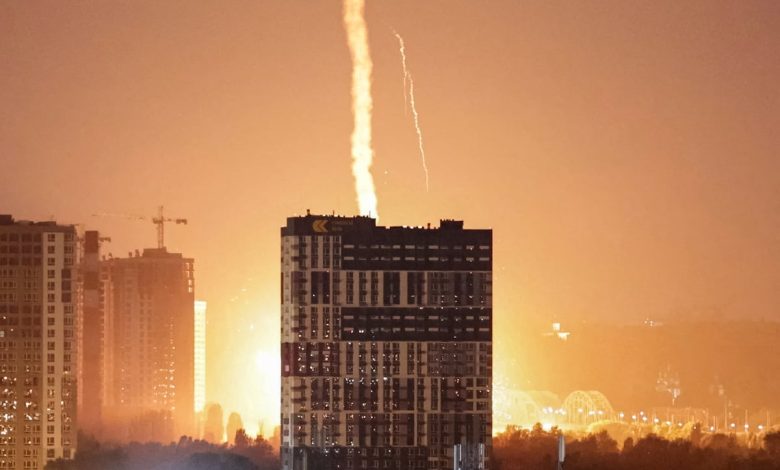
A mixed barrage struck Kyiv shortly after midnight local time on Thursday, with more than a dozen explosions heard across the capital – a fraction of the salvo Brovdi says Moscow is building toward.
The strike killed at least 15 people and injured dozens across the capital alone, damaging several residential buildings, a school, a children’s hospital and a kindergarten, according to Kyiv officials.
Magyar’s warning is that the country would likely face even higher numbers of dead in a combined attack of hundreds of Russian ballistic and cruise missiles.
Ukraine’s air defense network can intercept most drones and cruise missiles with cheaper systems, but Patriot and a handful of similar European systems are among the few systems capable of reliably intercepting ballistic and hypersonic missiles. Those interceptor stocks are at their lowest levels in years.
Ukraine fields two and a half times fewer interceptors than it did in 2025 while Russia fires twice as many ballistic missiles a month, Ukrainian President Volodymyr Zelenskyy told CNN on Aug. 12, with allied deliveries this year running at one-third of last year’s levels.
“Patriot systems capable of shooting down ballistic missiles are essentially on a ‘starvation ration,’” Air Force spokesperson Yurii Ihnat said in April after Russia fired more than 700 missiles over the winter, per Censor.NET.
The shortage runs so deep that the Air Force decided in early August to stop publishing attack tallies for ballistic missile intercepts because of the negative impact on morale.
“I understand that everyone already knows everything and sees that the topic is very sensitive, especially for the capital,” Ihnat wrote in an Aug. 13 Facebook post.
“But when we put an official message – 28/0 (ballistic missiles intercepted) the result is that all our media write ‘The Air Force did not shoot down a single missile,’ and amplify it throughout the country. Meanwhile, enemy media will only copy all this and replicate it for themselves, giving a standing ovation!”
The problem for Kyiv is that anti-ballistic interceptors remain the only immediate answer to the ballistic-missile threat, and they have been in short supply worldwide since the Iran war began.
The United States has burned through roughly two-thirds of its combined Patriot and THAAD stockpile since that war started, from more than 2,700 missiles to fewer than 1,000 by late July, according to the Center for Strategic and International Studies. Each PAC-3 replacement costs roughly $3.9 million and takes up to two years to build.
“There are no good alternatives to Patriot and THAAD for ballistic missile defense,” the center’s experts concluded.
Ukraine is working on several tracks to resolve the antiballistics shortage, negotiating Patriot co-production agreements with Raytheon and Lockheed Martin, though both makers have begun hedging, and backing Freyja, a cheaper European interceptor program led by Ukraine’s Fire Point.
Experts put licensed Patriot production 24 to 30 months away, and Freyja’s first intercept is not planned until the end of 2027, leaving interceptors from allied stockpiles as Kyiv’s only immediate answer to protecting its cities from increasingly large missile attacks.
“If [the United States] can sell us 5%, we will go through the winter and save people’s lives,” Zelenskyy said last week. “If they can sell us 10%, we will destroy all the Russians’ ballistic missiles. I have 1%.”
Katie Livingstone is the Ukraine correspondent for Defense News and Military Times. Based in Kyiv, she has covered Russia’s full-scale invasion since its first days. She is a former Fulbright fellow whose award-winning work has appeared in outlets across Europe and the U.S.