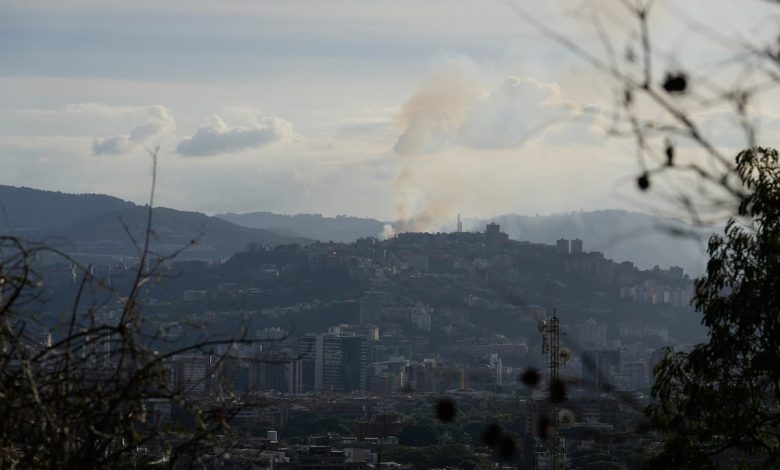
The fleet of aircraft that took part in the U.S. military’s capture of Venezuelan President Nicolás Maduro included bombers, fighters and surveillance aircraft from multiple services — and reportedly one of the Air Force’s secretive recon drones.
Gen. Dan Caine, chairman of the Joint Chiefs of Staff, said in a Saturday news briefing with President Donald Trump that more than 150 aircraft took off from 20 locations on land and sea to support Maduro’s capture.
The airborne element of Operation Absolute Resolve, as the U.S. government dubbed the mission, included F-22 Raptors, F-35 Joint Strike Fighters, F/A-18 Hornets and B-1 Lancer bombers, Caine said. It also included E/A-18 Growlers, a Hornet variant that specializes in electronic warfare, E-2 Hawkeye airborne early warning aircraft and other helicopters and support aircraft, Caine said.
Caine also said the force included “numerous remotely piloted drones.” Aircraft from the Air Force, Air National Guard, Navy and Marine Corps took part in the operation, he said.
“This was an audacious operation that only the United States could do,” Caine said. “It required the utmost of precision and integration within our joint force, and the word integration does not explain the sheer complexity of such a mission. An extraction so precise it involved more than 150 aircraft launching across the Western Hemisphere in close coordination, all coming together in time and place to layer effects for a single purpose, to get in an interdiction force into downtown Caracas while maintaining the element of tactical surprise.”
“Failure of one component of this well-oiled machine would have endangered the entire mission, and failure is never an option for America’s joint force,” Caine said. “Those in the air over Caracas last night were willing to give their lives for those on the ground and in the helicopters.”
When asked what type of drones took part in the operation, the Air Force referred Defense News’ inquiries to the Pentagon’s press office, which declined to comment on its drone presence in the area, citing operation security concerns.
But soon after the operation, videos taken by aviation observers began appearing online showing the Air Force’s stealthy RQ-170 Sentinel reconnaissance drone returning to Puerto Rico.
The War Zone highlighted a pair of videos purportedly showing the RQ-170’s dawn return to base. Aviation Week editor Brian Everstine also noted, in a December social media post, that Air Forces Southern had posted — and soon took offline — a photograph of an airman wearing patches showing the RQ-170 and the insignia of the 432nd Wing, which flies the Sentinel, suggesting it may be operating in that area.
In Caine’s description of the operation’s airborne component, he made multiple references to drone aircraft and surveillance coverage that could have encompassed the Air Force’s RQ-170, a low-observable intelligence, surveillance and reconnaissance drone created by Lockheed Martin’s Advanced Development Programs, or Skunk Works. The drone was regularly flown over Afghanistan during the war there, where it earned the nickname the Beast of Kandahar.
Weather in the region had presented a challenge for the mission, Caine said, but on Friday night broke “just enough, clearing a path that only the most skilled aviators in the world could maneuver through.”
Helicopters bearing the extraction force approached Venezuela from about 100 feet above sea level, Caine said, while aircraft overhead protected them. The airborne force struck and disabled multiple Venezuelan air defense systems to ensure the helicopters could safely proceed.
The extraction team took fire as they helicoptered in to Maduro’s Caracas compound — with one helicopter struck but remaining airborne — and the team moved to apprehend him and his wife, Caine said.
Fighter aircraft and drones overhead provided both suppressive fire, to allow the extraction force to withdraw, and intelligence updates. Caine said “there were multiple self-defense engagements” as the force withdrew, bringing Maduro and his wife to the USS Iwo Jima.
Iran downed an RQ-170 over its territory in 2011, allegedly using a cyberattack, and then reverse engineered the technology to produce its own knockoff variants of the drone.
Stephen Losey is the air warfare reporter for Defense News. He previously covered leadership and personnel issues at Air Force Times, and the Pentagon, special operations and air warfare at Military.com. He has traveled to the Middle East to cover U.S. Air Force operations.