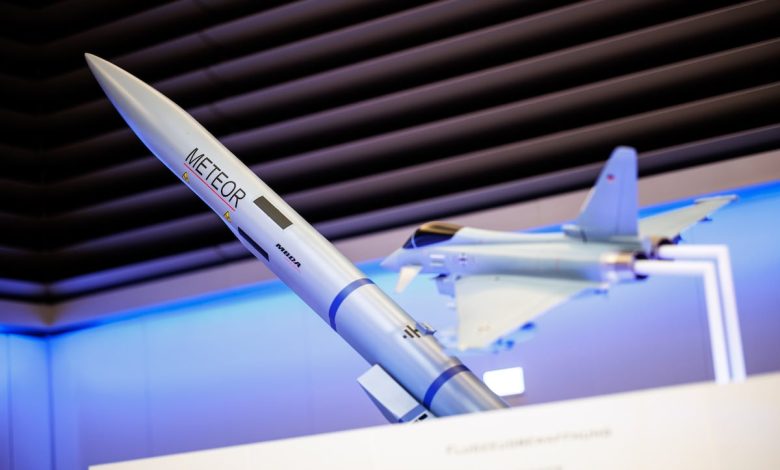
PARIS — Ukraine getting Swedish Gripen fighter jets equipped with Meteor long-range air-to-air missiles would give the country a counter to Russian glide bombs that have been hammering frontline positions, analysts said.
As part of a planned Ukrainian purchase of new Saab Gripen E aircraft, Sweden intends to donate 16 older Gripen C/D jets to Ukraine next year, the countries announced on Thursday. Sweden said the older planes may come supplied with MBDA’s Meteor, which would allow Ukraine to threaten Russian jets that remain out of reach for its F-16 and Mirage fighters fitted with shorter-range missiles.
Russia has been launching record numbers of glide bombs in 2026, according to the Ukrainian Ministry of Defence. The bombs pose a major challenge to Ukrainian defenders by grinding down fortified positions on the front, and aircraft such as the Sukhoi Su-34 drop the munitions at stand-off range behind the Russian frontline, where they’re relatively safe from air defenses.
“Gripen C/D with Meteor, in principle, offers the best capability to counter Russian glide bombs before they are launched that Ukraine realistically has access to,” said Fabian Hoffmann, a senior research fellow at the Norwegian Institute for Defence Studies.
Hoffmann said his understanding is Ukraine has gotten “really good” at countering Russian glide bombs with electronic warfare, “so this would have been a bigger priority in the past. Probably still useful to have.”
What remains ambiguous for now is whether donated Gripens will definitely come with Meteor. The 3.7-meter missile weighing 190 kg is widely considered by analysts to be one of the best beyond-visual-range air-to-air missiles in Western service, and MBDA says ramjet propulsion gives Meteor the largest no-escape zone of any air-to-air missile.
While Ukraine’s Brig. Gen. Pavlo Palisa, the deputy head of the office of the president, said the first batch of the fighters will come with Meteor, in a post on Facebook, Swedish Defense Minister Pål Jonson said the Gripen C/Ds “can be delivered” with the missiles.
Sweden’s Defense Ministry said the donation would include an advanced ammunition package “which may consist” of Diehl’s IRIS-T missile, Raytheon’s AIM-120 advanced medium range air-to-air missile, and the Meteor. An MoD spokesman referred a request for clarification to the minister, and a spokesman for Jonson didn’t immediately return phone calls or reply to requests by email.
For Ukraine, Meteor would give Gripen a clear edge over its other Western jets. Ukrainian President Volodymyr Zelenskyy specifically mentioned Gripen coming with Meteor, in order to push out Russian jets dropping aerial bombs, as “very important,” at press conference in Sweden on Thursday.
“Gripen C with Meteor offers a significantly better chance to successfully engage Su-34s dropping glide bombs 60-70km behind Russian front lines than F-16 with AIM-120 or Mirage 2000 with MICA,” said Justin Bronk, senior research fellow for air power at the Royal United Services Institute.
While data on the exact range of Meteor is undisclosed, Saab’s operations adviser for the air domain, Jussi Halmetoja, a retired Gripen pilot, has said the missile can fly 200 kilometers at high speed. Air-to-air missile range is typically affected by the launching aircraft’s speed and altitude.
Training of Ukrainian pilots and technicians on the Gripen is underway and will expand this autumn, according to Jonson.
Russia launched nearly 7,000 guided aerial bombs against Ukraine in April, after dropping a record 7,987 of the munitions in March, according to the Ministry of Defence of Ukraine. Russian jets mostly launch 500kg bombs but also 1,500kg fortification busters.
Sweden was the first country to deploy the Meteor on its Gripen fleet in 2016. Developed by pan-European missile maker MBDA in a consortium of six countries including France and the United Kingdom, the weapon also equips the Eurofighter Typhoon and Dassault Aviation’s Rafale.
Germany ordered more Meteor missiles in January, after Sweden and France both placed additional orders for the missile in 2025. France and the U.K. earlier this year agreed to conduct a joint 12-month study on developing a successor to the Meteor.
Rudy Ruitenberg is a Europe correspondent for Defense News. He started his career at Bloomberg News and has experience reporting on technology, commodity markets and politics.