Russia Built 4 Aircraft Carriers To Take on the US Navy. 1 Is a Luxury Hotel in China, 1 Became a Theme Park, 1 Serves in the Indian Navy and the Last Is Being Scrapped

Summary and Key Points: The Soviet Union built four aircraft carriers. One of them is now a luxury hotel in Tianjin. One became the centerpiece of a military theme park in Shenzhen, bought for $4,300,000 by a group of Chinese video game arcade owners. One was sold to India and is still in commission as INS Vikramaditya. The fourth caught fire in 1993 and was scrapped. Only Admiral Kuznetsov remained with Russia, and she has spent the years since a floating dry dock collapsed beneath her, dropping a crane through her flight deck.
Russia’s Aircraft Carrier Legacy Is Sad
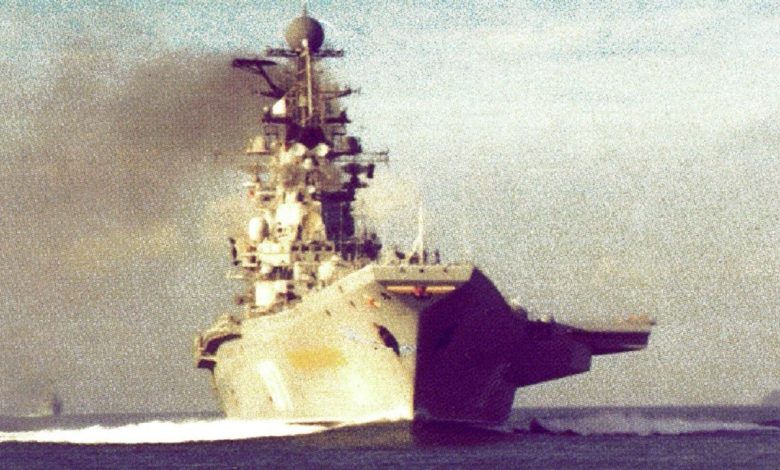
Kiev-Class Aircraft Carrier Rebuilt and Serving in India’s Navy.
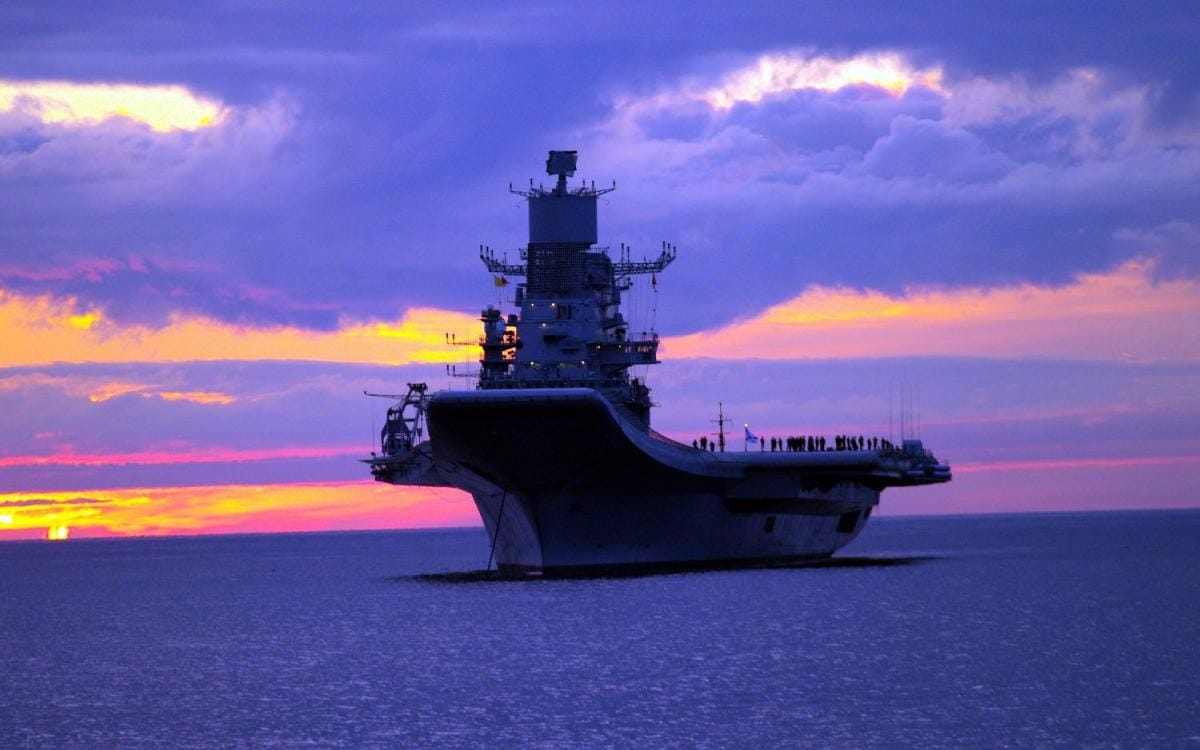
INS Vikramaditya in Baltic Sea during her trails in 2013.
In the 1970s, the USSR finally began investing in aircraft carriers.
Preferring to stick to its own waters, the Soviet Navy was never enthusiastic about the prospect of fielding large aircraft carriers.
However, with the development of the Yak-38 VTOL fighter, the idea became a lot more plausible. The USSR’s first carriers were the Kiev-class (Project 1143), followed later by the Kuznetsov-class (Project 1143.5).
The Soviets planned to build more carriers and even began construction on a new class similar in size to an American Nimitz-class supercarrier.
Unfortunately, the collapse of the USSR halted all of these plans, and none of the post-Soviet states had the money to care for the four active carriers.
What Happened to the Kiev-class Carriers?
After the end of the Cold War, all of the Kiev-class ships went their separate ways. Novorossiysk suffered a critical engine fire in 1993 and was sold for scrap.
Baku, sometimes considered a separate class, was withdrawn from service in 1996 after a boiler room explosion the year prior.
Rather than being sold for scrap, however, she was redesigned and sold to the Indian Navy, where she was reborn as the INS Vikramaditya.
In both cases, even without accidents, the Russian Navy likely would have sold them for scrap.
The two remaining Kiev-class ships made their way east to China.
Minsk was sold in 1995 to a South Korean company for scrap after a major accident in 1993.
However, rather than being scrapped, Minsk was sold to the Chinese state-owned Guangdong Ship Dismantling Company after protests from South Korean environmental activists.
The ship was again spared from the scrapyards after a group of video-game arcade owners banded together and formed the Shenzhen Minsk Investment Company to buy the carrier for $4.3 million.
From there, Minsk became the centerpiece of Minsk World, a military-themed park in Shenzhen.
However, after the Shenzhen Minsk Investment Company went bankrupt, the carrier changed hands several times before ending up with the Dalian Yongjia Group, a real estate firm located in Dalian.
In 2024, Minsk caught fire during a refit.
Although the fire was eventually put out, the ship’s future prospects are currently uncertain.
Kiev, the lead ship of the class, has had the most prosperous tenure of all the Soviet-era carriers. After the Cold War ended, Russia took her in.
But, like all her sister ships, the Russian Navy lacked the funds to maintain her, and she was sold to the highest bidder.
Kiev was sold to Binhai Aircraft Park, a theme park located in China’s Tianjin municipality. She served as a museum ship until 2011, when they converted her into a luxury hotel.
The cost of her renovation totaled around 100 million yuan (14 million USD), which was considerably less than the cost of refitting the carrier Varyag into the Type 001 Lioning.
And Then There’s Kuznetsov…
Admiral Kuznetsov needs no introduction.
She was the only carrier the Russians expressed interest in keeping.
For a time, the mechanically unreliable carrier seemed to have a promising career in the post-Soviet period.
She participated in routine patrols and even performed combat missions off the coast of Syria.
Although she had a number of mechanical issues along the way, none of these were, as of yet, too much for the struggling Russian Navy to handle.
After her final deployment to Syria in 2016, however, the number of mechanical issues the carrier suffered became too great. In 2017, she was laid up to undergo an extensive refit and deep modernization.
As Kuznetsov’s refit dragged on, however, more problems gradually mounted.
Her floating drydock collapsed, causing a crane to crash into the flight deck, puncturing a large hole in the structure.
Later on, a major fire started aboard this ship, which killed two workers and injured a dozen.
In 2022, the current war with Ukraine broke out, and the Russian defense budget, already comparatively small, was strained even further.
In 2025, Murmansk’s Integrated Shipbuilding Corporation officially announced that work on the carrier had ceased, with no timeframe given for when it might resume.
The company’s CEO also said he was discussing plans to scrap the carrier with the Russian MoD.
As of this writing, there has been no hard announcement of Kuznetsov’s fate. But most assume she will be scrapped.
However, given the project’s cost and the scale of the work, it is likely that the Russians will finally pull the plug on their single aircraft carrier.
The Fall of the USSR and its Carriers
How did a navy as large and powerful as the Soviet Navy manage to fall so low?
The answer requires its own article, but the long and short of it is that the collapse of the USSR was a disaster for the Russian Navy.
Many of the USSR’s shipyards and naval bases ended up in newly independent nations, and the facilities that still remained were converted to civilian use.
With its defense budget curtailed, its shipyards closing down or producing yachts for billionaires, and its technical know-how gone, the Russians never really had a choice.
The aircraft carriers had to go.
Although Moscow tried to keep Kuznetsov active, the consequences of the Soviet collapse soon caught up with her as well, leaving her in her current sad state.
About the Author: Isaac Seitz
Isaac Seitz, a Defense Columnist, graduated from Patrick Henry College’s Strategic Intelligence and National Security program. He has also studied Russian at Middlebury Language Schools and has worked as an intelligence Analyst in the private sector.