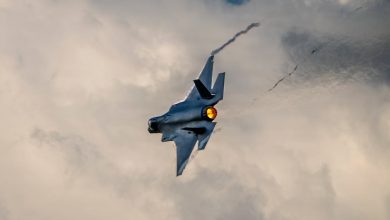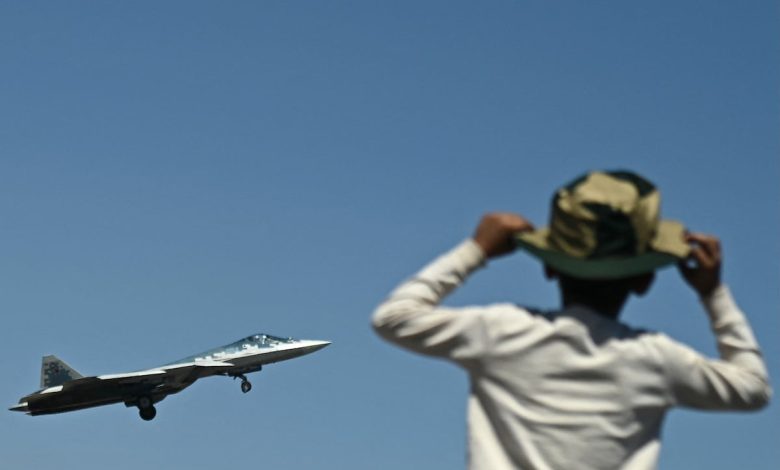
NEW DELHI — Russian President Vladimir Putin has offered India joint production of the country’s most advanced fifth-generation stealth fighter jet, the Su-57, and said Moscow was willing to cooperate without “limitations.”
His comments were made during an interaction with journalists at the St. Petersburg International Economic Forum on Friday.
India and Russia had initiated a joint program in 2007 to co-develop a fifth-generation fighter, but a decade later, in 2018, New Delhi withdrew from the project due to concerns over issues such as costs, technology access and the aircraft’s stealth capabilities. Russia went on to develop it independently.
Offering technology transfer and integration with Indian systems, Putin said in St. Petersburg that the Su-57 could be a joint venture between the two countries.
“We are ready to supply India with this aircraft, to keep developing it. We don’t have any issues or limitations,” the Russian president said.
The renewed Russian offer comes at a critical time for India’s airpower modernization plans. India does not have a fifth-generation fighter. The most advanced fighter jet in the country’s air force is the French Rafale, which is not a stealth platform.
This has led to a huge capability gap compared with China, which is rapidly expanding its stealth fighter fleet. According to reports, Pakistan is also planning to acquire these jets from China.
The dynamic is prompting India to weigh its options for stealth fighters. While New Delhi is accelerating a domestic program to develop an advanced fifth-generation multirole combat aircraft, operational deployment is still a decade away.
Indian officials have yet to respond publicly to the offer for the Su-57 jet. But in April, the then-chairman of the country’s premier aerospace manufacturer, Hindustan Aeronautics Ltd, D.K. Sunil, told news agency Asian News International that Russia had presented the capabilities of the fighter jet to India.
“We are awaiting the Russian quotation about the investment. Then we will approach the air force that these are the kind of numbers required to produce these aircraft,” he said.
The Russian Su-57 fighter jet was showcased at an Aero India exhibition held in the Indian city of Bengaluru last year.
Analysts say India faces a high-stakes choice in its pursuit of a fifth-generation fighter jet.
“India’s own stealth fighter is not expected to enter service until 2035 and even that maybe an ambitious timeline. In the meantime there are reports that Pakistan is planning to get J-35 stealth fighters from China. For that reason, there is a line of thinking that if we acquire two or three squadrons, or about 36 to 60 Su-57 aircraft in the interim, it will give India a stealth platform as well as payload capacity,” said Manoj Joshi, distinguished fellow at the Observer Research Foundation in New Delhi.
Analysts also say that the co-production and customization being offered by Russia marks one of the most expansive defense cooperation proposals made in recent years to India, which considers technology transfer a critical factor in major defense acquisitions.
At the same time, Joshi points out, there are concerns that entering a deal for the Su-57 could impact India’s own indigenous fifth-generation fighter jet project, which is being given high priority.
“The counterargument is that resources will have to be diverted for those jets and also once you have them, you might not have the incentive to push on with the domestic program,” he said.
The U.S. also offered its fifth-generation F-35 aircraft to India last year. But analysts say India is not pursuing that option due to concerns over stringent controls that are attached to the sale of advanced U.S. military equipment.
The modernization of India’s air force is facing challenges. Russian fighter jets were the backbone for India’s air force for nearly six decades, but many of those are due to be phased out.
As New Delhi began diversifying its defense purchases in recent decades to reduce its reliance on Russia, it bought 36 Rafale multirole combat aircraft from France and has also initiated the process of buying another 114 Rafales. But that will not completely bridge the gap for its air force, which faces a significant shortfall of fighter jets.
During the media interaction in St. Petersburg, Putin also said that Russia was willing to collaborate with India on other critical defense platforms, including fifth-generation technologies, air defense systems and a joint program to produce the supersonic cruise missiles called Brahmos.