Patriot makers hedge on Ukraine production deal as officials question cause of hold-up
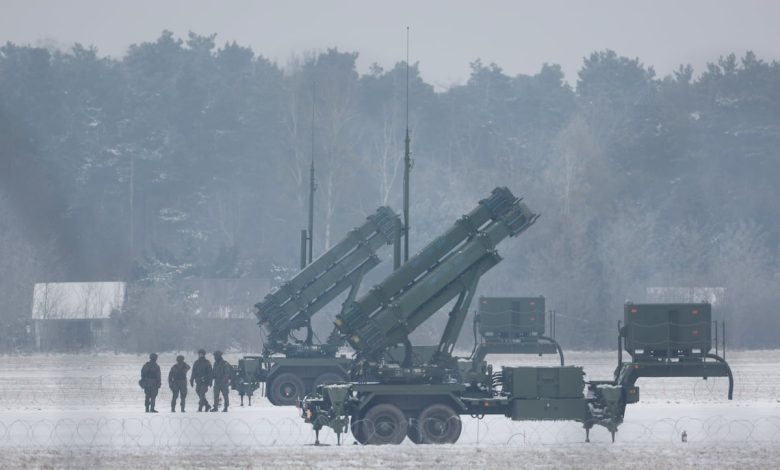
KYIV, Ukraine — Though U.S. President Donald Trump promised Kyiv a license to build Patriot missile interceptors last month, Lockheed Martin and Raytheon have begun putting the brakes on a joint-production deal as executives weigh what is “feasible” and the licensing runs into Washington’s red tape.
American officials are backpedaling too. Trump on July 20 told the Financial Times that the U.S. has to be “a little bit careful of who we license to.” Despite that, Ukrainian President Volodymyr Zelenskyy on Saturday posted on X that the two sides have “now reached an agreement.”
The glacial progress may reflect American defense giants’ fear that Kyiv could become a defense industry competitor — rather than posing risk to technology or intellectual property — a Republican official on Capitol Hill told The Atlantic.
“Their real worry is that the Ukrainians will find a way to improve the Patriot and then produce them at scale faster and for much less money than what the existing production lines in the U.S. could do,” the official said, adding that the companies will publicly frame their concerns around “IP theft and tech transfer” instead.
Ukraine’s weapons industry, honed by nearly five years of Russia’s full-scale invasion, has been booming since the U.S.-Israel war with Iran began in the spring. The conflict with Iran has drained an estimated two-thirds of America’s pre-war Patriot interceptor inventory, sparking discussion about inventory and strategy.
Some defense partners are eager to work with Ukraine, a country with rare recent experience fighting a large-scale land war, and have shown strong interest in collaborating with Kyiv to develop and field cheaper, faster-to-produce alternatives to million-dollar weapons.
The race toward competition is problematic for the defense giants, the official said — not because Ukraine might steal the Patriot — but because the country’s partners might outbuild it, cutting into the current monopoly on antiballistic capabilities and profits.
Trump first pledged the license at the July NATO summit in Ankara, promising Ukraine permission to produce Patriot missiles for the first time.
“We’re going to give a license to you to make Patriots. That’s pretty cool. This way, you can’t complain that we’re not giving ‘em enough,” Trump said, adding that the companies had not yet been consulted on the plan.
Zelenskyy said the next day that the question had been “resolved politically,” telling reporters that technical teams needed to start work “without delay, so that we can get licenses very quickly and start production in Ukraine as soon as possible.”
Five days after Trump’s pledge, Ukraine, nine European countries and defense heavyweights including Eurosam, Leonardo, Thales and Saab launched a coalition in Paris to field Freyja, an entirely new antiballistic system built around a Ukrainian interceptor priced at roughly one-fifth of a Patriot round.
A week after that, Lockheed unveiled its own cheaper, faster-to-produce Patriot missile at the Farnborough International Airshow, advertising the PAC-3 ACE at roughly $2 million a round – less than half the price of the round Ukraine fires at Russian ballistic missiles today.
The Patriot line rarely moves that fast. Its current top round, the PAC-3 MSE, was first accepted by the U.S. Army in 2015 and took until 2018 to reach full-rate production, per the Missile Defense Advocacy Alliance.
On July 21, one day after the ACE debut, Tim Cahill, president of Lockheed Martin Missiles and Fire Control, described production talks with Ukraine as simply “early,” telling reporters the company will “support the US Army and the [Trump] administration on what they want to go do,” according to Breaking Defense.
Raytheon’s process “has just started,” with the company working with the U.S. government “to determine what is feasible and what is best for Ukraine,” its president of land and air defense systems, Tom Laliberty, said at the same show.
Two days later, Zelenskyy wrote in a post on X that he was “grateful for the company’s readiness to take our partnership to an even higher level, where Ukraine would co-produce, together with Raytheon, some of the most vital air defense assets – Patriot interceptors,” after meeting representatives of the group.
But when Zelenskyy asked Trump for “several hundred” interceptors at a July 28 Oval Office meeting, the president refused, citing America’s shrunken stocks, The Atlantic reported.
Three days later, Trump reversed course on the license entirely.
“We have not agreed to that,” he said at a Camp David Cabinet meeting. “We’re talking about it, but it’s a hard thing to give away that kind of technology.”
Then, U.S. NATO Ambassador Matthew Whitaker dampened expectations further on Aug. 3, telling Fox News that “we do not allow anybody but US manufacturers to make those in the United States,” adding that a long-term production agreement “will not be concluded before this winter,” per Euronews.
The deal’s current status is unclear.
“The decision has been made,” Zelenskyy said during an interview on Ukrainian television over the weekend, according to United24. “It was made by the President of the United States and other important American government institutions.”
American officials have yet to respond to Zelenskyy’s latest comments.
Katie Livingstone is the Ukraine correspondent for Defense News and Military Times. Based in Kyiv, she has covered Russia’s full-scale invasion since its first days. She is a former Fulbright fellow whose award-winning work has appeared in outlets across Europe and the U.S.