Japan’s Electromagnetic Railgun Has Fired More Than 100 Shots Without Replacing Its Rails. The US Navy Spent About $500,000,000 on Its Own Railgun and Shut the Program Down in 2021.

Summary and Key Points: The US Navy spent about $500,000,000 on an electromagnetic railgun and effectively shut the program down in 2021. One of the reasons was that the weapon destroyed itself: every shot sent enormous current through two conductive rails, and the rails eroded fast enough that the barrel needed work after only a handful of firings. Japan made that specific problem the point of its own program. Its Acquisition, Technology and Logistics Agency now reports firing well over 100 rounds without replacing the rails, at a muzzle velocity of roughly 2,230 to 2,300 meters per second — about 5,000 miles an hour, or Mach 7 — from a projectile weighing around 320 grams and carrying no explosive at all. At that speed, the kinetic energy alone does the work.
The US Navy’s Railgun Failure Was Expensive
At times, the electromagnetic railgun has looked like the future of naval warfare.
Replacing gunpowder and rocket propulsion with electrical currents that generate magnetic forces sufficient to accelerate a projectile down two conductive rails, the railgun promised to offer so much hypersonic velocity that explosive warheads became redundant.
The US Navy took the idea seriously, pumping $500 million into its electromagnetic railgun before effectively ending the program in 2021 (though the program has since been revived in part).
The program was beset by problems, including barrel and rail erosion, enormous electrical requirements, pulse-power equipment, thermal management, and the general difficulty of converting impressive test performance into an affordable, consistent operational weapon.
Japan Railgun Test Creative Commons Image
Japan, however, remains undeterred.
Its Acquisition, Technology & Logistics Agency (ATLA) has continued developing a medium-caliber electromagnetic railgun and has now conducted shipboard firing trials, pushing the technology beyond a stationary laboratory setup.
Has Tokyo developed something practical here?
How Railguns Work
With a conventional naval gun, the propellant burns, and the expanding gas pushes the projectile down the barrel. The railgun works differently.
Massive electrical currents travel through two parallel, conductive rails and an armature/projectile. No conventional explosive propellant is required for launch.
Japan’s experimental weapon has fired roughly 320-gram projectiles at a reported muzzle velocity of about 2,230–2,300 meters per second.
That’s approximately 5,000-plus miles per hour, or roughly Mach 6.5–7.
And because kinetic energy increases with the square of velocity, an apparently modest projectile can become an extremely energetic thing when moving at several thousand meters per second.
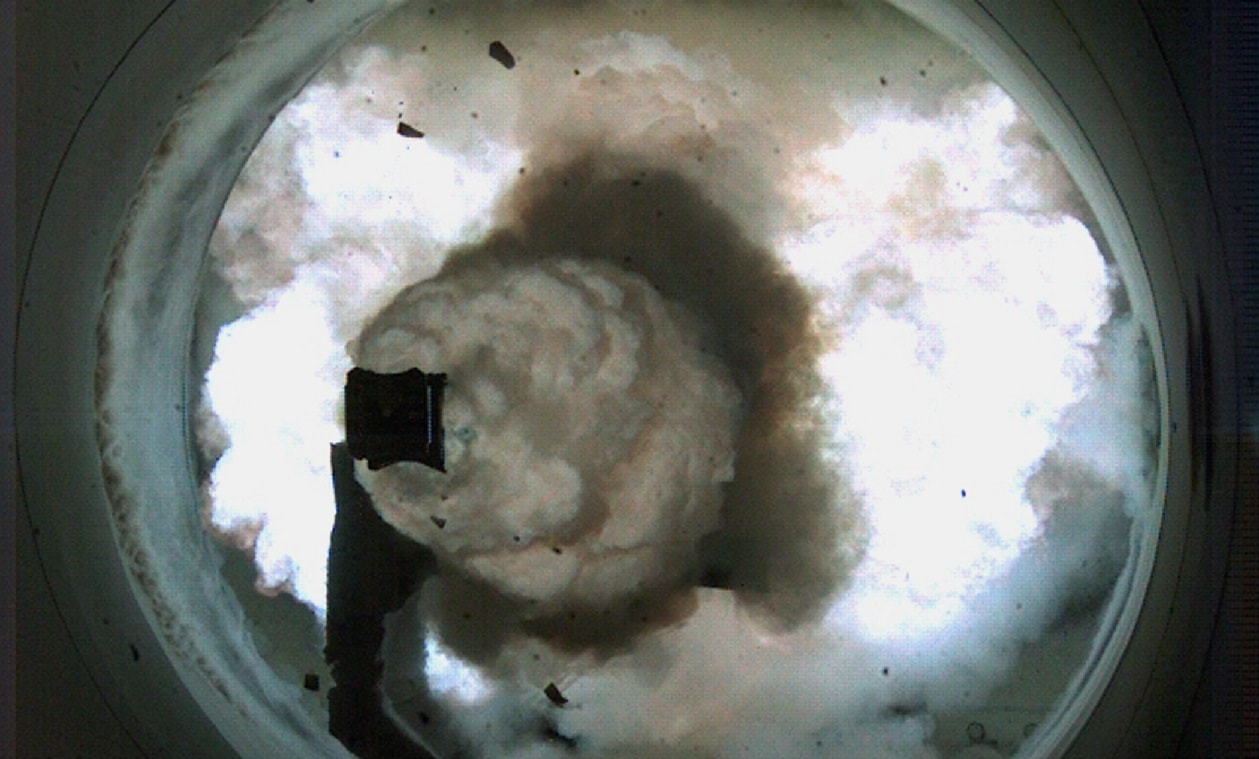
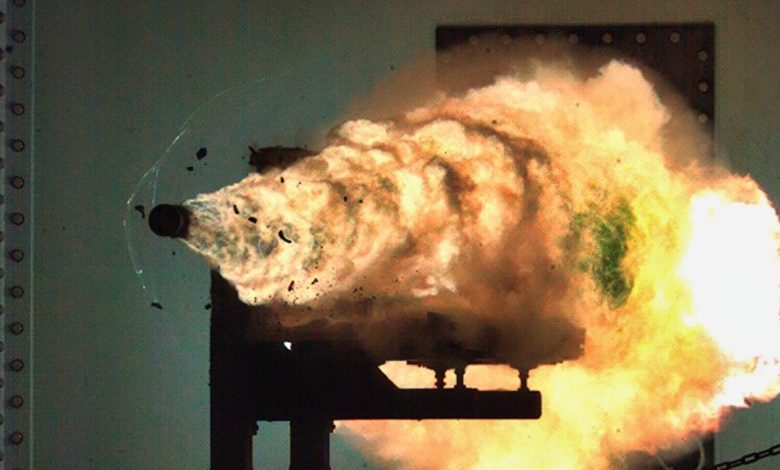
DAHLGREN, Va. (Dec. 10, 2010) High-speed camera image of the Office of Naval Research Electromagnetic Railgun located at the Naval Surface Warfare Center Dahlgren Division, firing a world-record setting 33 mega-joule shot, breaking the previous record established Jan. 31, 2008. The railgun is a long-range, high-energy gun launch system that uses electricity rather than gunpowder or rocket motors to launch projectiles capable of striking a target at a range of more than 200 nautical miles with Mach 7 velocity. A future tactical railgun will hit targets at ranges almost 20 times farther than conventional surface ship combat systems. (U.S. Navy photo/Released)
Japanese Improvements
When the Americans experimented with the railgun, one of the biggest problems was barrel life.
Railguns impose vicious stresses on their own components; every single shot produces huge electrical currents, extreme accelerations, friction and contact effects, heat, and electromagnetic and mechanical loads.
This means the conductive rails can erode rapidly, which is fatal to the operational concept if the barrel needs substantial maintenance after only a couple of shots.
The US encountered serious durability challenges while pursuing the railgun concept.
Japan, meanwhile, very intentionally emphasized rail and barrel durability as a core development objective of the program.
ATLA has reported significant improvements in repeated firing and maintaining muzzle velocity as shot count increases.
Indeed, Japan reports firing well over 100 shots with its ATLA program without replacement and aims to further push its durability.
And that’s where the feasibility of railguns starts to become serious.
It’s one thing for a railgun to produce the desired effect once in a controlled environment.
It’s quite another for the railgun to produce the same desired effect over and over and over. That’s when military application becomes a real prospect.
Unfavorable Economics
Japan faces an unfortunate defense-economic position.
Japan is surrounded by potential adversaries, including China, North Korea, and Russia, who all have substantial missile inventories.
Accordingly, Japan invests heavily in anti-missile defense systems like the Patriot, SM-3, and SM-6. These systems are effective, but each unit can cost millions of dollars.
That becomes difficult to sustain. A railgun projectile, meanwhile, costs dramatically less because it doesn’t require a rocket motor, large explosive warhead, or an elaborate propulsion system.
Some estimates suggest a railgun round could cost just five figures.
To put that in perspective: 40 railgun rounds costing $25,000 each would total $1 million, whereas one advanced missile interceptor can cost several million dollars.
So you can see why the economics of the railgun are so attractive.
And the railgun doesn’t need to replace Japan’s SM-3s or SM-6s. Instead, the railgun could offer Japan a layered defensive configuration.
High-end missile interceptors could target the hardest and longest-range threats. Cheap interceptors could handle intermediate threats.
The railgun could engage suitable targets deeper within the defensive magazine, while guns, EW, and, later, lasers could handle drones and close-in threats.
In this system, every target destroyed by a railgun saves on missiles, in both costs and magazine depth.
Japan isn’t there yet; the railgun isn’t ready for deployment. But Japan has demonstrated that the physics make sense.
Better barrel life, more modest initial power levels, and ships designed to accommodate the railgun could be the ticket to a sustainable railgun program.
About the Author: Harrison Kass
Harrison Kass is a writer and attorney focused on national security, technology, and political culture. His work has appeared in Tablet, City Journal, The Hill, The Spectator, and The Cipher Brief. He holds a JD from the University of Oregon and a master’s in Global & Joint Program Studies from NYU. More at harrisonkass.com.