I Am a Retired US Army Special Forces NCO: A 240-Grain .454 Casull Load Leaves the Taurus Raging Bull at About 1,900 Feet per Second With 1,923 Foot-Pounds Behind It. That Is .30-30 Rifle Energy, Out of a 5-Shot Revolver.

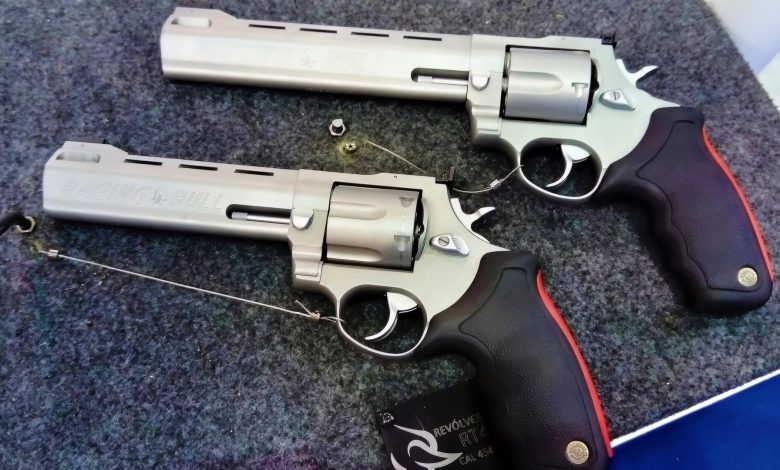
Some revolvers are built to be carried. The Taurus Raging Bull was built to be reckoned with. Taurus rolled the Raging Bull out in 1997, and it was the Brazilian gunmaker’s answer to a question the American market had mostly left to boutique builders like Freedom Arms: what happens when you put a full-size, full-lug frame under a cartridge that was never meant to be tame. The model line ran for more than two decades before Taurus retired it in 2019 and replaced it with the rail-equipped Raging Hunter.
Along the way, it was chambered in everything from .22 Hornet to .44 Magnum and, briefly, cartridges most casual shooters have never fired.
But the two versions that matter here, .454 Casull and .480 Ruger, tell two very different stories about what “too much gun” means and how a company decides which of its big-bore ideas survives.
The .454 Casull Version Hits Like A Rifle
Dick Casull started wildcatting his namesake round back in 1958, and it didn’t get an official SAAMI blessing until 1997, the same year the Raging Bull showed up to chamber it.
A 240-grain load leaves the barrel at roughly 1,900 feet per second and carries about 1,923 foot-pounds of energy, which is in the neighborhood of what a .30-30 rifle round delivers at the muzzle.
Out of a five-shot revolver. That’s the appeal and the problem in one sentence.
Taurus still sells this combination today, just under the Raging Hunter name.
It comes with a ported, shrouded barrel in 5.12, 6.75, or 8.37 inches, an integral Picatinny rail for a red dot or scope, a cushioned rubber grip, and a transfer-bar safety so you’re not carrying it on a live round out of necessity.
The 8.37-inch version runs about 54 ounces and lists for roughly $920. American Hunter named it Handgun of the Year in its 2019 Golden Bullseye Awards, and reviewers consistently praise the accuracy once you get a scope on it.
However, the single-action trigger pull, at 8.5 pounds, is the one thing nearly everyone flags as a letdown on a gun built for precision.
The .480 Ruger Version Is The One Nobody Talks About
Ruger and Hornady built the .480 Ruger in 2003 by shortening the .475 Linebaugh just enough to fit six rounds in a Super Redhawk cylinder without cracking it.
It runs at 48,000 psi, well under the .454’s 65,000, and the factory numbers back that up: a 325-grain load at 1,350 feet per second for 1,315 foot-pounds, a 410-grain Buffalo Bore load at 1,200 feet per second for almost identical energy.
That’s meaningfully behind the .454 Casull on paper. It’s also meaningfully ahead of the .44 Magnum, while shooting with recoil that’s much closer to a stout .44 load than to a .454.
Taurus built a Raging Bull around that cartridge from 2005 to 2012: an 8.375-inch heavy barrel with a built-in compensator, a five-round stainless cylinder, 63 ounces, and roughly $900 when new.
Then they stopped production. The .480 never made it into the Raging Hunter lineup, so if you want one now, you’re shopping the used market, not a dealer’s shelf, and clean examples still run $700 to $800.
I’ve always thought that was a mistake on Taurus’s part.
Taurus Raging Bull .454 Casull. Image Credit: YouTube Screenshot.
The .480 gives you most of what the .454 promises with a trigger you can actually call back on for a follow-up shot, and Taurus let it quietly die anyway while doubling down on louder, harder-kicking chamberings for the Raging Hunter.
The Recoil Is The Honest Trade-Off
Neither of these guns is subtle about what shooting them is like.
The .454 generates about 75 percent more recoil energy than a .44 Magnum, and the porting on the Raging Hunter barrel cuts muzzle flip at the cost of a blast wave that will make your shooting buddies take a step back.
Owners of the ported .454 models report sore hands after a full cylinder or two, recoil and all.
At 54 to 63 ounces empty, these aren’t guns you forget you’re carrying, either; that weight is doing real work soaking up recoil, but it comes out of your holster and your shoulder on a long day afield.
The .480, run through the same style of Taurus frame, is the gun you hand to someone who wants Casull-adjacent power without the full Casull tax.
Say what you want about whether anyone needs a five-shot handgun that outperforms rifle cartridges at the muzzle. That’s beside the point.
Shooters buy these guns to hunt hogs and deer inside a couple hundred yards, to have a serious answer to bears in the backcountry, or just because they want to own the loudest thing in the safe.
The Raging Bull, in either chambering, was never trying to be reasonable. It was trying to be enough gun. It still is.
About the Author: Steve Balestrieri
Steve Balestrieri is a National Security Columnist. He served as a US Army Special Forces NCO and Warrant Officer. In addition to writing on defense, he covers the NFL for PatsFans.com and is a member of the Pro Football Writers of America (PFWA). His work was regularly featured in many military publications.