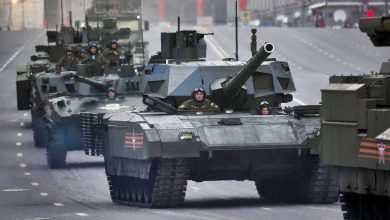
General Dynamics Land Systems Delivered its XM30 Wolf Infantry Fighting Vehicle to the US Army

General Dynamics Land Systems’ (GDLS) XM30 Wolf is meant as the replacement for the United States Army’s M2 Bradley Infantry Fighting Vehicle.
That system entered US Army service in the early 1980s and has undergone repeated upgrades. In fact, Bradleys remain integral to the Army’s armored brigade combat teams.
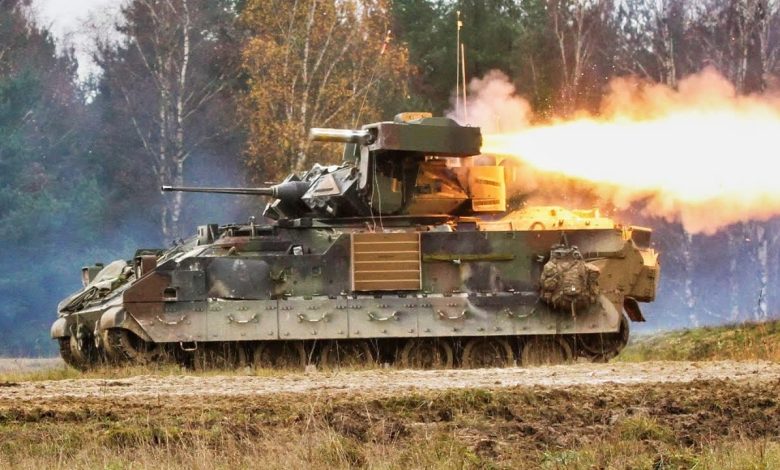
Troopers with 3rd Armored Brigade Combat Team, 1st Cavalry Division firing the 25mm canon on a Bradley fighting vehicle in order to zero the vehicles weapons systems at a range in Poland. Ranges such as these familiarize troopers with the vehicles systems in order to ensure combat readiness.
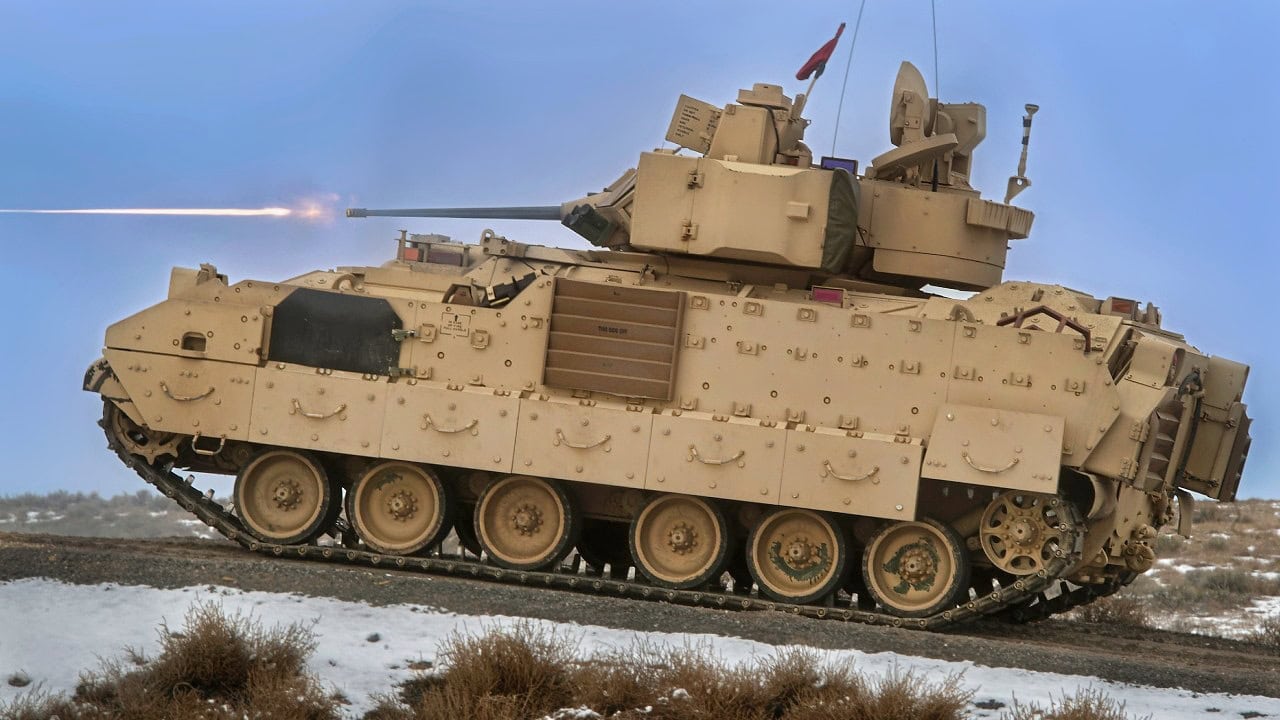
The Bradley Fighting Vehicle cuts loose several rounds from the 25mm main gun on the orchard Combat Training Center Range.
Soldiers completed training this week of the Bradley Commanders Course with the 204th Regional Training Institute, (RTI), of the Idaho Army National Guard on Gowen Field. The course is designed to train active duty, reserve and national guard officers and non-commissioned officers in combat critical M3 Bradley Fighting Vehicle Commander Skills. Field exercises were conducted on the newest Range 10, the Digital Air Ground Integrated Range (DAGIR), on the Orchard Combat Training Center grounds.
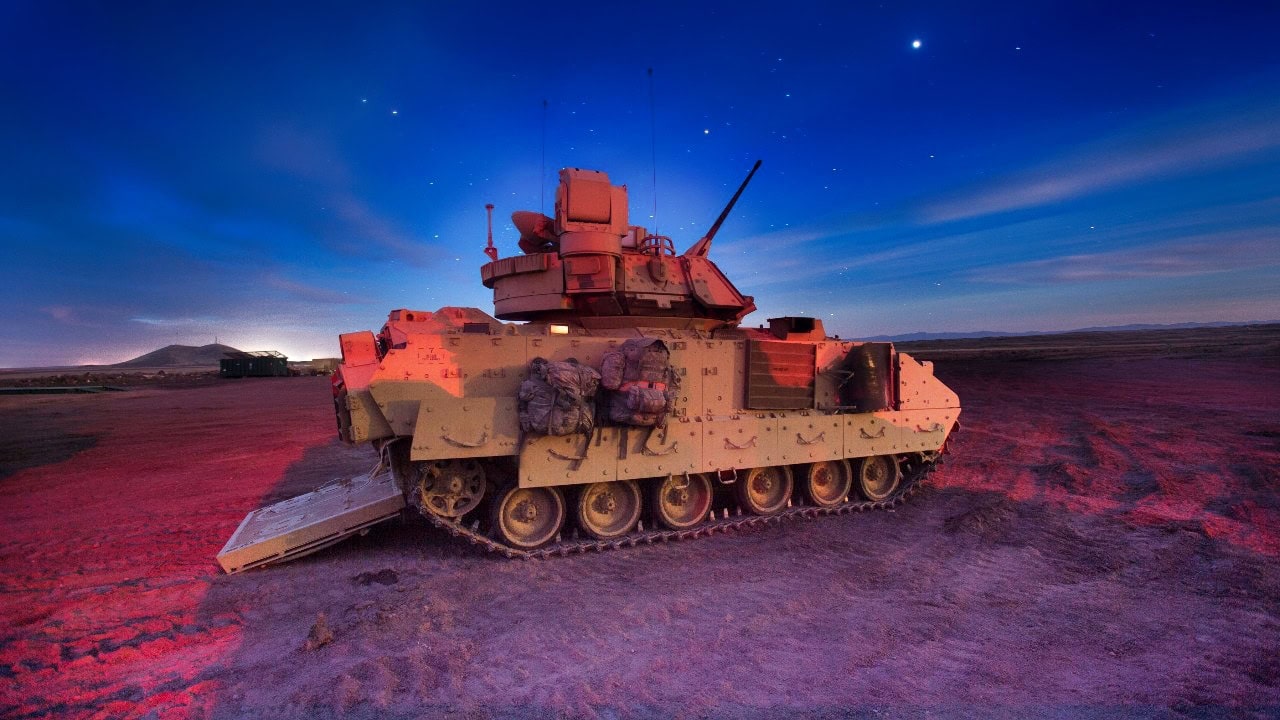
Engineers with the 116th Brigade Engineer Battalion conduct M2A3 Bradley fighting vehicle gunnery qualification on March 27, 2018, Orchard Combat Training Center, south of Boise, Idaho. Combat engineers with the 116th BEB trained through gunnery table XII, evaluating their ability to execute collective platoon-level tasks in a tactical live-fire environment; including integrating dismounted soldiers with their assigned BFV. (U.S. Army National Guard photo by 1LT Robert Barney)
But the Pentagon views the platform’s age as a significant limiting factor, regardless of how many upgrades the Bradley receives.
Why Does the Army Want to Replace the Bradley?
The Army wants more than a mere replacement for the Bradley. After more than 40 years of service and a rapidly changing strategic threat environment, the Army’s needs are fundamentally different from what they were when the Bradleys first arrived on the scene.
The Army wants a brand-new start for its next light armored fighting vehicle that not only carries infantry into battle but also provides significant direct-fire support to advancing infantry.
The Army’s $1.6 billion Optionally Manned Fighting Vehicle program advanced in June 2023, when the Army selected GDLS and American Rheinmetall Vehicles to enter the prototype phase of the competition.
A Major Milestone
On August 28 of this year, GDLS delivered the prototype of the XM30 Wolf to the US Army’s Aberdeen Proving Ground in Maryland.
It is the first of several Wolf prototypes delivered to the Army as GDLS competes against American Rheinmetall for what will ultimately be the most significant armored-vehicle upgrade the Army has overseen in decades.
The XM30, per the Army’s requirements, will be operated by two soldiers and will carry six infantrymen. The XM30 must carry a remotely operated turret equipped with a 50mm cannon and anti-tank guided missiles.

XM-30 Image. Defense Contractor Handout.
Advanced sensors and fire-control equipment will give the crew of the XM30 Wolf greater awareness–and protection–of threats around the vehicle.
In the age of drone swarms, survivability of the platform and the men and women on it will be instrumental.
Part of the Army’s design requirements call for the proposed XM30 to integrate advanced active-protection systems, modular armor, and signature-management technology from the start of the design process.
The Army wants to avoid adding as many add-ons as it did with the Bradley. Instead, the Army wants the XM30 designed around the upgrades rather than the other way around.
XM30 was “Born-Digital”
This aspect of the design is known as the Modular Open Systems Architecture (MOSA). It is intended to make it easier for the Army to install hardware and software without requiring major redesigns each time technology changes.
For instance, GDLS says their version of the proposed XM30 Wolf is a “born-digital” vehicle.
In other words, the Army is learning the hard lessons from the Bradley IFV program. The XM30 must provide more room to grow from the outset of the program.
Army designers want a hybrid-electric powertrain for the XM30, too.
Of course, this design improves fuel efficiency, which is always an advantage.
But the XM30 will need greater power-generation capacity to meet the increased demands imposed by the powerful sensors, communications gear, and other electronic systems on the powertrain.
As with many new military platforms, the Army wants the XM30 to operate alongside unmanned systems. The XM30 will, therefore, control robotic and semi-autonomous systems.
This requirement will become increasingly important as the Army incorporates drones, unmanned ground vehicles (UGVs) like Swarmbotics AI’s FireAnt UGV, and other robotic systems into its armored formations.
So, the XM30 is more than a troop carrier. It’s a troop carrier and drone-combat-control platform.
A Model for Future Land Warfare?
GDLS’s proposed version of the XM30 Wolf must compete against whatever design is being offered by American Rheinmetall Vehicles.
Both companies are sending prototypes for Army evaluation.
Testing will determine which vehicle best meets the Army’s new and drastic requirements.
The Army intends to have one of these two versions of the XM30 in production by 2028.
The Army’s First Cavalry Division will receive the XM30 prototypes and provide feedback as the Army develops its future armored formations.
Additional Wolf prototypes will be sent to Fort Hood, Tex., where soldiers will conduct operational evaluations.
For GDLS, the XM30 being in the Army’s hands for testing is a major milestone. Now the Army has to approve the design and its handling at Aberdeen.
It has taken 40 years to replace the controversial Bradley IFV.
Now the physical prototypes of those replacements are rolling into the Army’s testing site. It remains to be seen, though, if the GDLS XM30 Wolf will meet the Army’s exacting standards.
About the Author: Brandon J. Weichert
Brandon J. Weichert is the Senior National Security Editor at 19FortyFive.com. He also manages The Weichert Brief on Substack. Weichert also hosts “National Security Talk” on Rumble. He is the author of four bestselling national security books, the most recent of which is A Disaster of Our Own Making: How the West Lost Ukraine (Encounter Books). Follow him via Twitter/X @WeTheBrandon.