BESANÇON, France — The French Army’s 68th African Artillery Regiment is reorganizing its gun batteries into smaller units and creating a dedicated section to prepare firing positions and set up decoys, a move aimed at increasing survivability on a modern battlefield where drones and counter-battery fire pose a constant threat.
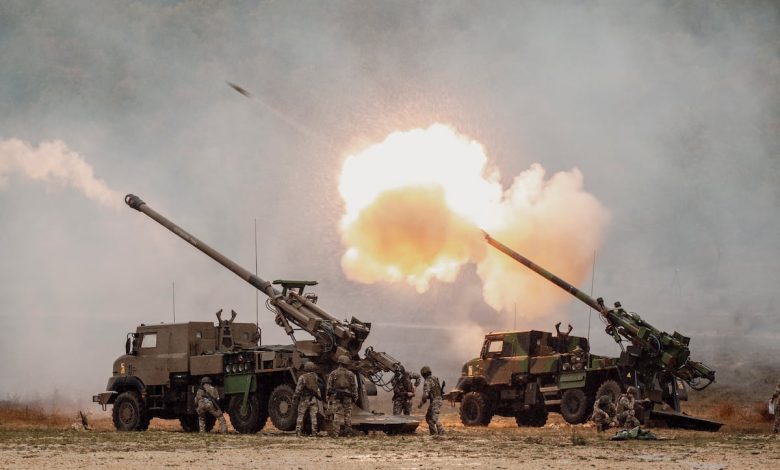
The 68e RAA is reshuffling its batteries of 155 mm Caesar howitzers into three two-gun sections from two four-gun sections, while keeping the overall size of its fleet of truck-mounted howitzers unchanged for now, according to Col. Rémy Jaillet, who commands the artillery formation.
The regiment is relying on the Atlas fire-control system to coordinate multiple sections and retain the ability to mass fires despite dispersing the guns, Jaillet said on the sidelines of an innovation day organized by the 7th Armored Brigade at its headquarters in Besançon in eastern France earlier this month.
“As counter-intuitive as it may seem, splitting sections into pairs increases the availability of fires and therefore their responsiveness,” Jaillet told Defense News in a followup comment via email. “Smaller, more dispersed units also improve their survivability and resilience in a degraded environment with a strong counter-battery threat.”
The move comes as NATO militaries study lessons from Ukraine, where persistent drone observation has made firing positions vulnerable to counter-battery fire. Ukrainian forces have responded by dispersing guns, shortening firing missions, concealing positions and separating ammunition from firing units, according to an analysis by the Royal United Services Institute.
Jaillet said the reorganized artillery structure is spearheaded by the 68e RAA and shouldn’t currently be considered a standard format for the Army. In the reorganization, each battery has fewer guns, but there are more batteries, he said.
The 68e RAA is one of six French artillery regiments equipped with the Caesar, manufactured by KNDS. The French Army’s model for a combat-ready brigade includes an artillery regiment equipped with 16 Caesar self-propelled howitzers and eight MEPAC mortars.
The regiment’s new artillery-support section is in charge of identifying all firing positions, setting up decoys and prepositioning ammunition, in a move away from each gun section having its own small reconnaissance element, according to Jaillet.
The idea is to “recreate a dynamic artillery maneuver” by bringing together all functions related to survivability, maneuver and coherent deployment under a section commander, instead of having two firing sections that are autonomous in preparing their movement and protection, “with all the limitations that entails,” Jaillet said.
The colonel said the new structure “in a way” recreates the reconnaissance sections that existed previously in French artillery formations, but augmented with new capabilities, particularly in the field of deception.
‘Opacity bubbles’ and metallic cages
In the regiment’s deployment zone, Caesar guns will wait before fire missions in what Jaillet called “opacity bubbles,” concealed and emitting as little as possible to avoid detection. The support section will set up ammunition resupply plots, decoys and equip firing positions with protective metallic cages that the self-propelled howitzers can reverse into.
The 68e RAA tested the new organizational model at the Canjuers military camp in southern France earlier this year and again during the French large-scale exercise Orion 2026 that ran until the end of April. The experience allowed the regiment to fine-tune the structure and components such as the protective cages and the decoys, the colonel said.
The first Caesar battery will permanently transition to the new structure next year, with the remainder to follow, Jaillet said.
The French Army, during a drone observation-artillery shooting competition in Romania in August, fired its Caesar howitzers from dug-in positions, which Jaillet called a particular case that “we shouldn’t turn into a general rule.”
“The essence of the Caesar is to provide survivability through mobility,” Jaillet said.
While the static frontline and the transparency of the battlefield in Ukraine have translated into “very defensive” tactics, with prepared positions that require heavy engineering assets and lengthy groundwork, Jaillet said those are “not the be-all and end-all. We need to be able to adopt a more dynamic approach.”
The biggest change for artillery due to the widespread use of drones has been in target acquisition, with “the real shock, the real turning point” happening before the war in Ukraine, during the 2020 conflict in Nagorno-Karabakh, according to the regimental commander.
Azerbaijan deployed integrated target acquisition and strike systems during the conflict, with drones providing target information via rapid communications that enabled artillery strikes to be called in, the colonel said. Jaillet likened it to a modern iteration of aircraft observing targets and adjusting artillery fire, with drones creating a new synergy and accelerating the sensor-to-shooter loop.
The Atlas fire-control system used by the 68e RAA is interoperable with brigade-level systems such as SitaWare command-and-control, but Jaillet said more capabilities are needed to link sensors and effectors across the battlefield.
The structure of the regiment’s liaison, observation and coordination detachments is evolving, from fairly self-contained, “essentially a vehicle with a team inside,” to teams combining an armored vehicle capability with ground, radar and drone capabilities, Jaillet said.
The colonel said he’s satisfied with the regiment’s equipment, including the Caesar howitzer and the MEPAC mortar that’s entering service, as well as the Thales-produced Murin ground-surveillance radar and Delair’s DT46 reconnaissance drone.
“For ground-to-ground artillery and target acquisition, this is high-quality equipment that has proven itself in operations,” Jaillet said. “There’s always room for technological improvement. The battlefield is expanding, so we need to increase range and improve responsiveness.”
Rudy Ruitenberg is a Europe correspondent for Defense News. He started his career at Bloomberg News and has experience reporting on technology, commodity markets and politics.