PARIS — France’s Air Force, together with the country’s Directorate General for Armament and the agency for defense artificial intelligence, plans to fly crewed fighter jets in collaboration with combat drones in 2028, part of a project to experiment with AI in combat aviation dubbed Hypairion.
The project seeks to develop open, modular architecture for combat aircraft and sovereign AI technology that gives the government greater control over the tech, rather than having to rely on companies for critical systems, said Col. Cédric, head of the Air Force capability-development office, in a press briefing here on Thursday.
As AI becomes more powerful, the likes of Airbus and BAE Systems in Europe and General Atomics and Anduril in the United States are leveraging the technology to develop collaborative combat aircraft, also referred to as “loyal wingmen.” While many of those projects are company-driven, the French project would keep some of the critical technology under state control.
“What Hypairion is really about is equipping the Air Force and our platforms with architectures that are open, modular and owned by the government,” Col. Cédric said. He was identified only by his first name, in line with the Armed Forces Ministry’s policy for military staff. “Our goal is to move away from proprietary systems that lock down sensors and weaponry.”
The Ministerial Agency for Defence AI will be in charge of providing sovereign AI technology for the project in several areas, particularly command and control as well as mission autonomy, said Col. Thibault, deputy director for AI applications at the agency, known as Amiad. He described mission autonomy as AI that assists pilots with mission planning, in-flight decisions and post-mission analysis.
Amiad already uses AI to coordinate different platforms in the French Army’s Pendragon robotics project, and proposes to create an industrial hub for Hypairion where both traditional aerospace firms and smaller startups can interact with the project, an approach tested in Pendragon.
“The point of the Hypairion project is for the French state to retain control of the overall architecture and to be able to integrate the most capable startups or industrial companies,” Col. Thibault said. He said companies might join and leave the project, while Hypairion retains its capabilities in-house.
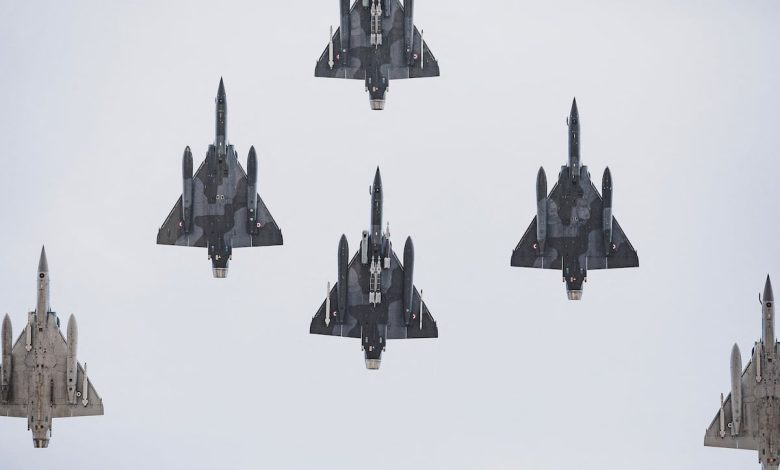
The Air Force is modifying two Mirage 2000s fighters at Mont-de-Marsan airbase to become AI test beds, adding a new computer that will allow to test “all kinds of use cases” starting by the end of the year, according to Col. Cédric. Mont-de-Marsan in southwest France is home to the Escadron de chasse et d’expérimentation, a dedicated fighter squadron for testing and evaluation.
Development will be incremental, and the first stage of Hypairion won’t necessarily be about having an operational capability, but will look at areas such as energy consumption and system interfacing, Col. Cédric said. First use cases being considered include using AI to optimize flight paths or tactical decisions such as when to deploy air-to-air or air-to-ground weapons.
The unmanned aircraft set to fly in 2028 will be a test platform and may not be the future wing-man drone planned for France’s Rafale jet as part of the fighter’s future F5 standard, though the experimentation will help pick a suitable platform later in the decade, Col. Cédric said.
The DGA has set a target data of 2033 for the first version of the Rafale F5, but will work on collaborative platforms within the framework of the current F4 standard before then, said General Engineer of Armaments Sébastien, in charge of the Rafale program at the directorate.
The goal of integrating AI on the Rafale is to help crews manage the “absolutely phenomenal cognitive load” to maintain future operational superiority, he said. The armaments engineer cited the Talios laser-designation pod from Thales, set to be delivered to the armed forces in 2027, as a concrete application of AI, able to scan an area and provide a fighter crew a list of potential targets.
Col. Cédric described a hypothetical future in which a fighter crew would carry out a mission in the morning, in between missions identify an adaptation against an enemy countermeasure, and take off again in the afternoon with updated software. That will require system architectures to evolve, he said.
The French Air Force officer likened future manned and unmanned platforms to “flying computers” on which the keyboard, screen or software could be changed without compromising security. The goal of the architecture being developed within Hypairion is to separate the flight-safety aspect from the ability to carry out missions, he said.
The Air Force doesn’t envisage a future with only unmanned aircraft, for both ethical and operational reasons, according to the colonel, who said the decision to deploy weapons remains a human one, and AI can make mistakes. “Humans can be augmented or supplemented by AI, but the assessment of the operational situation, tactical judgment, and so on, these are still entirely the domain of humans.”
As the Air Force prepares the Rafale F5 standard, “a true mid-life overhaul of the aircraft,” focus areas include adequacy of hardware resources, as the system needs to be able to handle complex calculations, Sébastien at the DGA said. Another focus is system openness, meaning “the armed forces must be able to tailor artificial intelligence according to their own needs and so dispose of an open system.”
The Rafale’s F4 standard already includes an initial level of openness through a tablet connected to the mission system, and the F5 standard will seek to broaden the scope of data available to the tablet, give it access to the mission system’s computing resources, and improve the ability to interface with onboard communication systems and data links, according to the DGA engineer.
“This in particular will make it possible, and without waiting for the deployment of the F5 standard, to control autonomous combat platforms from the Rafale,” Sébastien said.
While France relies on Dassault Aviation and other major industrial partners for the Rafale to develop AI in the fighter’s major systems, the armed forces want to ensure operational autonomy, meaning having “the ability to tailor the AI to the specific operational needs of the theater,” the engineer said.
Hypairion will work on a road map covering usage concepts, doctrine, scaling up the work force as well as the actual equipment, resulting in a first full-scale trial of collaborative combat drones flying alongside fighter jets in 2028, according to Col. Cédric.
“The challenge for the Air and Space Force is ultimately to determine what a fighter squadron will look like in 2035 or 2040, once all these systems are potentially integrated into the squadron,” Col. Cédric said. “Today, it’s actually quite rare to come across computer scientists in a fighter squadron. Perhaps tomorrow, that will be a daily occurrence.”
Rudy Ruitenberg is a Europe correspondent for Defense News. He started his career at Bloomberg News and has experience reporting on technology, commodity markets and politics.