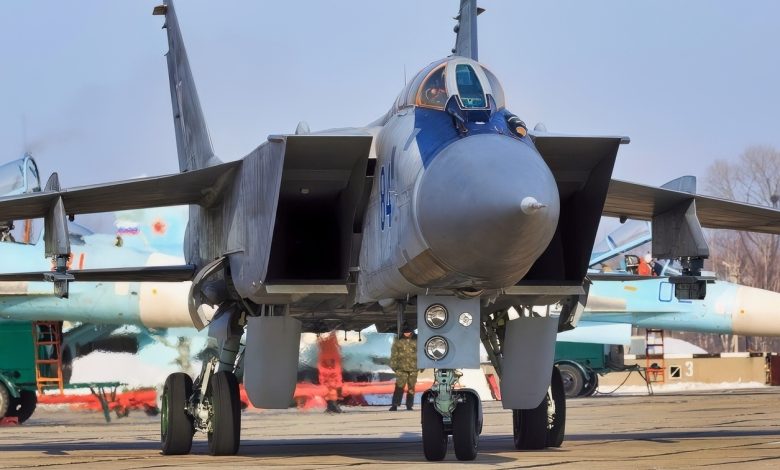
Russia’s MiG-31 is one of the older aircraft still in service with the Russian Air Force today, having survived the post-Cold War collapse of the Russian military. Though a legacy Soviet fighter, the MiG-31 remains airworthy thanks to periodic upgrades, modernization, and refurbishment and replacement of consumable components.
The MiG-31’s Origin Story
MiG-31 Fighter. Image Credit: Creative Commons.
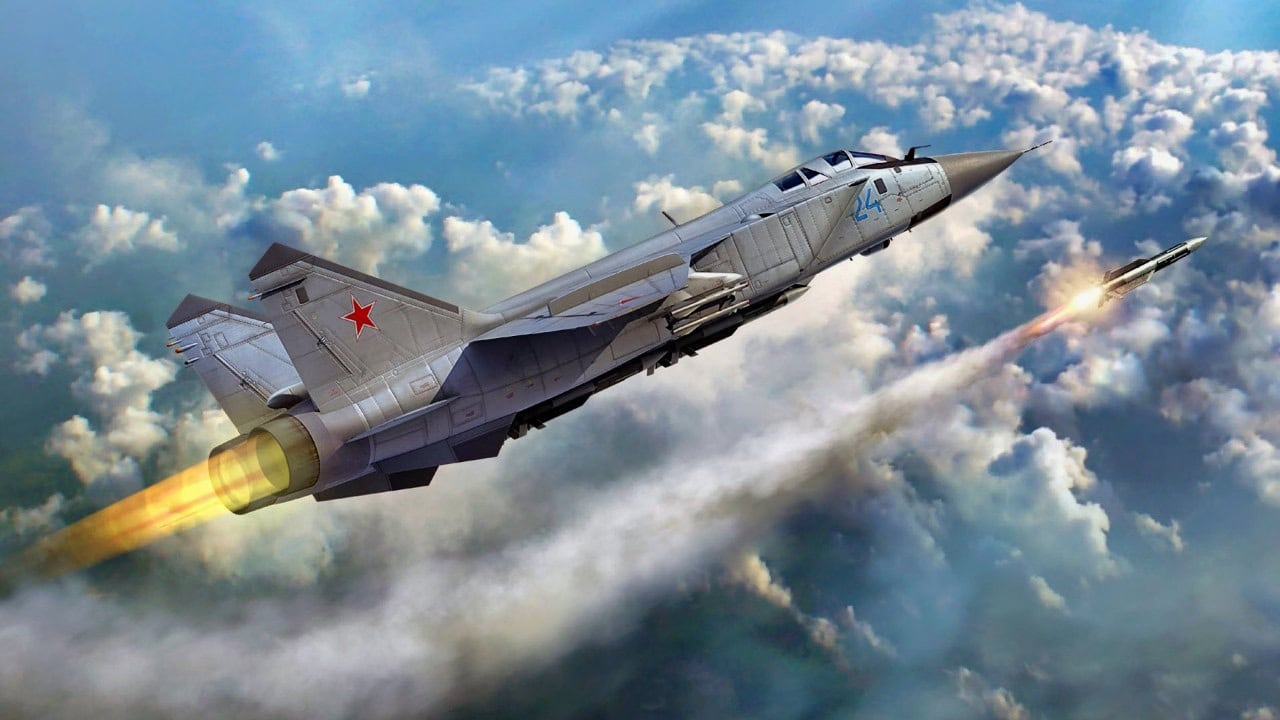
MiG-31 from Russian Air Force. Image Credit: Creative Commons.
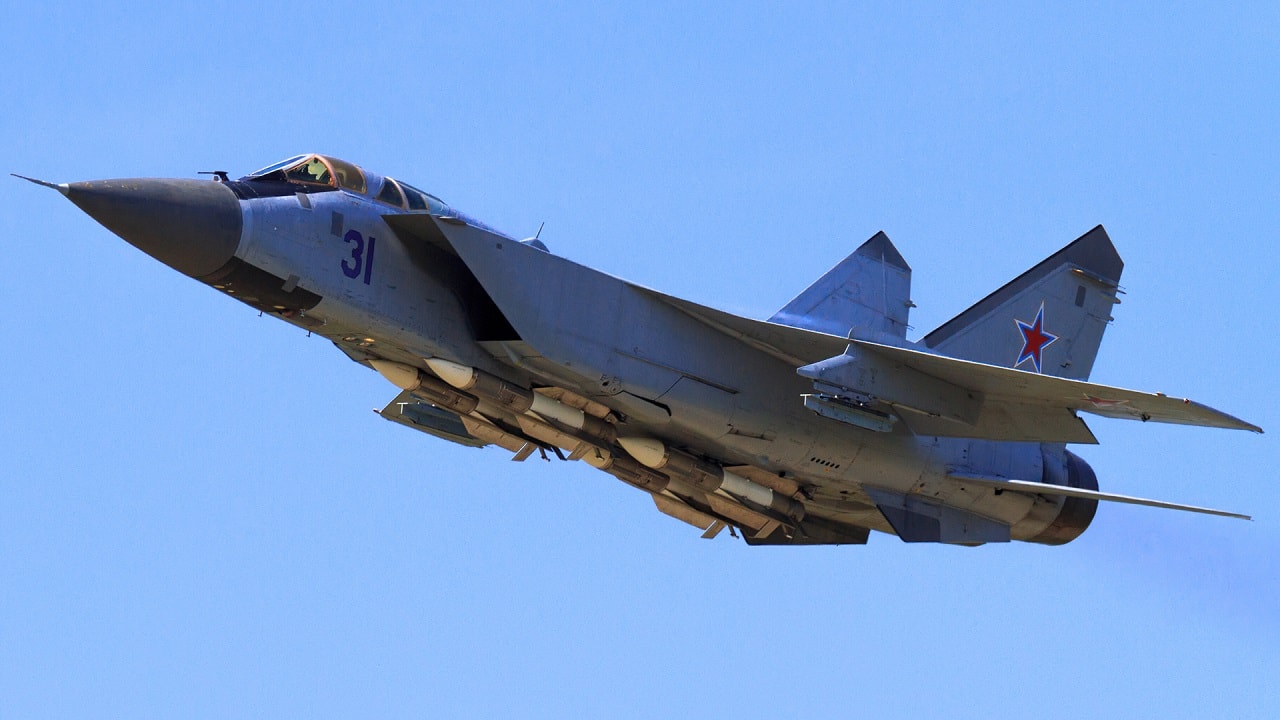
MiG-31. Image Credit: Creative Commons.
The aircraft was originally drawn up on MiG drawing boards in the late 1970s and early 1980s, when Cold War tensions were heating up.
Envisioned as a powerful interceptor jet, the MiG-31 benefited from a very high top speed, which helped police the Soviet Union’s vast geography and ensure the integrity of its borders.
Although the MiG-31 looks similar to the MiG-25 Foxbat, the two aircraft are distinct.
While the older MiG-25 mitigated the immense amount of heat generated by its fast, Mach 3.2 speeds, the MiG-31 incorporated a great deal of titanium into its design, a choice aimed at lightening the aircraft.
As a result, the MiG-31 was one of the era’s most resilient aircraft, able to withstand the incredible stresses of its extreme supersonic sprints.
Despite the weight-cutting titanium offered, it was still heavier than many Western fighters, including the American F-15 Eagle.
Still, it had an outsized fuel capacity because of its high supersonic fuel burn rate and anticipated long interception runs.
Today’s MiG-31 Fleet
Though the MiG-31 design hearkens back to the post-Vietnam Cold War era, the jets are still in service today thanks to extensive maintenance of the aircraft, including close examination of the jet’s airframes for stress-related fatigue, more modern digital cockpit upgrades, and periodic deep maintenance to the jet’s two power plants, large D-30F6 turbojet engines.
But the jets have also been modernized since entering service.
The MiG-31BM variant, for example, sports a newer Zaslon-M radar, updated all-digital avionics, and compatibility with newer post-Soviet-era weaponry.
That last aspect of the MiG-31 platform has proven to be one of its most valuable in the modern era.
Russia has relied on its modified MiG-31 fleet to ferry and fire Kh-47M2 Kinzhal missiles, a hypersonic weapon that Russia has repeatedly fired at targets in Ukraine, often targeting energy infrastructure or other civilian targets across the country, in addition to other outsized weaponry.
But the MiG-31 fleet is one of a limited number of platforms that the Kremlin can call upon to patrol in the high north, in and around the Arctic. Aside from some long-range bombers, most other aircraft available to Russia lack the range — and, importantly, the speed — that the MiG-31 offers.
But despite the jet’s Cold War vintage, it has stayed relevant well past that conflict, even making headlines today.
MiG-31s Encroaching in Europe’s Far North
Earlier this month, Finnish and Swedish Quick Reaction Alert (QRA) fighter jets intercepted several Russian aircraft, including at least two MiG-31s.
The interception marked the first joint Swedish-Finnish interception mission.
“Fighters are kept on QRA duty as directed by the Air Operations Center.
The locations of QRA aircraft and response times are tailored to meet existing requirements and in accordance with the prevailing situation,” the Finnish Air Force wrote. “Finnish and Swedish fighter jets are on QRA duty mainly in their national air bases, but they may operate from each other’s bases, if necessary.”
Just days before the interception of the Russian aircraft, the Finnish Air Force took delivery of the first two F-35A Lightning II fighter jets, part of a larger order of 64.
Flying into the Future
One aspect of the jet’s longevity has been its capabilities, as well as the somewhat niche role it fills in today’s Russian Air Force as an interceptor.
Unlike other fourth-generation aircraft of the MiG-31’s era, like, say, the American F-16 fighter, the MiG-31 was never intended to be a dogfighter, engaging aircraft from close range.
By eschewing the kind of high-G maneuvers that other fighters would not hesitate to perform, some kinds of airframe stressors are avoided, which is a boon to the MiG-31’s longevity.
With the Kremlin focused on prosecuting its war in Ukraine, a conflict that is largely contested on the ground or in the air by drone, the prospects for a successor to the MiG-31 are rather unlikely in the near term, and given the aircraft’s usefulness to Russia for launching air-to-ground munitions against Ukrainian targets, the MiG-31’s future within the Russian Air Force is all but assured.
About the Author: Caleb Larson
Caleb Larson is an American multiformat journalist based in Berlin, Germany. His work covers the intersection of conflict and society, with a focus on American foreign policy and European security. He has reported from Germany, Russia, and the United States. Most recently, he covered the war in Ukraine, reporting extensively on the war’s shifting battle lines in the Donbas and writing on the war’s civilian and humanitarian toll. Previously, he worked as a Defense Reporter for POLITICO Europe. You can follow his latest work on X.