China’s J-20 And J-35A Stealth Fighters Don’t Have To Beat US Military F-22 Raptors And F-35s. Beijing Is Building Enough That They Don’t Need To

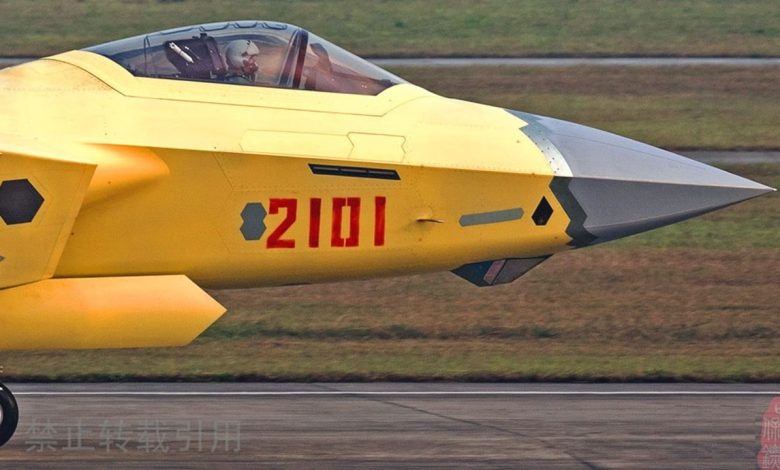
China Can Build the Entire F-22 Fleet in Under 2 Years. A 1916 Equation Explains Why That Decides It — America built 187 F-22 Raptors and closed the line in 2011. It will never reopen. Open-source analysis of commercial satellite imagery now suggests that the Chengdu aircraft plant alone may be capable of producing as many as 100 J-20 stealth fighters per year, with the Royal United Services Institute estimating 2025 output at 120.
That’s bad news for a simple reason: China’s single largest fighter factory can build the equivalent of the entire American Raptor force in under two years, and it has a second stealth fighter in production at another plant. The argument over whether a J-20 could defeat an F-22 in a turning fight has consumed twenty years of magazine columns, and it was always the wrong argument. An English engineer worked out why in 1916.
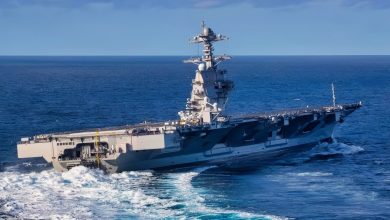
F-35C Lakeland Airshow Photo 19FortyFive Image Taken on 4/19/2026.
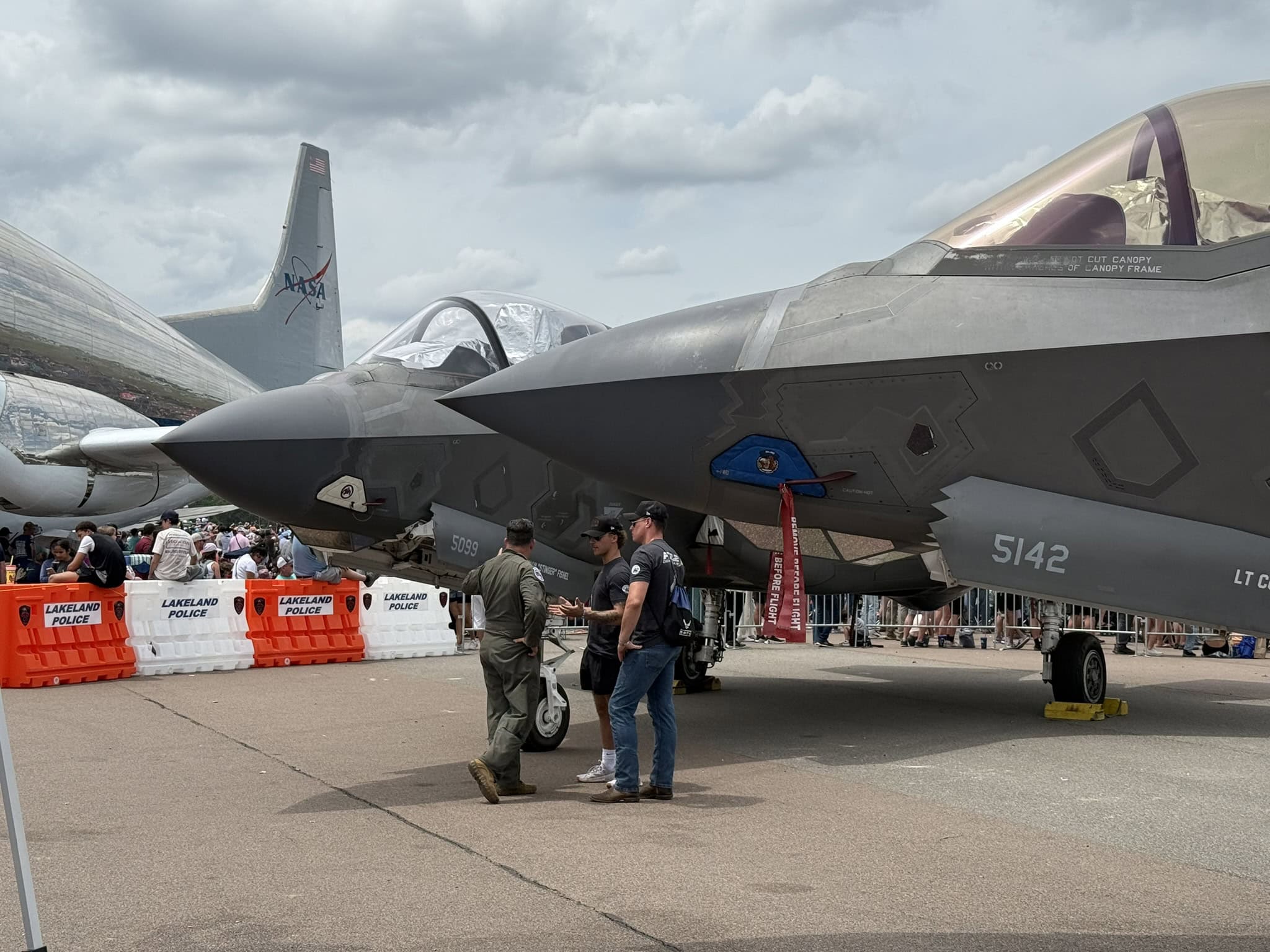
F-35C. Image Credit: 19FortyFive.com taken on 4/19/2026.
The Equation Nobody Quotes in the Quality Debate
Frederick Lanchester was an automotive and aeronautical engineer who, during the First World War, sought to put combat on a mathematical footing, and he published his conclusions in a book titled Aircraft in Warfare: The Dawn of the Fourth Arm.
His central finding, now known as Lanchester’s square law, applies precisely to the situation the Pacific presents.
Under conditions of aimed fire, where every unit on each side can engage the enemy, the fighting strength of a force is proportional not to its numbers but to the square of its numbers, multiplied by the effectiveness of each individual unit.
The consequence is brutal and counterintuitive.
Doubling the size of a force quadruples its combat power. Doubling the quality of each platform merely doubles it. To survive a two-to-one numerical disadvantage, each of your aircraft must be four times as capable as each of theirs. At three-to-one, the requirement is nine times.
Nobody in Washington argues that an F-35 is nine times the aircraft a J-35A is. Nobody argues four. The most aggressive American assessments of the capability gap put the F-22 and F-35 comfortably ahead in sensors, stealth, and mission systems, and “comfortably ahead” is not the same currency as the square of the numbers.
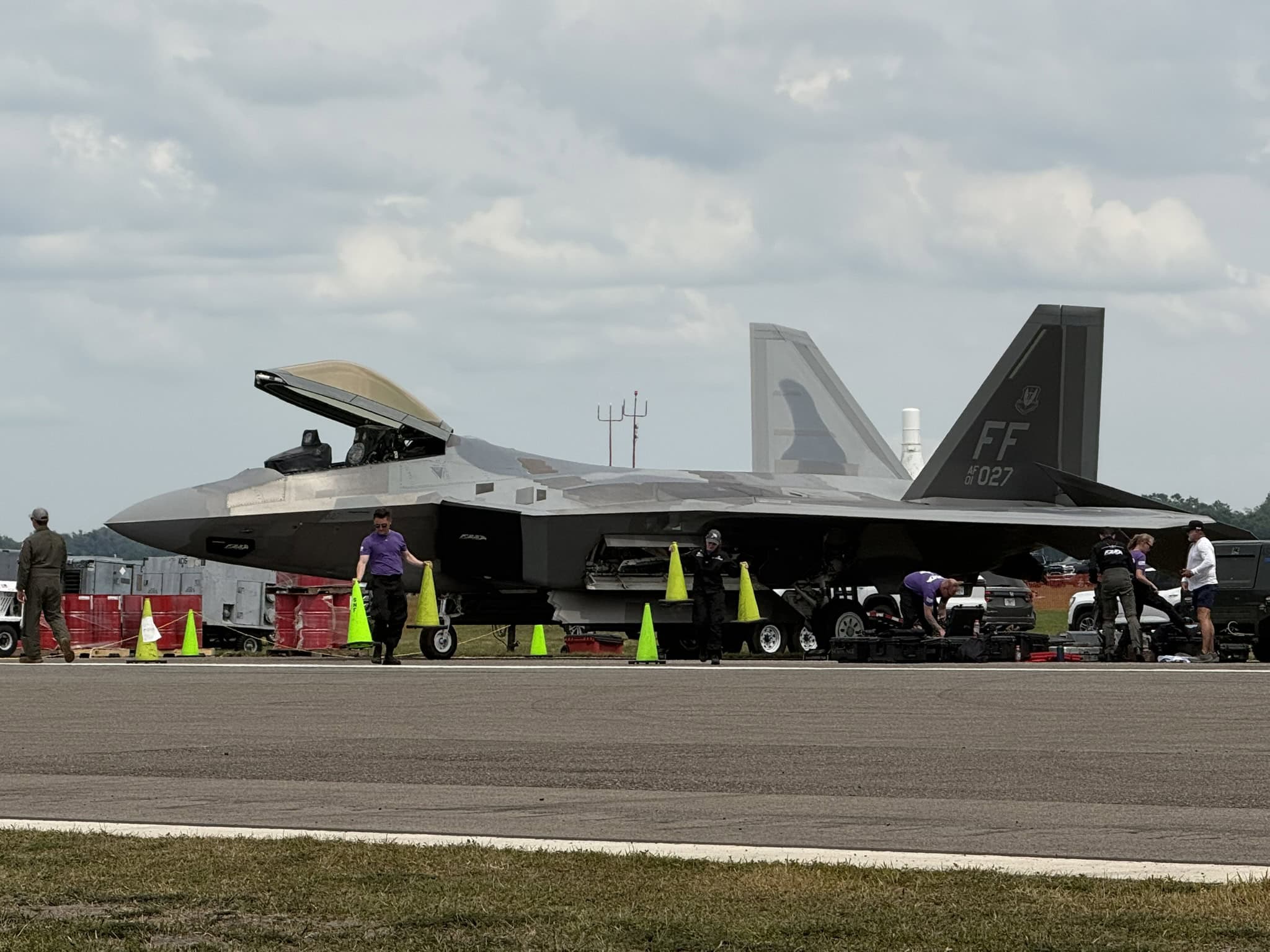
F-22 Raptor Lakeland Florida Airshow. Image Credit: 19FortyFive.com
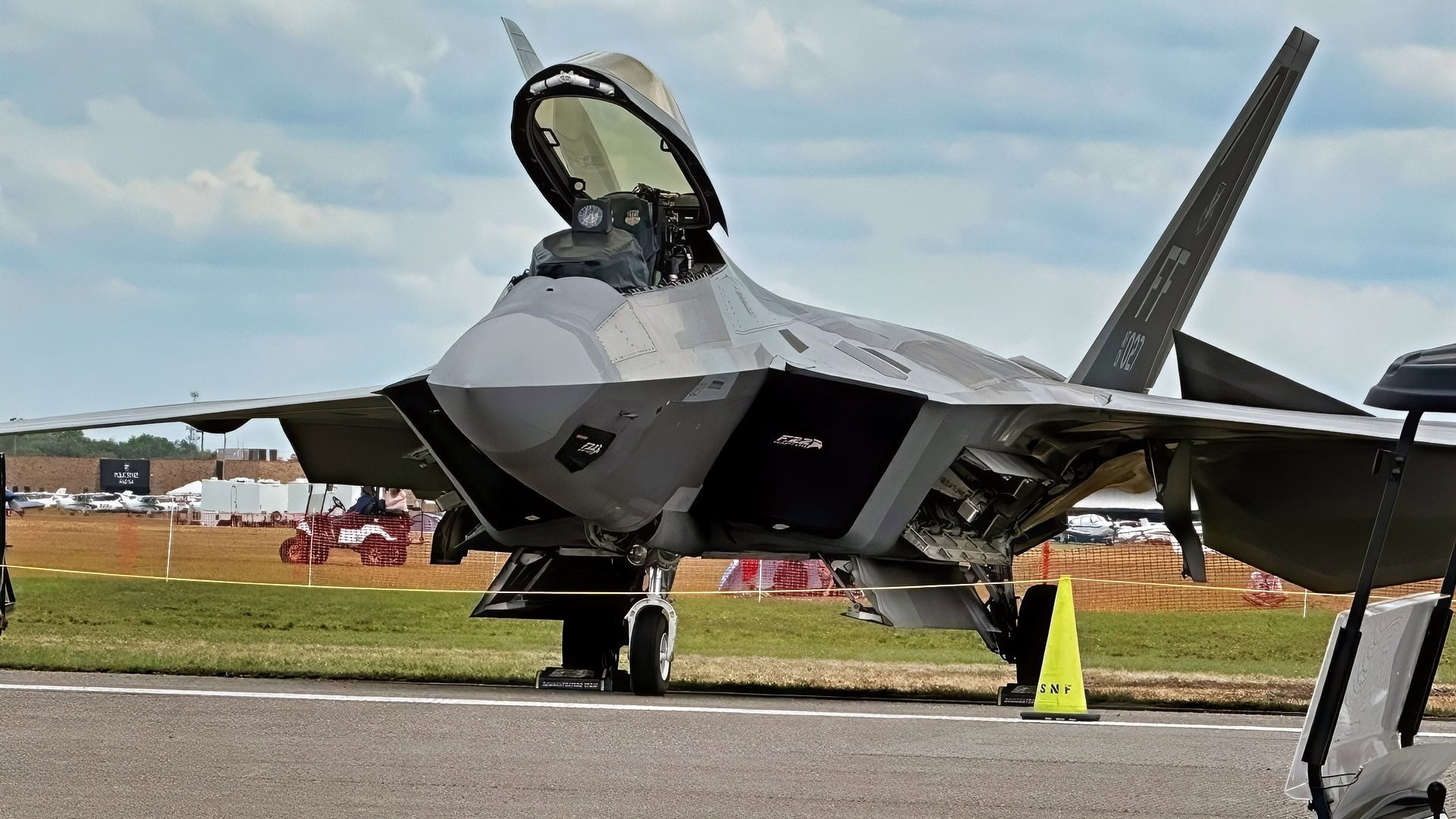
F-22 Raptor Lakeland Florida Airshow. Taken by Harry J. Kazianis on 4/19/2026.
This is the mathematics behind the old aphorism about quantity having a quality of its own, and it is why the production charts matter more than the capability charts.
What the Factories Show
The physical evidence arrived through commercial satellites rather than intelligence leaks, which is what makes it checkable.
Imagery of the Aviation Industry Corporation of China’s principal plants at Chengdu, Shenyang, and Changhe shows more than 743,000 square meters of new manufacturing floor space, roughly eight million square feet, added across the complexes.
Chengdu, which builds the J-20, has multiplied its final assembly halls.
Shenyang, which builds the J-35 family, has expanded alongside it. Cleared ground sits beside the Chengdu site, apparently held for whatever follows the fifth generation, and something is following, because China’s J-36 demonstrator and its J-50 stablemate have both been flying.
The estimates themselves tell a story worth reading twice. Public figures drawn from American military and open sources put J-20 output at 40 to 50 per year, with a fleet of nearly 200 as recently as 2024. French analysis then tracked 70 to 80 a year. The Mitchell Institute assessment presented at the Air and Space Forces Association’s warfare symposium this February supports 100 a year at Chengdu, and RUSI says 120. Total Chinese fighter production capacity across all types is now assessed at 300 to 400 aircraft annually, with analysts projecting a thousand-aircraft fifth-generation fleet by 2030.
Capacity is not output; nobody outside Chengdu holds the real number, and every honest analyst says so. What matters is that the direction of every credible revision for three consecutive years has been upward, and the estimates have doubled in twenty-four months. Again, bad news.
The American Denominator
The other half of the ratio is a story of deliberate subtraction. The Air Force originally intended to buy 750 F-22s. That became 648, then 381, and in 2009 the Secretary of Defense ended the program at 187 airframes, on the reasoning that no adversary would field a comparable fighter in numbers that mattered. Attrition has since taken a few, leaving 184 in inventory, and the fleet is smaller than that figure suggests in practice, because roughly thirty of the oldest Block 20 jets serve as trainers and are not combat-coded, a limitation the service has spent years deciding whether to fix.
The F-35 line is the healthy one, running near 156 aircraft a year, and last year’s record of 191 deliveries deserves a big fat asterisk: much of the margin came from clearing about a hundred completed jets that had been parked awaiting software certification, which is a delivery surge rather than a production surge. Those 156 aircraft also supply the entire planet, including a dozen allied air forces and the Navy and Marine Corps.
The Air Force’s own force-structure analysis concluded that it needs F-35 procurement pushed to roughly 100 jets a year for itself simply to reach what it calls “acceptable military risk,” which is not the language of a service that believes it is winning the numbers game. The pattern extends beyond aviation, which is the part that should worry Washington most. The Navy built three Seawolf-class submarines, the finest attack boats ever launched, and stopped on purpose because the Cold War had ended. It operates eleven nuclear aircraft carriers and can usually deploy four. Exquisite platforms in small numbers, produced on lines that close and cannot restart, are not an aviation policy. It is an industrial culture, and it was built for a world with no peer competitors.
Two Stealth Fighters, Not One
The second Chinese type is what converts a production story into a structural one. The J-35A appeared publicly at the Zhuhai airshow in November 2024 and entered air force service in September 2025, while its carrier-capable sibling has been working from the electromagnetic catapults of the carrier Fujian. That makes China the only nation besides the United States ever to run two stealth fighter types in simultaneous production, and the naval version arrives while the US Navy’s own next-generation fighter remains a contested line item in the budget.
Two types is not vanity. A large long-range air-superiority aircraft and a smaller multirole fighter cover different missions, force an opponent to solve two different identification and tracking problems, and insulate the force against the grounding of any single design. In many respects, it is the structure the United States invented by pairing the Raptor with the Lightning.
Beijing copied the architecture and is filling it at industrial speed, and the J-35 family doubles as an export product for the many air forces the F-35 will never be sold to. The naval variant’s reported ability to carry anti-ship missiles internally makes the point that these aircraft are not being built to win duels. They are being built to sink ships and close airspace.
The Magazine Problem
Here comes more bad news. An F-35 flying a stealthy profile carries four air-to-air missiles in its internal bays, six once the Block 4 rack modification is fielded. Hanging more under the wings restores the radar signature the aircraft exists to avoid. Grant the American jet everything its advocates claim, a first look, a first shot, and a kill on every launch, and it is still out of missiles after four engagements.
Then it must fly hundreds of miles to a tanker orbiting in contested airspace, or to Kadena or Andersen, and land on a runway that China’s rocket force has been targeting since the first hour of the war.
A J-20 rearms at a base an hour’s flight from the strait, on one of dozens of airfields the People’s Liberation Army can use, many of them protected by hardened shelters of a kind American forces in the Pacific mostly lack. The relevant quantity is not aircraft alone. It is sorties per day into the same square of sky, and that quantity is a function of airframes, distance, ramp space, fuel, munitions, and how many places you can safely put an airplane.
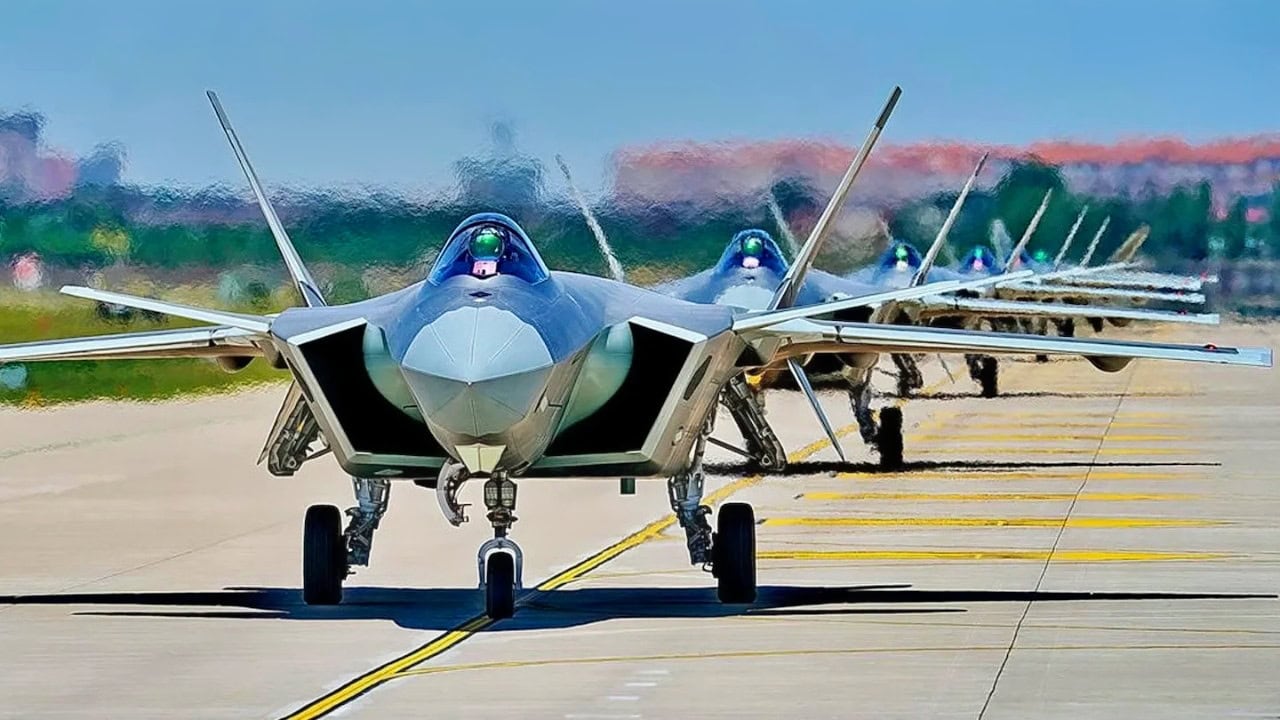
J-20 Fighter from PLAAF China. Image Credit: Creative Commons.
On every one of those variables, geography and construction favor Beijing, which is the operational reason the porcupine strategy for Taiwan keeps running into the same wall. Attrition then compounds everything. A force that loses fifty stealth fighters and replaces them in six months is playing a different game from a force that loses fifty and cannot replace any. Every Raptor destroyed is subtracted from American air superiority permanently.
Every J-20 destroyed is a slot on next quarter’s assembly schedule.
Where the Equation Breaks
But what if the math is just wrong, or we are thinking about this too theoretically?
Lanchester’s square law assumes both sides can see and engage each other, and defeating that assumption is precisely what stealth is for. When one side shoots from beyond detection, and the other never gets a firing solution, the model shifts toward the case that rewards quality without limit, and that is the scenario American planners have organized the force around for thirty years. The problem is that stealth degrades gracefully rather than absolutely.
Every additional Chinese radar, satellite, airborne sensor, and fighter adds a chance of detection, and more shooters mean fewer engagements the American pilot can decline. Numbers erode the exemption rather than ending it. The other counterweights are substantial and permanent. No Chinese pilot alive has flown in combat, while American and allied crews have decades of it, including recent stealth operations against Iranian air defenses, and the global F-35 fleet has passed a million flight hours across nearly 1,300 aircraft.
The J-20’s engine history, years of underpowered interim powerplants before the WS-15 matured, argues for humility about briefed performance. Stealth is a discipline of coatings, maintenance hours, mission data files, and tactics, and China has two decades less practice at the unglamorous parts. Most important, the American side is not a country but a coalition: Japan, South Korea, and Australia are building toward hundreds of fifth-generation fighters based permanently in the theater, European buys keep growing, and China’s stealth force would fight alone against a dozen air forces flying a common aircraft.
Allied mass is the one form of quantity Beijing cannot manufacture. But the experience gap is not frozen in place. China’s flying-hour totals and training throughput have climbed steadily while the US Air Force has spent years short of the pilots and maintainers its own plans require, and gaps that close slowly still close.
America Used to Be the Quantity Power
The strangest thing about this debate is that, by historical standards, the United States is arguing the wrong side, at least historically speaking.
America won the Second World War by building roughly 300,000 aircraft, Liberty ships faster than submarines could sink them, and Essex-class carriers on an assembly schedule. Germany fielded the first operational jet fighter, the Me 262, and it did not save them, because the Allies produced more of everything that mattered. The MiG-15 arrived over Korea as an unpleasant surprise and lost anyway.
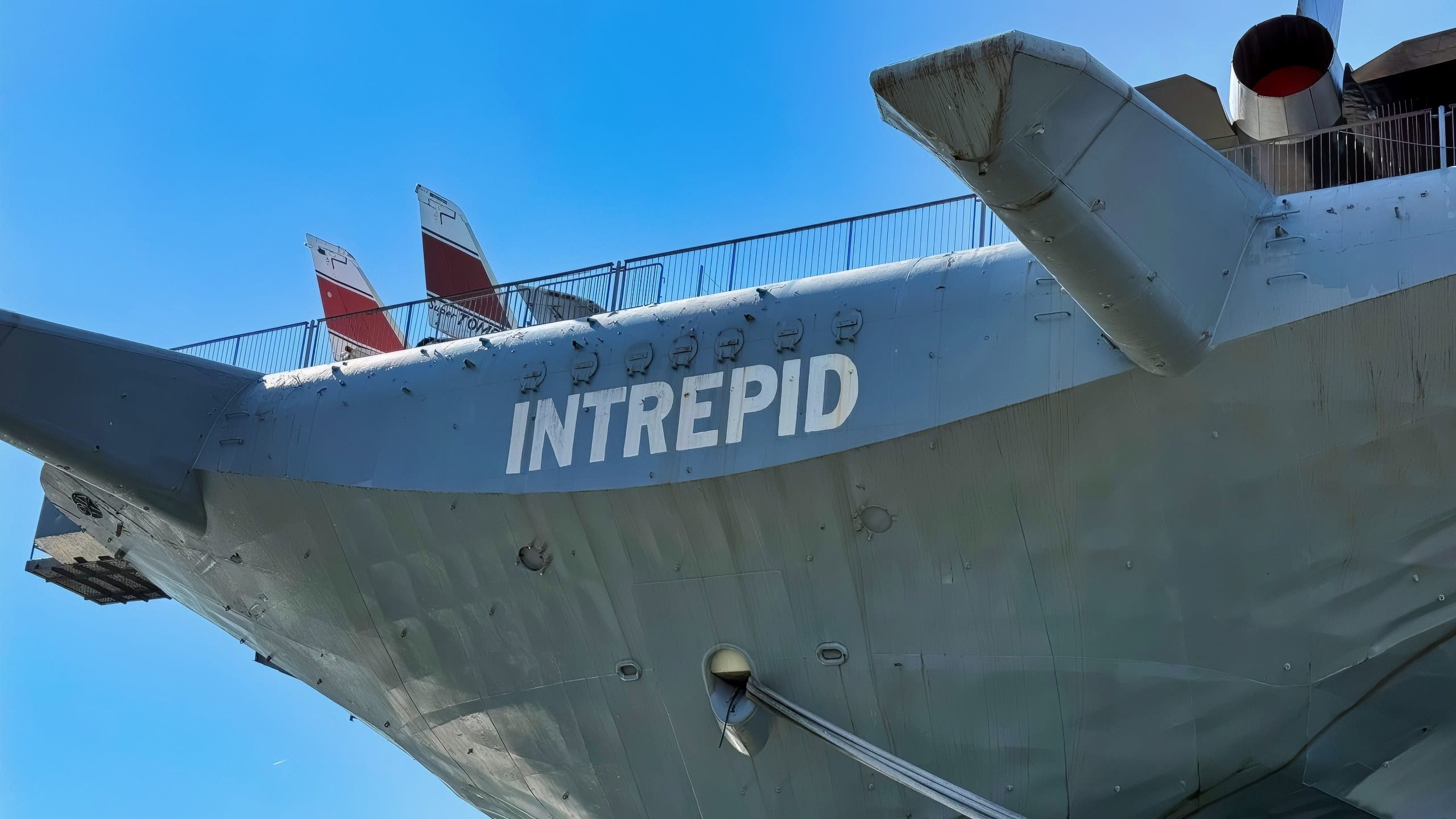
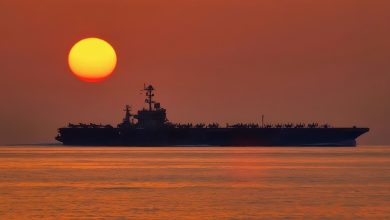
USS Intrepid of the Essex-Class Aircraft Carriers. Image Credit: 19FortyFive.com Original Photo.
American strategy for most of the twentieth century assumed that the enemy might have a better machine and that it would not matter, because the arsenal would decide. The unipolar decades inverted that instinct: with no peer to outbuild, small fleets of extraordinary aircraft became both affordable and sensible, and production lines were closed as monuments to a settled question. Chengdu is reopening the question. The J-20 does not have to beat the F-22, and the J-35A does not have to beat the F-35, because Lanchester’s arithmetic does not ask which airplane the pilots would rather fly. It asks how many can shoot at each other over the same water on the same afternoon, and it squares the answer.
Let’s just hope we never have to ‘solve’ this math question.
About the Author: Harry J. Kazianis
Harry J. Kazianis (@Grecianformula) was the former Senior Director of National Security Affairs at the Center for the National Interest (CFTNI), a foreign policy think tank founded by Richard Nixon based in Washington, DC. Harry has over a decade of experience in think tanks and national security publishing. His ideas have been published in the NY Times, The Washington Post, The Wall Street Journal, CNN, and many other outlets. He has held positions at CSIS, the Heritage Foundation, the University of Nottingham, and several other institutions related to national security research and studies. He is the former Executive Editor of the National Interest and the Diplomat. He holds a Master’s degree focusing on international affairs from Harvard University.