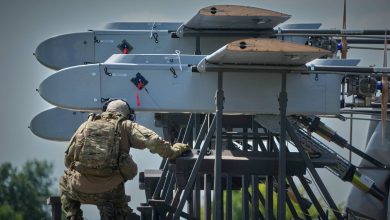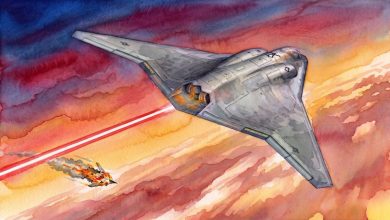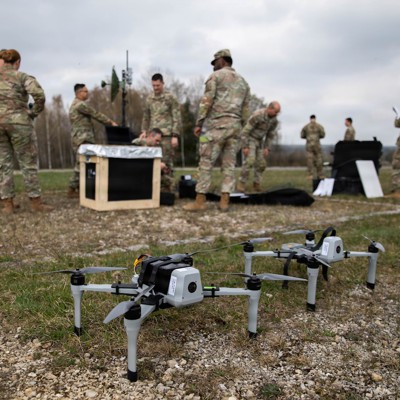
Military drone and counterdrone demand is booming amid a rush to spend funds before the end of the fiscal year—but the Pentagon’s drone marketplace is making it a little easier, defense officials said.
“These contracts are available to everybody. And so what we’ve seen across the department is a surge of end-of-year requests for procurement,” Brig. Gen. Matthew Ross, who leads the Pentagon’s Joint Interagency Task Force 401, told reporters Tuesday. “End-of-year spending is nothing new inside of the department, but when you have an available contract vehicle, it makes it really easy to execute. And so, we’ve seen that from across the services.”
The Army issued 10 indefinite delivery, indefinite quantity contracts Tuesday with a total ceiling of $4.15 billion for systems to disable or destroy unmanned aerial drones, including command-and-control systems, sensors, and weapons.
Seven companies received $500 million awards: Allen Control Systems, Digital Force Technologies, DroneShield, L3Harris WESCAM, Napatree Technology, RADA Technologies, and SRC.
Echodyne and PVP Advanced EO Systems received $250 million contracts, and SmartShooter received a $150 million contract. Only about $50 million was obligated at the time of award, the Army said.
But there’s room for more—up to $7 billion.
“As of today we have awarded over $5 billion, which includes previous contracts with [Aerovironment] and CACI, these 10 new IDIQs and others that we expect to sign before the end of next month. The $7 billion ceiling is in full effect today, and additional contracts will be pursued to get us to that point,” Col. Tony Lindh, JIATF-401’s lead for rapid acquisitions, told reporters.
The new enterprise contracts reflect a new way of doing business for the Army, providing buyers more flexibility over time.
“These platforms are software-defined, hardware-enabled systems…so we have to be able to partner with industry and then hold them accountable over time,” said Ross, JIATF 401’s director.
The Army’s unmanned aerial systems marketplace has done about $800 million in transactions since it opened earlier this year, and the expectation is for counterdrone demand to follow a similar path—especially with allies and partners, said Brent Ingraham, who leads Army acquisitions.
“About 10 days ago, Australia successfully procured, in this case, it was a UAS off the drones.mil marketplace,” Ingraham told reporters. “We still have to use the [foreign military sales] process as we go through this marketplace. But…we’ve automated the tools on the back end.”
That means it now takes days from request to purchase instead of months or longer when an ally or partner nation wants to buy a system the U.S. has.
“When they see the U.S. military buying certain products, they’re all in,” Ingraham said. “And so this is a way to share those technologies, share what we’re doing,” and help smaller businesses “scale.”