VIENNA — The United Arab Emirates, a Western darling for security cooperation in the region, appears to have regularly used Aviacon Zitotrans, a sanctioned Russian airline linked to the Kremlin’s military and paramilitary operations, over the course of the past year, a Defense News investigation shows.
Analysis of thousands of flight records as well as gigabytes of leaked internal company documents, aviation filings and emails suggest a link between the sanctioned aircraft and more than 100 missions flown on behalf of the UAE government and its royal family since mid-2025.
The Russian company behind these planes, Aviacon Zitotrans, has been sanctioned by the United States, Canada and Ukraine for its support in Russia’s war effort. Previous reporting also revealed its role in sustaining Moscow’s mercenaries in Africa. The specific planes that pop up in the flight logs of UAE’s operations have been separately designated as blocked property by the U.S. government.
This article is the second in a multi-part series that uncovers the peculiar network of front companies, airlines and Soviet-era freight planes.
The UAE’s apparent use of a military-linked Russian cargo airline, alongside its role as a hub for Russian sanctions circumvention, runs contrary to Western efforts to isolate Moscow internationally and cut the Kremlin off from cash flows it needs to maintain its war against Ukraine.
Flight tracks collected by Defense News show that Aviacon Zitotrans’s Soviet-era Ilyushin Il-76 aircraft flew missions linking the UAE to destinations in Africa, following the same routes and operational patterns as those used by other operators that have been tied to the UAE’s support for the paramilitary Rapid Support Forces in Sudan’s civil war. Several flights operated out of UAE military bases rather than civilian airports, implying a government connection.
Defense News reached out to the UAE embassies in Vienna and Washington, to the Abu Dhabi Media Office and the UAE’s foreign ministry for comment on the Aviacon Zitotrans links, but received no response. The airline itself also did not respond to a request for comment.
Other flights flown by Aviacon Zitotrans aircraft and identified by Defense News appear to have flown from the UAE to a private airstrip in eastern Pakistan known as Chandana Airstrip or Al Habieb Airport, which previous reporting has tied to the royal Al Nahyan ruling house of Abu Dhabi. The airstrip does not appear in online ICAO/IATA code databases or Pakistan’s Civil Aviation Authority lists. International reporting has identified it as a gateway to the Gulf royal family’s falconry hunting grounds in Pakistan.
Sparse videos and images exist on the internet of the airfield. Defense News reviewed footage showing large portraits of Gulf monarchs and Pakistani politicians next to the apron and framed in a plush airport waiting room, along with plenty of UAE flags flying alongside Pakistani ones. UAE personnel are flown in ahead of the royals’ use of the airstrip, according to a private plane tracker’s 2022 investigation.
Delivering weapons
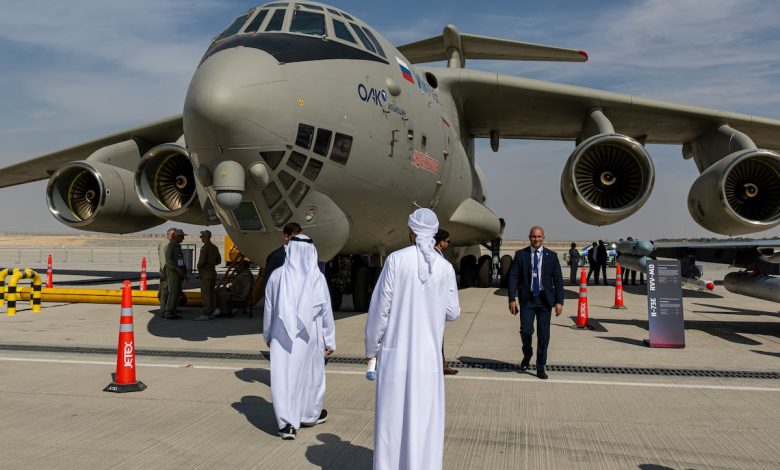
When not operating on behalf of the UAE, Aviacon Zitotrans flies missions for the Russian government, including the shipment of weapons around the world. Leaked internal documents viewed by Defense News show that the airline has delivered combat helicopters to Southeast Asia, armored personnel vehicles to Turkey, and received a special exemption from the Russian government to fly missiles and their warheads.
The company lists “government and military airlifts” as one of its areas of operations on its website, touting that the Il-76 planes it uses are “capable of operating from short and unpaved runways” and “achieved an excellent reputation for its versatility and operational reliability.”
The cabin and rear ramp “provides smooth loading/unloading for many kinds of rolling stock, such as armored personnel carriers (APCs), utility trucks, trailers etc,” the company’s website explains.
“Aviacon Zitotrans specializes in using Il-76 aircraft, which are very helpful, very sturdy aircraft for transporting cargo and transporting people,” said Margaux Garcia, senior analyst with C4ADS, a U.S.-based nonprofit organization specializing in analyzing illicit networks. “They were originally built to be military transport aircraft, so it makes sense that they’re being used for that purpose.”
The company’s Russia-linked operations in Africa have previously attracted attention and prompted the U.S. government to sanction the airline. Sub-Saharan Africa was the main theatre of operations for the infamous Wagner Group, which has been rebranded as Africa Corps following the death of its leader, Yevgeny Prigozhin.
While most Western countries have cut trade with Russia and its state-affiliated entities to a minimum, and the European Union has banned all Russian aircraft from its airspace, the UAE government maintains friendly commercial and diplomatic relations. As a consequence, the country has turned into a hub for Russian sanctions circumvention and foreign procurement, a trend confirmed by the leaked Aviacon Zitotrans air waybills Defense News examined, which routinely showed the procurement of Western goods, including sanctioned electronics, through the Gulf monarchy.
Previous reporting by Reuters has also identified Dubai’s gold markets as a crucial lifeline for Russia, given its exclusion from global payment systems such as SWIFT.
At least three Aviacon Zitotrans-affiliated aircraft have flown routes that match known patterns of UAE government-sponsored missions since September 2025: RA-76842, RA-76502, RA-76846. Another aircraft, RA-76834, flew a mission connecting the UAE’s Sweihan Air Base to Bosaso, Somalia, a known Emirati logistics hub used for weapons shipments into Africa before Somali authorities canceled the relevant agreements with the UAE in January 2026.
“It perfectly makes sense within their business model that they would work for any kind of group that would be willing to fund them. It’s a similar type of work to the work that they seem to do for Russia. So it makes sense that they would expand into this other market,” said Garcia.
All three aircraft flying the vast majority of apparent UAE-chartered missions are explicitly listed by the U.S. Office of Foreign Assets Control as directly blocked property. Any other Aviacon Zitotrans airframes, including all that may have touched UAE territory on their Russian missions, are blocked by extension due to their connection to the company.
Most flights generally followed the same pattern: The aircraft would first depart a UAE airfield, usually the joint civil-military airport at Al Ain, Abu Dhabi airport, or, more rarely, a military base in the UAE. It would then fly south and west to the Gulf of Aden, where its transponder track would disappear. It would then reappear at the same location over the Gulf of Aden, flying back to the UAE later that day or a few days later.
Transponder conundrum
“If you notice that all of these planes that are run by the same airline all drop off of coverage, then that’s a notable pattern — especially if it happens that most other airplanes are able to travel through that area without dropping coverage,” said Garcia, whom Defense News showed its findings and data. “So it’s not a signal issue. It’s not a coverage issue. That suggests perhaps they are intentionally turning off their transponders; they’re hiding their activity.”
In total, Defense News identified well over 100 Aviacon Zitotrans sorties that had telltale characteristics of UAE government-linked cargo operations.
Defense News used a commercial aircraft tracking archive including ADS-B transponder and MLAT location data to follow the aircraft in question, building an extensive database of almost 9,000 flights conducted by a number of shadow airlines globally since early 2025. Each flight was manually reviewed. The data is often spotty due to deliberate obfuscation techniques or limited coverage, requiring pattern-matching and secondary sourcing through local reporting, ground photography and satellite imagery.
A handful of transponder tracks gave a more complete picture, filling in some of the blanks. A recurring destination was Ethiopia, particularly the Harar Meda Air Base, the Ethiopian military’s main air force facility, and Addis Ababa International Airport.
The Ethiopian embassies in Washington and Berlin did not return a request for comment.
The UAE and Russia are both deeply embroiled in the Sudanese civil war, but their governments support opposing sides. While Abu Dhabi supports the Rapid Support Forces, Russia has thrown its weight behind the government and its Sudanese Armed Forces. Aviacon Zitotrans’s apparent work for both the UAE and Russia has led to the situation that the same aircraft may be supplying opposing sides of the brutal civil war, sometimes flying from Russia and Turkey into Port Sudan, the SAF’s main supply point, and sometimes operating on UAE missions likely supporting the RSF through the African hinterland.
Aside from Africa, a handful of flights that took place during these aircraft’s apparent use by the UAE connected the Emirates to other Gulf countries, including Kuwait and Qatar.
Beyond the use of Aviacon Zitotrans aircraft, the UAE operates a fleet of cargo aircraft using front companies and ostensibly civilian charter cargo aircraft on similar missions, which Defense News will explore in a forthcoming investigation.
It’s unclear why UAE leaders picked Aviacon Zitotrans from the extensive market of cargo charter airlines. “It may be that they have seen Aviacon Zitotrans’s experience in this area, that they’ve worked in the same kind of high-sensitivity operations,” said Garcia.
The aircraft were also tracked flying other missions in equatorial and sub-Saharan Africa, including in Libya, Uganda, D.R. Congo and Nigeria, over the past year and a half. However, based on known patterns, many of these missions are likely to have been Russia-linked rather than on behalf of the UAE, even though the UAE was sometimes used as a stopover location or hub on the way.
Defense News has previously reported on an Aviacon Zitotrans Il-76 aircraft flying a secretive mission to Venezuela during mounting U.S. pressure on the country in October 2025. It was later revealed that the aircraft had delivered a Russian air defense system to Caracas. Intermediary refuelling stops are essential for these aircraft to cover such distances, as the range of the Ilyushin planes would otherwise be insufficient, the CEO of a different Russian shadow airline told Defense News as part of an earlier investigation.
“If this is the case that Aviacon is also running missions for the UAE alongside illicit missions for Russia, then it is significant because it shows that the UAE does not see the sanctions against Aviacon as a sufficient deterrent to stop working with them,” Garcia concluded.
Linus Höller is Defense News’ Europe correspondent and OSINT investigator. He reports on the arms deals, sanctions, and geopolitics shaping Europe and the world. He holds master’s degrees in WMD nonproliferation, terrorism studies, and international relations, and works in four languages: English, German, Russian, and Spanish.