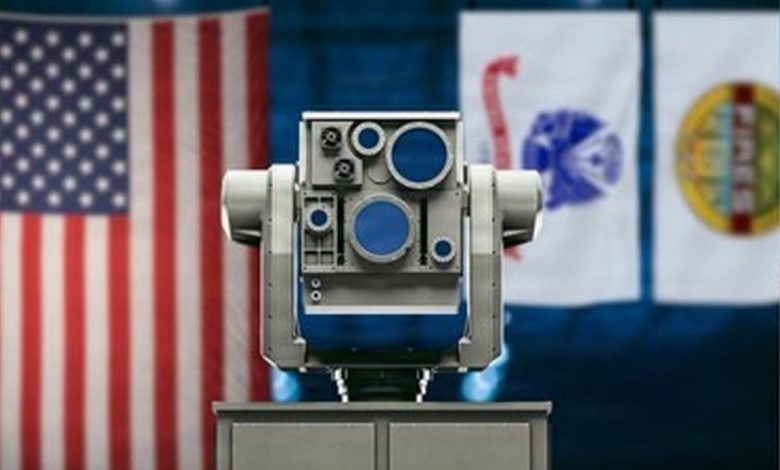
The U.S. Army awarded a $464.8 million production contract to AeroVironment, Inc., this week for the Enduring-High Energy Laser program (E-HEL), marking the first production contract for a directed energy system in the U.S. military’s history, the company stated in a release Wednesday.
Rather than deploying missiles to shoot down unmanned aircraft, the E-HEL fires a laser beam at its targets and can reload its magazine through the system’s power supply, according to the Army.
“This first-of-its-kind directed energy program will enable our formations to defeat unmanned systems and dominate from the outset,” Vice Chief of Staff of the Army General Christopher LaNeve said in an Army statement. “Pairing human ingenuity with advanced technology is what ensures our Army will continue to outpace America’s adversaries.”
Under the Other Transaction Agreement, AV will deliver dozens of 30 kW LOCUST laser weapons capable of taking down smaller drones that fit within what the Defense Department characterizes as groups one through three. Those include miniature UAVs comparable to the Air Force’s Wasp III to the Army’s RQ-7B Shadow in the larger class.
The E-HEL production announcement also notches a much-needed win for the service’s laser program, following soldiers’ disappointing feedback on the Army’s Directed Energy Maneuver Short-Range Air Defense (DE M-SHORAD) performance in the Middle East.
While those prototypes were tailored for the Stryker combat vehicle, AV’s LOCUST X3 laser weapon is platform-agnostic and can fit on the Army’s Joint Light Tactical Vehicle (JLTV).
The E-HEL program builds on the success of the Army Multi-Purpose High Energy Laser (AMP-HEL) prototypes currently in use by U.S. soldiers.
The contract follows LOCUST’s successful testing at White Sands Missile Range, led by Joint Interagency Task Force 401 (JIATF-401) and PAE Fires, which demonstrated safe, effective counter-drone operations in U.S. airspace and directly enabled a DOW–FAA safety agreement validating the system for domestic use.