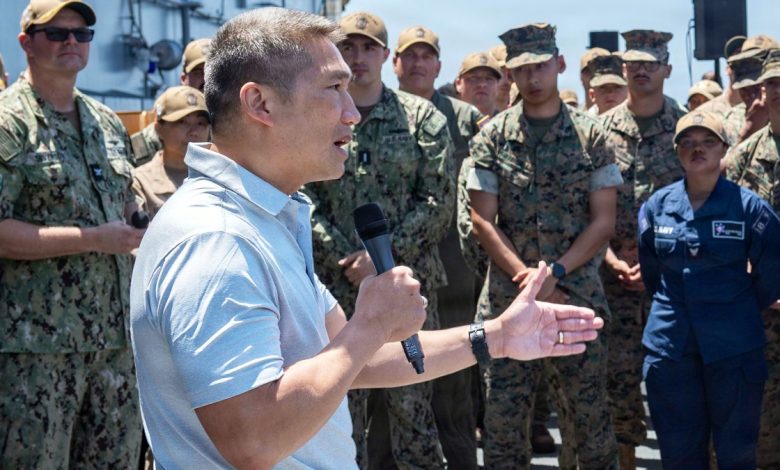
Acting Navy Secretary Hung Cao told a gathering of officers and senior enlisted Marines in North Carolina that they need to do more as front-line leaders to address the rate of suicides. The comments came during Cao’s first public appearance after being formally nominated as Navy secretary Tuesday, a role he has held in an acting role since April.
Cao traveled to Camp Lejeune Wednesday with Marine Corps Commandant Gen. Eric Smith and other senior leaders. The group spent close to two hours in two town halls focused on suicide prevention and mental health.
“It’s a leadership issue, and I’m not blaming you for anything. I’m saying you need to know your Marines really well,” Cao said to a crowd of several hundred Marines stationed at the base. “I need for you guys to know your Marines so well that you know how they smell, when they breathe, and when they walk up, you can hear them behind you. But also when they’re hurting, to be able to pull aside and say, ‘Come here, Marine. Let’s walk for a second here.’”
At Camp Lejeune, Cao and Smith were joined by Sergeant Major of the Marine Corps Carlos Ruiz, Pentagon special assistant and Medal of Honor recipient Dakota Meyer, and Cao’s senior advisor for mental health. Cao said he is planning other town halls with senior leaders at major Navy and Marine Corps bases in the coming months.
A Task & Purpose reporter traveled with the group to the events.
Though suicide numbers across the military dipped in 2024, the long-term rates have trended upwards since 2011. Pentagon officials say that 472 service members died by suicide in 2024, the most recent year for which data has been released, a decline from the previous year. The Pentagon’s official 2025 report is scheduled to be released this fall, but a quarterly report from the final months of that year showed an increase among active-duty and Reserve sailors and Marines over the year before.
Commandant urges ‘intrusive leadership’ as prevention
At Lejeune, Gen. Smith urged the room of officers and NCOs to practice more “intrusive leadership,” charging the group to learn more about their Marines, their spouses and children, financial needs, stressors, and histories, and to “take risks.”
“No one is going to fault you for being intrusive and getting into the lives of your Marines and your sailors. No one is going to fault you for that. If you get an [Inspector General] complaint, fine. Get an IG complaint. It will be the first of many as a leader,” Smith said.
Meyer, also a Marine Corps Reserve sergeant, had a similar message and told the group to focus on “taking care” and “showing up for each other.”
“We have leadership problems that’s failing a generation. My NCOs took care of me. My NCOs raised me up,” he said. “They were available 24/7. They showed up to be my solution. They didn’t outsource it. They didn’t look for another program. They didn’t look for a phone number to call when I had a problem.”
The in-person town halls came as Cao and the Navy face growing questions on mental health in the ranks amid the USS Abraham Lincoln’s current deployment, which has included at least one suicide attempt among the crew. The extended deployment has been dogged by reports of food shortages, moldy showers and missed mail, and deteriorating mental health among sailors. A sailor who attempted to jump overboard is now facing non-judicial punishment. Navy leadership initially pushed back on those reports but subsequently sent more mental health help and acknowledged that the lack of port calls added to the crew’s strife.
More chaplains, different programs
Cao has been the acting Navy Secretary since John Phelan left the role in April. On Tuesday, Cao’s nomination was officially announced via social media by President Donald Trump. He still faces a Senate confirmation hearing.
When Cao testified in front of a Senate committee in May, he promised to take care of and invest in people. One of his goals was to establish a Suicide Prevention and Response Task Force to examine existing programs, identify gaps, and recommend new ideas.
Todd Peters, Cao’s senior advisor for mental health and suicide prevention who sits on the task force, told Task & Purpose that the group is meeting once a week and in the process of coming up with policy recommendations for which programs to grow and cut.
One program that Peters said they’re looking to bring to the Navy and Marine Corps is one that’s found success in the Air Force. Wingman Guardian Connect focuses on building peer-to-peer connections and has airmen talk through different scenarios as a group with a facilitator. The program was developed by University of Rochester medical experts who have also brought it to first-responder groups and predominantly Black churches. University experts described it as more “active” prevention training rather than the “passive” approach or what a Pentagon-led committee called a “one-size-fits-all” method of presenting PowerPoints to troops in dark auditoriums.
Subsequent studies have found that the Air Force program reduced suicide-risk scores, depression symptoms, and work-related stressors and “counteracted standard drift towards disconnection” for airmen who were considered “at-risk.”
“It’s the only program that had 10 years of research data points to prove that it worked. The Air Force used it, and it drastically reduced the numbers. It’s measurable,” Peters said. “There’s two gentlemen for the Navy and the Marines. Their job is to make it fit the Marine Corps language and the Navy language.”
Peters also said he is advocating for the Navy to grow its chaplain corps. To date, he said, 25 new positions have been approved for the next fiscal year. Peters, who is a retired Navy SEAL and pastor, said he’s submitted a recruiting plan to the Navy Secretary with the intent to grow the corps.
“What I’ve learned from every Marine and sailor so far is they all love chaplains, and they wish they had more. And when I looked at the numbers, the Army has twice the number of chaplains. They have 1,800 to our 980, and we have more people to serve and care for,” he said. “I put a package together because, again, I’m fluent in that world as a pastor. Well, let’s go recruit.”
If you’re thinking about suicide, are worried about a friend or loved one, or would like emotional support, the Lifeline network is available 24/7 across the United States. Reach the National Suicide Prevention Lifeline by calling or texting 988 and you’ll be connected to trained counselors.