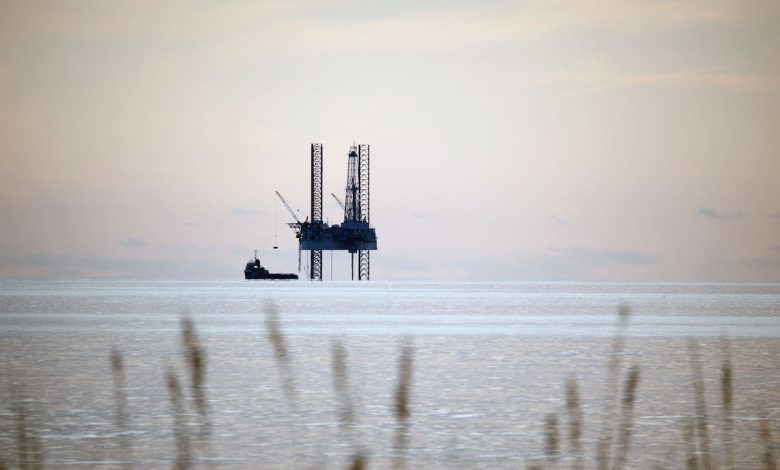
The U.S. Air Force is looking to repurpose offshore oil rigs into landing platforms to recover rocket boosters launched by the U.S. Space Force and private spaceflight companies.
The proposal, called Project Able Baker, would solve two problems, the Air Force said. First, the new Sea-Based Recovery Stations would offer a cheaper way of retrieving reusable heavy-lift rockets so they can be launched again. And, it would provide a new purpose and refurbishment for decommissioned oil platforms before they become environmental hazards.
“This approach aims to provide the U.S. Space Force and its commercial partners with a distributed network of recovery sites that enhance launch cadence, reduce sonic-boom exposure, and leverage existing maritime infrastructure to lower operational costs,” according to an Air Force solicitation posted through the Small Business Innovation Research program.
The Air Force sees these old oil platforms as an alternative to using ships to recover rockets — a method used by companies like SpaceX. One benefit would be “reducing dependence on expensive, custom-built drone ships and facilitating higher launch frequencies,” the solicitation says.
To accomplish this, old oil rigs must be strengthened to handle the “specific plume, vibration, and high-intensity point-load dynamics” of modern rockets, such as SpaceX’s Falcon 9, United Launch Alliance’s Vulcan and Blue Origin’s New Glenn, the Air Force said. The rockets are capable of sending heavy equipment into orbit.
Other desired features of the offshore oil platforms include “passive/active flame deflection, remote fire suppression systems, and precision navigation aids for autonomous landing guidance.”
In addition, these platforms should have “integrated barge or Vertical Takeoff and Landing systems to move boosters from the landing pad to transit vessels.”
The first phase of the solicitation calls for companies to establish the technical and economic feasibility of the concept. The focus is on “structural load analysis, environmental impact assessment, and the development of a regulatory roadmap for operations in federal waters.”
Companies may also be asked to identify at least three offshore platforms that can handle heavy-lift rockets.
Part of the assessment process should include the impact of sonic booms on nearby shipping and coastal populations, as well as the impact on the local ecosystem, the Air Force said. The platforms must align with the federal government’s Rigs to Reefs initiative to turn decommissioned oil rigs into aquatic habitats.
The second phase would involve fabricating and installing “a modular reinforcement kit on a representative deck section of an offshore structure to validate construction techniques and material resilience,” said the SBIR. Testing would use “inert-mass drops (10—25 tons) or static-fire simulations —to capture high-fidelity strain, vibro-acoustic, and plume-interaction data.”
The Project Able Baker SBIR has an unusually detailed list of potential dual-use benefits for the government and commercial sectors.
With the number of space launches and orbital satellites soaring in recent years, the Air Force envisions a series of converted oil platforms that can ease the strain on land-based sites to speed up the entire launch and recovery process.
“By repurposing legacy offshore assets, the system provides a strategic alternative to traditional coastal launch-landing operations, significantly increasing launch cadence while reducing acoustic and debris risks,” the SBIR said.
It would also enable Tactically Responsive Space capabilities “in deep-sea or high-latitude environments, critical for responsive space access.”
China is already building offshore platforms to recover heavy rockets.
Perhaps anticipating scrutiny from environmentalists, the Air Force emphasizes that the Sea-Based Recovery Station concept is an “environmentally conscious solution.”
There are “hundreds of offshore oil and gas platforms in federally controlled waters are reaching the end of their operational lifecycle,” the Air Force said. “Traditional decommissioning and full-removal processes are capital-intensive, costing upwards of $1.6 billion per platform, and often cause significant disruption to established marine ecosystems.”
Michael Peck is a correspondent for Defense News and a columnist for the Center for European Policy Analysis. He holds an M.A. in political science from Rutgers University. Find him on X at @Mipeck1. His email is [email protected].