Editor’s note: This story originally appeared on Laser Wars, a newsletter about military laser weapons and other futuristic defense technology. Subscribe here.
Operation Epic Fury may have strengthened the case for directed energy weapons, but the U.S. Navy’s dream of putting “a laser on every ship” may take significantly longer than expected to realize.
In a posture statement delivered to the House Armed Services Committee on May 14, Chief of Naval Operations (and noted directed energy champion) Adm. Daryl Caudle delivered a forceful argument for why high-energy laser weapons are a necessity for the sea service — namely, to take over missile defense from kinetic interceptors and free up space for offensive weapons across the Navy’s Arleigh Burke-class destroyers, which he proclaimed “the workhorse of the surface Fleet, as illustrated clearly by Operation Epic Fury.”
“Directed energy is a critical component of future naval warfare, particularly for ballistic missile and terminal defense,” Caudle stated. “The current paradigm, which forces a trade-off between defensive interceptors and offensive strike weapons within the limited space of the Vertical Launching System (VLS), is unsustainable. Every VLS cell used for a defensive missile is a lost opportunity for a long-range offensive strike.”
But Caudle’s testimony also contained an admission that the dream of a laser fleet remains a dream deferred — at least, until the Navy can actually build it.
The vision of a laser fleet Caudle laid out in his posture statement is anchored in the Navy’s proposed nuclear-powered battleship and future surface combatants, platforms that must be “designed with the power and cooling capacity necessary to scale these systems to very high energy levels, thereby providing lethality against exquisite threats.”
To translate those designs into real-world capabilities, the service “must prioritize and fund R&D for compact, high-density energy storage and thermal management systems capable of handling the demands of [directed energy weapons],” he said, as well invest in “digital engineering and land-based test facilities to de-risk the complex integration of DEW systems with legacy combat and ship control systems.”
The structural reason for Caudle’s emphasis on future warships is one Laser Wars readers will recognize immediately: the Navy’s current surface fleet — including its most modern warships, the Flight III Burke-class destroyers — simply cannot support the power demands of laser weapons at scale.
As the service’s then-surface warfare boss Rear Adm. Ron Boxall bluntly put it back in 2019, the Flight III Burkes are already “out of Schlitz with regard to power,” their generators fully committed to feeding the new AN/SPY-6 Air and Missile Defense Radar system.
Caudle isn’t pretending a viable laser weapon for missile defense can be engineered around existing hulls; they must be built into the next generation of warships from the keel up.
The implication is stark: the first vessel in America’s true laser fleet won’t set sail until the first battleship or next-generation frigate steams out of a shipyard. Battleship procurement isn’t planned until 2028, with delivery to the fleet projected for the 2030s, if at all.
The Navy may see directed energy as a critical capability, but don’t expect it to show up on any active warships outside of its existing Optical Dazzling Interdictor, Navy (ODIN)-equipped fleet anytime soon.
None of this makes Caudle’s urgency any less real. Indeed, Epic Fury offers the most vivid illustration yet of exactly why he feels it so acutely.
Consider the Presidential Unit Citation recently awarded to the USS Gerald R. Ford Carrier Strike Group. According to the citation, nine surface combatants — eight as part of Destroyer Squadron 2, plus the USS Winston S. Churchill — fired 207 Tomahawk Land Attack Missiles at Iranian targets between February 28 and May 1.
Assuming all of these combatants were Arleigh Burke destroyers with 96 VLS cells apiece, that’s a potential combined ceiling of roughly 864 cells, with those 207 Tomahawks representing roughly one offensive strike weapon for every four cells.
The citation makes clear where the rest of the magazine went: the strike group “protected vital sea lines of communication while under persistent threat from enemy missiles and one-way attack drones,” meaning the remaining cells were loaded with (and presumably expending) the defensive interceptors required to keep the formation in the fight.
This is Caudle’s unsustainable paradigm in action: the destroyers that prosecuted one of the most significant U.S. naval combat operations since World War II potentially went into the fight with roughly three-quarters of their magazine committed to self-defense.
And once those interceptors are spent, they are not easily replaced. Unlike fuel or food, vertical launch weapons cannot be reliably transferred at sea under operational conditions. The Navy has been pursuing an underway VLS reloading capability through its Transferrable Reload At-Sea Method (TRAM) program, but the system is not yet operationally fielded.
The directed energy solution to this problem is, in theory, elegant: a laser weapon defending a warship at $10 per shot leaves every VLS cell free for Tomahawks for offensive strikes and SM-6s for remaining high-end threats, converting the destroyer from a platform split between offense and defense into one optimized for offensive power projection.
“Every VLS cell used for a defensive missile is a lost opportunity,” Caudle told lawmakers — and directed energy, as he envisions, eliminates the choice. The problem is that the ships capable of hosting those laser weapons at the power levels required haven’t been built yet.
Caudle’s posture statement does offer something of a bridge between the Navy’s current surface combatants and the laser fleet of the future: the Containerized Capability Campaign (C³), an initiative he describes as enabling “missiles, unmanned systems, sensors, electronic warfare packages, and directed energy” to be deployed across “a wide range of platforms and shore sites” without major structural redesigns.
Caudle explicitly frames containerization as a workaround for the power and integration constraints that make bolting high-energy laser weapons onto existing warships so difficult.
It “decouples payloads from platforms,” as he puts it, allowing the Navy to “adapt capability faster than traditional acquisition timelines” and deliver combat power “at the speed of relevance — not the speed of platform-centric acquisition.”
Caudle had previously made the vision concrete at the McAleese Defense Programs conference in Arlington, Virginia in March: “From towed array sensors to drone swarms to electronic attack systems to high-powered lasers, I want to containerize everything.”
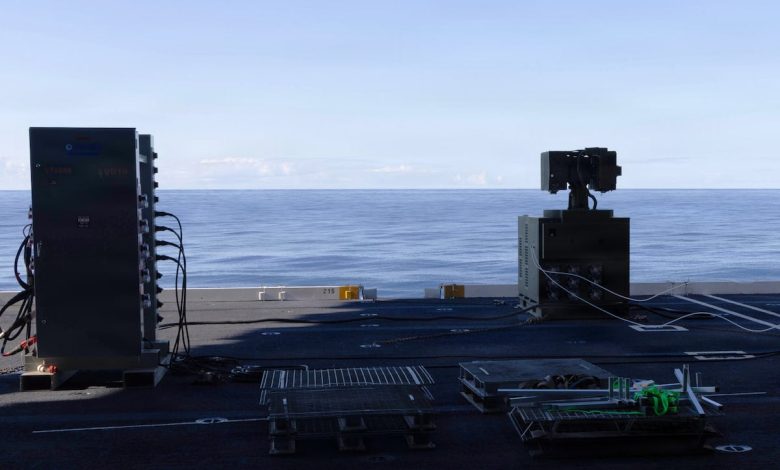
There is evidence to support this approach. In October 2025, the Navy conducted a successful live-fire test of the palletized 30 kW LOCUST Laser Weapon System from the flight deck of the Nimitz-class aircraft carrier USS George H.W. Bush, demonstrating that a containerized laser could draw cleanly from a carrier’s nuclear reactors without the issue that plagues the Burke fleet.
Lockheed Martin, meanwhile, is developing a containerized version of the service’s lone 60 kW High Energy Laser with Integrated Optical Dazzler and Surveillance (HELIOS) system currently installed aboard the destroyer USS Preble specifically so the system can be seamlessly transferred across vessels in maintenance rather than sitting idle pierside.
The Navy’s fiscal year 2027 budget request also supports the “development, integration and marinization” of the U.S. Army’s Enduring High Energy Laser (E-HEL) systems for potential shipboard applications.
The most significant containerized effort reaches considerably higher up the power curve. The Joint Laser Weapon System (JLWS) — the collaboration between the Army and Navy whose existence Laser Wars first reported in June 2025 — is designed from the outset as a containerized system, initially aiming for 150 kW with potential to scale to at least 300 kWs specifically for cruise missile defense, according to the Navy’s fiscal year 2027 budget request. The system will also include a Joint Beam Control System capable of supporting a 300-500 kW weapon.
Together, the Army and Navy have outlined a vision of $675.93 million in combined R&D spending through fiscal year 2031, with the Navy planning to award the first JBCS development contracts as soon as the fourth quarter of 2026. If JLWS delivers on its promise, it would represent a containerized laser weapon powerful enough to engage the missile threats that sit at the heart of Caudle’s VLS argument without requiring a keel-up redesign.
What Caudle’s testimony describes, then, are two directed energy tracks running in parallel — with a third, more tentative one emerging between them.
One narrative is near-term and modest: containerized, lower-power systems like LOCUST and even HELIOS, deployable across the surface fleet now and effective against the ever-expanding drone threat.
The second is transformational and distant: megawatt-class systems embedded in the hull of a battleship that won’t reach the fleet for close to a decade.
The JLWS represents an attempt to thread the needle between them with a containerized missile defense capability that could arrive before the battleship does.
For Caudle and his fellow Navy leaders, Epic Fury may have crystallized a need for a laser fleet that matches their ambition for one.
Time will tell if they can actually build it.
Jared Keller is a Los Angeles-based military technology writer and author of the Laser Wars newsletter.