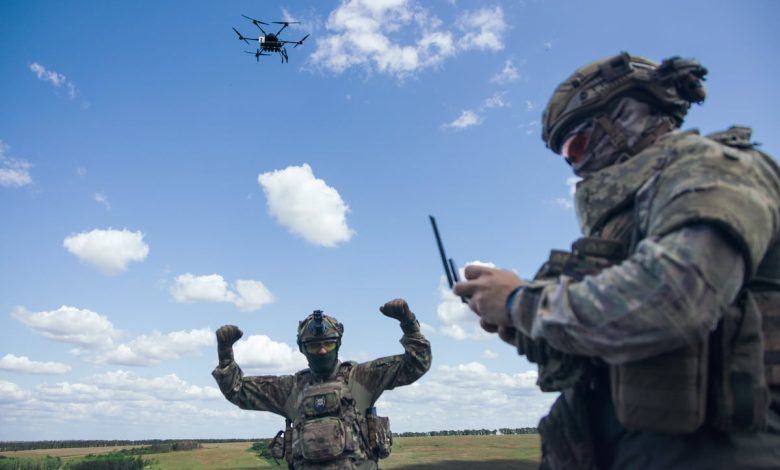
The Pentagon on Tuesday announced 25 small technology and drone companies that will compete for a chance to quickly field thousands of low-cost one-way attack drones for the military.
Kratos SRE Inc., a subsidiary of Kratos Defense, and Halo Aeronautics are among the more than two dozen vendors taking part in the first phase of the Defense Department’s Drone Dominance Program, the department said in a statement.
“Drone dominance is a process race as much as a technological race,” Defense Secretary Pete Hegseth said in a July 2025 memo that the department highlighted. “We are buying what works — fast, at scale, and without bureaucratic delay. Lethality will not be hindered by self-imposed restrictions.”
Hegseth’s memo followed a June 2025 executive order signed by President Donald Trump that spelled out ways for the U.S. to improve its military and commercial drone capabilities, focusing on inexpensive, American-made combat drones.
The evaluation for the first phase, which the DOD dubbed the Gauntlet, will start Feb. 18 at Fort Benning, Georgia, and finish in early March. After military operators fly and evaluate the proposed vendors’ systems, the department will place about $150 million in orders for prototype drones.
Those prototypes will be delivered over the following five months, per the DOD. The department said in an early December release that it planned to have 12 vendors produce a total of 30,000 drones, at $5,000 per unit.
Hegseth’s Drone Dominance Program, which was rolled out in early December with a request for information, aims to quickly and inexpensively acquire hundreds of thousands of one-way attack drones by 2027.
Ukraine has used such “kamikaze” drones extensively in its fight against Russia’s invasion over the last four years, and it has drawn attention to their effectiveness in a modern war.
Hegseth said in December that the military can’t afford to continue to use costly munitions worth millions of dollars apiece to take out inexpensive enemy drones, and that a cheaper arsenal of attack drones is critical.
The Pentagon expects to spend $1.1 billion on the program over its four phases and wants to have “warfighters” be the ones evaluating how well potential drones work.
The department intends to buy large amounts of drones on a regular schedule, which will create a stable demand signal allowing industry to build out its own capacity.
The following three phases will see the number of vendors decline from 12 to 5, the DOD said in December, as the number of drones ordered will grow to 150,000 and the price will drop to $2,300.
The competitive cycles for improving these drones will be “measured in months, not years,” the Pentagon said.
The companies competing in “Gauntlet I” are:
- Anno.Ai Inc.
- Ascent Aerosystems Inc.
- Auterion Government Solutions Inc.
- DZYNE Technologies
- Ewing Aerospace
- Farage Precision
- Firestorm Labs
- General Cherry Corp.
- Greensight Inc.
- Griffon Aerospace Inc.
- Halo Aeronautics
- Kratos SRE
- Modalai Inc.
- Napatree Technology
- Neros Inc.
- Oksi Ventures Inc.
- Paladin Defense Services
- Performance Drone Works
- Responsibly LTD
- Swarm Defense Technologies
- Teal Drones Inc.
- Ukrainian Defense Drones Tech Corp.
- Vector Defense Inc.
- W.S. Darley & Co.
- XTEND Reality Inc.
Stephen Losey is the air warfare reporter for Defense News. He previously covered leadership and personnel issues at Air Force Times, and the Pentagon, special operations and air warfare at Military.com. He has traveled to the Middle East to cover U.S. Air Force operations.