NEW DELHI — Pakistan has commissioned the first of eight advanced Chinese submarines, marking a significant step in strengthening its maritime capabilities and deepening defense cooperation with its close ally Beijing.
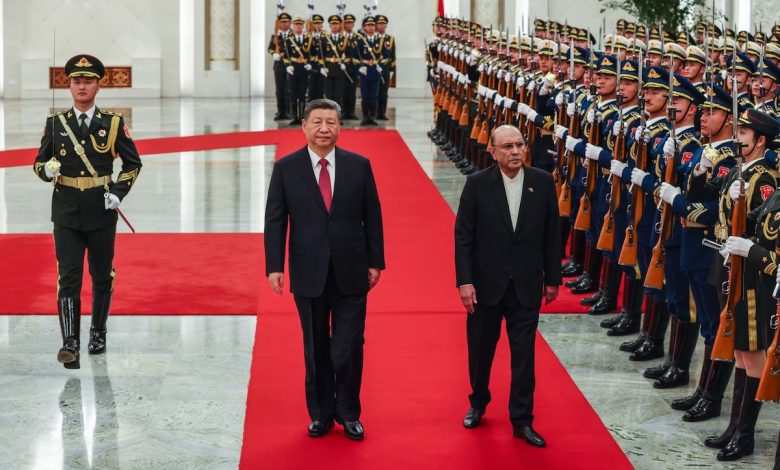
A ceremony to commission the attack submarine called Hangor was held in the Chinese city of Sanya on April 30 in the presence of Pakistani President Asif Ali Zardari and navy chief Naveed Ashraf as well as senior Chinese military officials, according to a Pakistani statement. Sanya, a port city, hosts a major submarine base of the People’s Liberation Army.
The diesel-electric Hangor-class submarine is an export variant of China’s 039A Yuan-class submarines. It has a displacement of approximately 2,800 tons. Armed with advanced sensors, torpedoes and anti-ship cruise missiles that can strike surface warships, submarines and land-based facilities, these Air-Independent Propulsion (AIP) conventional boats aim to enhance the Pakistan navy’s undersea warfare capability. The AIP submarines can remain under water significantly longer without needing to surface.
The deal for the eight Chinese submarines, struck in 2015, is estimated at $5 billion. Four boats are being built in China and the remaining four will be built in Pakistan under a technology-transfer agreement. All four Chinese-built boats are scheduled to be inducted by 2028.
Pakistani President Zardari described the commissioning of the first Chinese attack submarine as a “historic milestone” in the South Asian country’s naval modernization. Until now, Islamabad operates a fleet of eight submarines including three mini ones.
RELATED
Pakistan’s navy chief Naveed Ashraf said that the Hangor submarines, equipped with state of the art weapons “will play a pivotal role in deterring aggression and ensuring security of vital sea lines of communication across the Arabian Sea and wider Indian Ocean region.”
India, Pakistan’s main rival, is also upgrading its submarine fleet as the Indian Ocean, a vital global sea lane, becomes a strategic domain where China is increasing its influence — Beijing’s close partnership with Islamabad helps it gain access to the Arabian Sea and the Indian Ocean. New Delhi is expected to seal a deal with Germany to buy six AIP submarines in the coming months.
China’s defense supplies are playing a key role in Pakistan’s military build-up and modernization, as both countries nurture a close partnership with an eye on India, with which both have fought wars triggered by long-standing border disputes.
According to the Stockholm International Peace Research Institute’s global arms transfer database, China supplied approximately 80% of Pakistan’s arms imports between 2021 and 2025. Pakistan also serves as Beijing’s top arms customer, buying as much as 60% of its defense exports.
Chinese weapons also boosting Pakistan’s aerial capabilities — the Chinese J-10C and the JF-17, which is jointly made by China and Pakistan, are the main combat jets in the Pakistan air force. These jets were combat-tested for the first time during a four-day conflict between India and Pakistan last year. Pakistan claimed that it had shot down Indian fighter jets including Rafale aircraft with the J-10. Both India and Dassault Aviation, the French company which manufactures the jets, denied the claim.