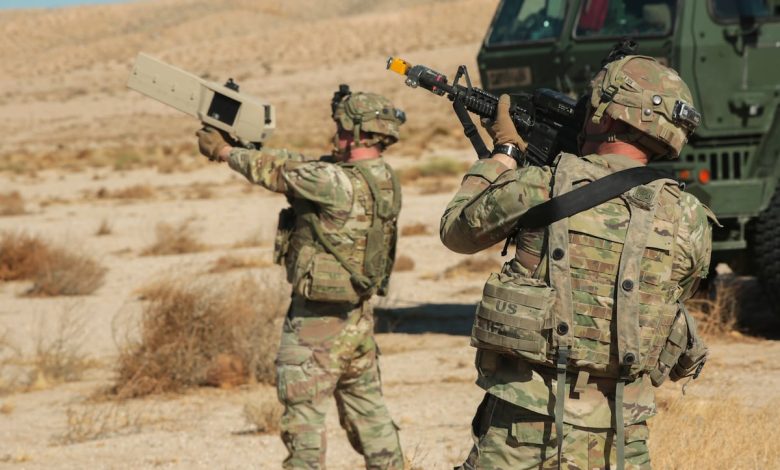
Major military installations in the United States are unprotected from drone attacks, despite policies that mandate otherwise, a Pentagon watchdog report warns.
The problem appears to be bureaucratic confusion over which bases should be covered, according to a Jan. 20 Department of Defense Inspector General report. The result is some startling lapses in counter-unmanned aerial system defenses, even at installations that have experienced multiple drone incursions.
For example, Luke Air Force Base, Arizona, “where F-35 training takes place for 75 percent of the world’s F-35 pilots, is not designated as a covered facility or asset,” according to the report.
RELATED
Under Section 130i, Title 10, of the U.S. Code, counter-drone defense is mandated for installations that fall under one of nine categories that range from nuclear missiles to weapons testing facilities. But training bases are not on the list.
“DOD officials told us that training is not covered,” the report said. “Therefore, the installation officials cannot use C-UAS capabilities to prevent [unmanned aerial system] activity while training on the F-35s.”
Officials investigated 10 Defense Department sites that have suffered drone incursions, including the Air Force’s Plant 42 in Palmdale, California, a government-owned, contractor-operated facility that produces spare parts for the Global Hawk and other drones. The plant, which suffered several drone incidents in 2024, is included on the Air Force’s list of covered sites. But “Air Force officials told us that Plant 42 is not covered, while “DOD officials could not tell us whether or not it is covered,” the report noted.
The report also cited the Supervisor of Shipbuilding, Conversion and Repair, USN, Newport News facility, where contractors perform construction and maintenance of aircraft carriers and submarines. The report — which was heavily redacted — blocked out details on any incidents there. But unidentified drones flew for weeks over military installations in Virginia in 2024, generating fears that it could be a prelude to something more sinister.
A 2020 DOD memo requires C-UAS packages to be tested in an operational setting before being submitted for Section 130i approval. But the various armed services have different policies for submitting those packages, such as different requirements for organizational and leadership approvals.
“Therefore, a large percentage of installations do not have operational approval to use C-UAS capabilities,” the report noted.
DOD has also issued more than 20 policies that failed to offer clear guidance regarding C-UAS deployment on U.S.-based installations, according to the report.
In 2025, DOD established the Joint Interagency Task Force 401 to coordinate C-UAS efforts. The DOD IG recommended that the new task force review existing policies and issue a “consolidated DoD policy that defines: (1) clear roles, responsibilities, and authorities; (2) requirements for covered designation for facilities and assets; and (3) a standardized and streamlined process for section 130i packages.”
The findings of the IG report match those from a series of wargames conducted by the U.S. Army’s Joint Counter-Small Unmanned Aircraft Systems Office and the RAND Corp. think tank. The exercises studied the drone threat to military bases in the U.S.
Researchers found a hodgepodge of varying policies, such as rules of engagement for disabling drones, between the 500 or so military bases in the U.S. Under Section 130i, some base commanders had authority to shoot down marauding drones, while others could face criminal prosecution.
The JCO/RAND study also found confusion over who has responsibility for protecting bases. The wargames “emphasized the need for a framework to integrate, enable, and synchronize state, local, tribal, and territorial authorities into counter-drone operations at or near military bases,” researchers said.
The vulnerability of bases in the U.S. has become a concern after last year’s Operation Spiderweb, in which Ukrainian drones attacked airbases and destroyed parked aircraft deep inside Russia. Experts worry that if Ukraine could smuggle drones into Russia aboard trucks and launch a surprise attack, terrorists and other adversaries could do the same in the U.S.
Michael Peck is a correspondent for Defense News and a columnist for the Center for European Policy Analysis. He holds an M.A. in political science from Rutgers University. Find him on X at @Mipeck1. His email is [email protected].