Amid focus on Strait of Hormuz, experts sound warning on Yemen’s Houthis and Red Sea

The world’s attention is fixed on the Strait of Hormuz now that the U.S. Navy is blockading the crucial shipping channel at President Donald Trump’s behest. But some foreign policy experts warn that the strait is not the only potential choke point that Iran and its proxies could leverage.
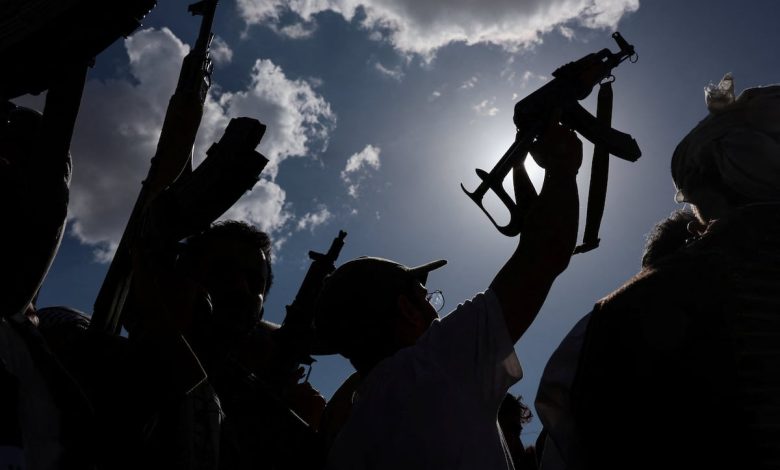
In particular, they cite the Bab el-Mandeb Strait, which sits at the mouth of the Red Sea just off the coast of Yemen. The waterway is highly susceptible to attack from the Iranian-backed Houthis, who control most of Yemen.
“The Houthis are the ones who pioneered, in a way, this idea of using asymmetric capabilities to disrupt maritime traffic,” Mona Yacoubian, the director of the Middle East Program at the Center for Strategic and International Studies, said in an interview with Military Times. “It has to be the right set of circumstances, but we could potentially see a situation in which they choose to engage on Red Sea shipping and ships attempting to cross the Bab el-Mandeb and also — by virtue of which way the water flows — the Suez Canal.”
Skeptics fear that if the Houthis stepped fully off the sidelines and into an aggressive posture on Bab el-Mandeb, another economic shock would result. This, in turn, would greatly complicate Trump’s desire to claim a victory in the war on Iran that began with combined U.S. and Israel strikes on Feb. 28.
Elisabeth Kendall, president of Girton College at the University of Cambridge, said that the Houthis’ restraint thus far should be seen as strategic patience, not avoidance.
“The reality is that asymmetric warfare suits the Houthis. They don’t need to be accurate or sophisticated. They just need to harass shipping to achieve their goal of disrupting trade and pressuring the U.S.,” Kendall told Military Times. “The Houthis are seasoned fighters. They have been at war — on and off — for over 20 years. Their battle logic is unlike our own inasmuch as war has become a way of life and they are relatively comfortable with absorbing casualties.”
Kendall explained that a Houthi attempt to close the Bab el-Mandeb Strait would “likely prompt a further spike in oil prices and, in time, inflation,” significantly ramping up pressure on Trump.
This all takes place against the backdrop of a fragile ceasefire between the U.S. and Iran. After peace talks reached an impasse over the weekend, Trump recalibrated his strategy, aiming to turn the tables on Iran’s economy by seizing control of the Strait of Hormuz.
On Sunday, the president said the U.S. Navy would begin blockading “any and all ships trying to enter, or leave,” the strait. By Monday, U.S. Central Command had refined the operational scope to only apply to vessels bound for or departing Iranian ports. CENTCOM stressed that it would not impede on the freedom of navigation and will be “enforced impartially.” The Pentagon has not explained how the mission would be carried out.
Under international maritime law, naval forces have the right of visit and search, which authorizes them to board vessels — regardless of flag — to determine their “enemy character.” This categorization hinges on whether ships are materially supporting Iran’s war effort, including through arms transfers or financing. If so, they may be subject to diversion or capture by U.S. forces.
James Kraska, professor of international law at the Naval War College, told Military Times that the approach essentially constitutes an expansion of longstanding bipartisan sanctions targeting the Islamic Revolutionary Guard Corps.
“The U.S. sanctions are so aggressive that it’s sanctioned other entities that aid or facilitate transactions that benefit Iran,” Kraska said.
He added that he sees the blockade and the American assertion of the right of visit and search as “simply a wartime extension of what we’ve been doing for a decade. It’s economic warfare.”
Trump’s blockade is expected to cost Iran roughly $435 million a day — or $13 billion a month — Miad Maleki, a former official with the Treasury Department, wrote in a post on X.
Vice President JD Vance has argued that with this move, Trump has flipped the script on the Islamic Republic.
“What [the Iranians] have done is engage in this act of economic terrorism against the entire world,” Vance said in an interview with Fox News on Monday. “They’ve basically threatened any ship that’s moving through the Strait of Hormuz. Well, as the president of the United States showed, two can play at that game.”
Tanya Noury is a reporter for Military Times and Defense News, with coverage focusing on the White House and Pentagon.