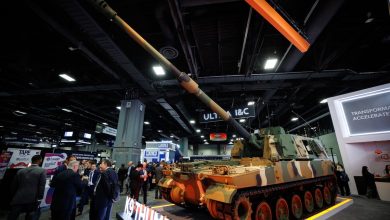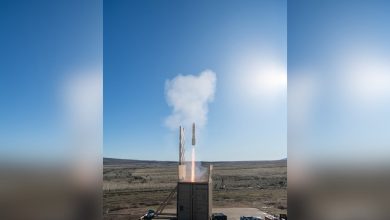
NEW TAIPEI CITY, Taiwan — A U.S. strategy aimed at prioritizing foreign arms sales to recipients that vigorously support themselves and have geopolitical value to Washington should help Taiwan receive advanced weapons faster than usual, according to defense analysts.
While it does not call out any country or contain granular details for evaluating them for weapon sales, experts said the America First Arms Transfer Strategy ordered by U.S. President Donald Trump on Feb. 6 probably applies to Taiwan because it fits the strategy’s overall intent.
“The basic logic is that the United States will only prioritize military assistance to countries that contribute their own defense rigorously, and Taiwan would fit itself into that category at least for the time being,” said Alexander Huang, a Taiwanese university professor and chairman of the Council of Strategic and Wargaming Studies in Taipei.
The White House developed its strategy to “ensure” that future arms sales generate capital to build up American weapons production and that the United States has capacity to support allies and partners, “especially as we increase burden-sharing.”
RELATED
It calls for avoiding arms sales backlogs that would impact allies or partner readiness and for prioritizing sales and transfers to partners that have “invested in their own self-defense and capabilities, have a critical role or geography in United States plans and operations, or contribute to our economic security.”
Scholars say Taiwan has a “critical role” as an informal yet staunch ally in a chain of Western Pacific U.S. allies. Those allies, particularly Japan and the Philippines, are often seen together as a bulwark against Beijing’s maritime expansion.
“The strategy shifts from first-come delivery to prioritization based on strategic relevance and defense investment,” said Nathan Attrill, a senior China analyst at the Australian Strategic Policy Institute. “Given Taiwan’s geography, that could mean faster delivery of key systems and fewer bottlenecks, which is operationally significant.”
Today’s deliveries take time that invites strong backlashe from China, said Denny Roy, senior fellow at the East-West Center think tank in Hawaii. China sees self-ruled Taiwan as part of its territory and has not ruled out the use of force, if needed, to unify the two sides. It resents the United States for helping arm Taiwan.
“The current process is slow, cumbersome and draws maximum PRC attention, increasing the likelihood of an intensified reaction from Beijing driven by nationalistic public opinion,” Roy said.
Washington’s arms sales to Taiwan date back to 1979, and Taipei said in December it would buy an unusually large $11.1 billion U.S. package including HIMARS rocket systems. Beijing strongly condemned the sale.
Experts say the new U.S. arms-sales strategy is unlikely to raise or lower the odds of Washington actually coming to help Taiwan if China attacks. The U.S. has long remained vague about how it would respond. China for its part has stepped up naval and air drills near Taiwan since August 2022.
“The American First Arms Transfer Strategy does not make Trump’s adoption of strategic ambiguity more clear,” said Chen Yi-fan, assistant professor in the Diplomacy and International Relations Department at Taiwan’s Tamkang University.
Chen believes the U.S. government already considers Taiwan a lower priority than Ukraine, Israel, North Atlantic Treaty Organization (NATO) countries and Asian allies Japan, South Korea, and the Philippines.
“If it accelerates delivery of munitions and strengthens Taiwan’s capabilities, (the strategy) could improve deterrence by denial by making a rapid Chinese victory less plausible,” Attrill said. “But the decision to intervene would still depend on presidential judgement and escalation risks.”
The strategy’s focus on sales that fortify the American defense industry could backfire in Taiwan if it “strengthens the narrative by the Chinese government and by some (Taiwan opposition) politicians that U.S. arms sales to Taiwan are self-serving and exploitative,” Roy added.
A media liaison for Taiwan’s Ministry of National Defense said in late February the ministry had not announced any reaction to Trump’s strategy and declined further comment. The Department of Defense in Washington also did not answer a request for information.