Allies surpassed the US in military budget purchasing power last year, new report shows

VIENNA — America’s allies now outspend it in purchasing power-adjusted defense budgets, a new analysis by the Economist shows.
Using data on global defense budgets collected annually by the Stockholm International Peace Research Institute, SIPRI, the London-based weekly calculated that American allies in the North Atlantic and Indo-Pacific spent 111% of what the U.S. did on its own defense in 2025.
The countries included in the tally are the 31 non-U.S. NATO members plus Washington’s treaty allies in Asia: Japan, South Korea, Thailand, Australia and the Philippines.
For the first time, spending by the U.S. treaty allies surpassed $1 trillion in 2025, adjusted for purchasing power, according to the Economist’s data. In absolute terms, it still lags around $200 billion behind Washington’s own defense spending, despite the year-over-year 7.5% decrease in the Pentagon’s 2025 budget.
America’s NATO allies in Europe and Canada alone don’t quite surpass American defense spending yet, coming in at 81% of the U.S. military budget, the Economist analysis said.
However, while the U.S. military spending has been more or less stagnant for several years, the allies’ defense budgets have seen record growth over the same time period, driven in large part by European rearmament as a consequence of Russia’s war in Ukraine.
The number doesn’t include Ukraine, which is not a NATO member and not a formal U.S. ally, but stood out in the data as the most significant defense spender by percent of GDP: A staggering 40% of Ukraine’s economy went to the military.
War spending in Europe surged 14% from 2024 to 2025, SIPRI’s data showed, making the region the main driver in a global surge in military spending to record levels at $2.9 trillion. Although the U.S. remains by far the largest single military spender – in absolute terms and adjusted for purchasing power – the uptick in budgets across the globe offset the significant reduction in the Pentagon’s own 2025 checkbook.
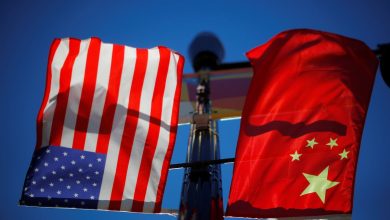
The United States still accounts for more than 20% of total global military spending, with the second-ranked China making up just 12.7%.
Linus Höller is Defense News’ Europe correspondent and OSINT investigator. He reports on the arms deals, sanctions, and geopolitics shaping Europe and the world. He holds master’s degrees in WMD nonproliferation, terrorism studies, and international relations, and works in four languages: English, German, Russian, and Spanish.