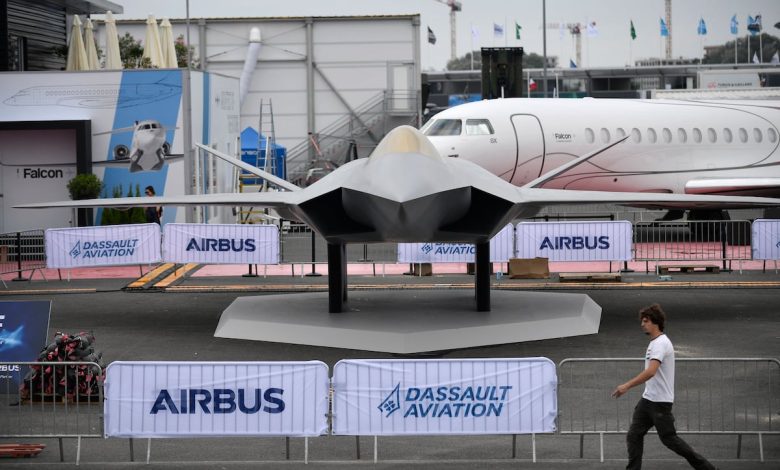
PARIS — Airbus is open to a “two-fighter solution” to break the deadlock on the future air-combat system that France, Germany and Spain are developing, Chief Executive Officer Guillaume Faury said, as work on the next-generation fighter (NGF) that’s part of the program has stalled amid infighting between Airbus and Dassault Aviation.
The Future Combat Air System program, or FCAS, is at “a difficult junction,” Faury said at the Airbus full-year earnings press conference in Toulouse, France, on Thursday. Work is divided into multiple areas, and Faury said other than the future fighter segment, other pillars such as the combat cloud, remote drone carriers and engine are “working well and making good progress.”
“The deadlock of a single pillar should not jeopardize the entire future of this high-tech European capability, which will bolster our collective defense,” Faury said. “If mandated by our customers, we would support a two-fighter solution, and are committed to playing a leading role in such a reorganized FCAS delivered through European cooperation.”
The program for a sixth-generation air combat system, first announced in 2017, has been dragging for years amid disputes over work share, leadership and issues around technology transfer.
Frustrations have mounted recently as a deadline by France and Germany to clarify the program’s future by the end of 2025 slipped by without an announcement.
There are also questions “under a certain governance, on the ability to reach the objective of the program for the different customers,” according to Faury, who said it’s up to the program clients to comment on the that issue.
German Chancellor Friedrich Merz said in an interview this week his country doesn’t currently need the same aircraft as France.
Officials in Paris have stated from early on in the project that the nation requires a fighter able to operate from an aircraft carrier and fire nuclear weapons to ensure sovereign capabilities.
Merz said if the requirement profile can’t be solved, the project can’t be maintained.
Belgian Minister of Defence Theo Francken summarized the Merz interview as meaning “FCAS is dead according to the German Chancellor,” in a social media post, saying there will be no French-German fighter aircraft, and Belgium would reassess its observer status in the program.
“We continue to believe that the program as a whole makes sense and that we should not jeopardize the progress and the relevance of the other pillars,” Faury said. “And we need to find a way forward on the NGF pillar, expecting decisions from customers. And then we’ll see. We are not at the point of deciding next before this step is passed.”
Asked whether Airbus would prefer to develop a new fighter alone, do so together with Sweden, or join the British-Italian-Japanese Global Combat Air Programme, Faury said “we would be wrong to be right too early.” He said Airbus has invested “a lot of time, energy” into the FCAS program.
“We believe if there’s a way forward with two fighters, it could be an opportunity to have other partners with us,” the Airbus executive said. “But it belongs to our customers to decide with whom they want to join forces, would it be the case. Again, we are not yet at that point.”
The European need for an “ambitious” future combat air system is unchanged, according to Faury, who said a project of the scale of FCAS can only be delivered through cooperation.
A number of air forces face the question of whether to move directly to a future of unmanned aircraft, with the risk of becoming irrelevant for a period of time due to a lack of modern manned fighters, or invest “a lot of money” in crewed fighters before moving to the next capability, Faury said.
While autonomous technology is moving fast, “the belief at this stage is that there is still a need for a manned fighter, besides growing capabilities in unmanned flight,” Faury said. He said there is an expectation that at some point “quite far in the future” manned capabilities will be largely replaced by unmanned capabilities.
Regarding the troubled Eurodrone program to develop a long-range drone led by Airbus, Faury said discussions are ongoing between customers “about the way forward,” though he expects the program to continue as the majority of partners still back the project.
France is in negotiations with Germany, Italy and Spain to exit the program, Challenges reported earlier this month.
Rudy Ruitenberg is a Europe correspondent for Defense News. He started his career at Bloomberg News and has experience reporting on technology, commodity markets and politics.