I Am a Retired US Army Special Forces NCO: The M21 Sniper Rifle Put 10 Rounds Inside 10 Inches at 900 Meters — About 1 MOA — Out of a Semi-Automatic Rifle in the Late 1960s
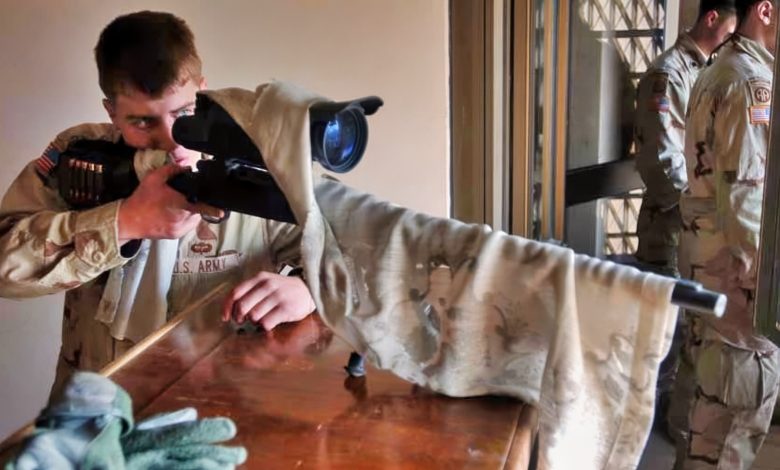
Some rifles are built to win a war. The M21 was built to fix a mistake. By the time American troops were fighting in Vietnam, the U.S. Army had let its sniper program wither away almost completely. The M21, born from a match-grade M14 and a clever scope, brought it back.
The Army Disregarded The Sniper’s Utility
M14. Image: Creative Commons.
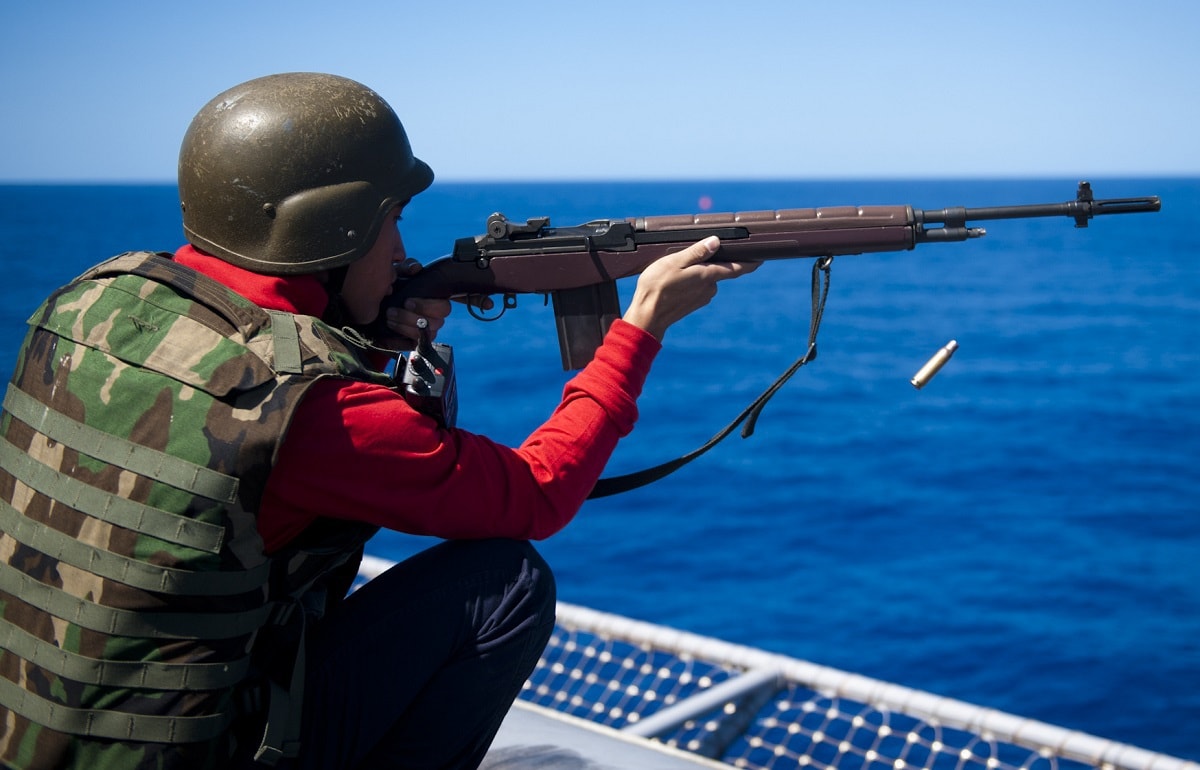
PACIFIC OCEAN (Feb. 12, 2012) Aviation Ordnanceman Airman Justin Fortuno fires an M-14 rifle during a live-fire exercise aboard the Nimitz-class aircraft carrier USS John C. Stennis (CVN 74). John C. Stennis is operating in the U.S. 7th Fleet area of responsibility while on a seven-month deployment. (U.S. Navy photo by Mass Communication Specialist 3rd Class Kenneth Abbate/Released)
The Army fielded capable snipers in World War II and Korea, using the M1903A4 Springfield rifle. But once the shooting stopped, the skill withered.
Cold War planners were focused on nuclear weapons, armor, and massed formations in Europe.
A guy lying in the weeds with a scoped rifle didn’t fit the picture.
It was extremely short-sighted, but it became the norm, not the outlier, in the US military.
Vietnam changed that in a hurry.
The enemy fought in small units, at night, from tree lines and rice paddies.
Infantry units were burning through staggering amounts of ammunition for every enemy soldier killed.
Commanders needed precise, aimed fire, and they needed it fast.
Building A Match Rifle For The Jungle
The Army didn’t have to start from scratch.
The M14 had just been replaced as the standard service rifle by the M16, but the Army Marksmanship Training Unit at Fort Benning had been winning competitions with National Match M14s for years.
So the shooters and gunsmiths of the AMTU, working with the Limited Warfare Laboratory, turned those match rifles into sniper rifles.
The work was meticulous.
They used hand-selected National Match barrels, individually fitted receivers, fiberglass bedding, epoxy-impregnated walnut stocks, and triggers tuned to 4.5 to 4.75 pounds.
The results spoke for themselves.
AMTU technicians shot 10-round groups at 900 meters that measured under 10 inches.
Out of a semi-automatic rifle in the late 1960s. That’s remarkable.
The rifle was fielded as the XM21 and officially adopted in 1972 as the Rifle, 7.62mm, Sniper, M21.
It weighed 11.25 pounds, measured 44.1 inches, and fed M118 match ammunition from a 20-round magazine. They converted roughly 1,400 National Match M14 rifles.
The ART Scope Was Ahead Of Its Time
The rifle was only half the story.
The other half was the Adjustable Ranging Telescope, designed by James Leatherwood.
He took a commercial Redfield 3-9×40 scope and mounted it on a cam system that tied magnification to bullet drop.
Here’s how it worked.
The sniper turned the power ring until a target of known size fit between the stadia lines in the reticle.
As he did, the cam physically tilted the scope to compensate for the drop at that distance, anywhere from 300 to 900 meters.
Put the crosshairs on the target and squeeze the trigger.
No dope book, no clicking turrets.
For a young soldier fresh out of sniper school, that was a huge advantage.
It wasn’t perfect, and it depended on targets being the size the system expected.
However, it was a ranging solution decades before laser rangefinders and ballistic calculators were standard issue.
Fired with the 7.62×51mm M118 Match cartridge and a 173-grain boat-tail bullet, the rifle is extremely accurate, and the M14’s reliability was well documented.
Proven In The Mekong Delta
The 9th Infantry Division set up the Army’s most serious sniper program of the war in 1968, bringing in AMTU instructors to run the school.
Only about half the candidates made it through.
Those who did went to work.
Through March 1969, 54 of the division’s snipers recorded 211 confirmed kills.
The best of them was Staff Sergeant Adelbert Waldron.
Working with the Brown Water Navy in the Mekong Delta, he was credited with 109 confirmed kills, the highest total of any American sniper in Vietnam.
He is credited with a 900-meter shot from a moving boat and once took out nine enemy soldiers in a single night using a Starlight scope. He earned two Distinguished Service Crosses for his work.
None of that happens with a rifle that can’t shoot.
The M21’s Trade-Offs
The M21 had its drawbacks.
At over 11 pounds before you add a scope mount and ammunition, it was heavy to hump through the paddies.
Like any accurized M14, it was sensitive to its bedding condition.
Rough handling in the field could open up groups, and keeping it shooting to standard took care and a good armorer.
The Marines went a different direction, favoring bolt guns like the Remington 700-based M40. Eventually, so did the Army.
In 1988, the M24 bolt-action rifle replaced the M21 as the Army’s primary sniper weapon.
I believe that decision made sense at the time. A bolt-action rifle is simpler to keep accurate.
However, it gave up the quick follow-up shot that made the M21 so valuable in a fluid fight.
The M21 System Came Back
The M14 family never really left. Delta Force sniper Randy Shughart carried an M14 in Mogadishu in 1993, where he and Gary Gordon earned posthumous Medals of Honor defending the crew of Super Six-Four.
When Iraq and Afghanistan heated up, the Army pulled M21s and M14s back out of storage to arm snipers and newly formed designated marksman teams.
The lesson was the same one learned in Vietnam.
In a fight against small, mobile enemy groups, a semi-automatic precision rifle in 7.62mm is a force multiplier.
That thinking led directly to the M110 Semi-Automatic Sniper System and the rifles that followed it.
Its Place In History
The M21 rebuilt the Army sniper program from almost nothing.
It proved a semi-auto could deliver real precision, and it trained a generation of snipers whose experience shaped the schools and doctrine that followed.
It was built to fix a mistake.
It did the job, and did it well.
And it is still a great weapon to take out on the range for some precision shooting.
About the Author: Steve Balestrieri
Steve Balestrieri is a National Security Columnist. He served as a US Army Special Forces NCO and Warrant Officer. In addition to writing on defense, he covers the NFL for PatsFans.com and is a member of the Pro Football Writers of America (PFWA). His work was regularly featured in many military publications.