Russia Was 40 Percent Done With a Nimitz-Class Style Aircraft Carrier That Might Have Been 94,000-Tons and Had 4 Nuclear Reactors When It Was Scrapped

Summary and Key Points: When the Soviet Union collapsed in 1991, the nuclear-powered aircraft carrier Ulyanovsk sat 40% complete at the Black Sea Shipyard in Mykolaiv. Designed with four KN-3 reactors, two steam catapults, and a 68-aircraft air wing, the 1,054-foot ship would have been the largest the Soviet Navy ever built. Russia declined to finish her, Ukraine couldn’t afford to, and they scrapped her in 1992, while her shipyard neighbor Varyag went on to become China’s first carrier.
Russia Wanted a Nimitz-Class Nuclear Aircraft Carrier Like the US Navy
When the USSR collapsed in 1991, the Soviet Navy had three aircraft carriers under construction.
One was the Kuznetsov-class carrier Varyag (formerly Riga), which was mostly complete and later became China’s Type 001 Liaoning.
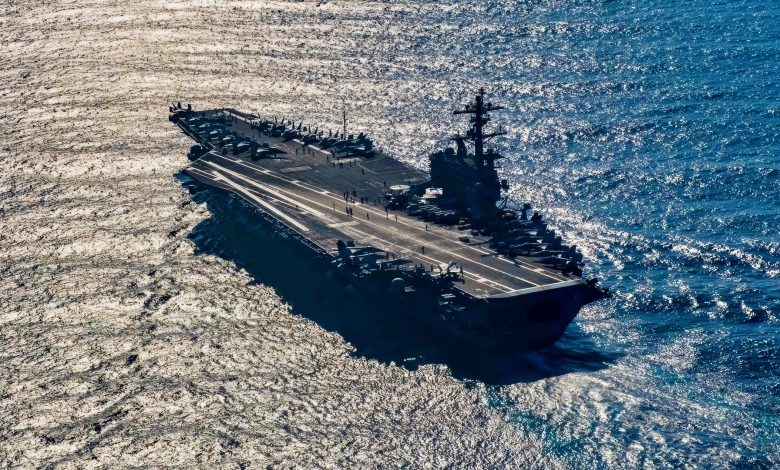
The second was the Project 1143.7 ship Ulyanovsk, a new class of nuclear-powered aircraft carrier that was much larger than its Kiev-class and Kuznetsov-class predecessors.
Although it was smaller than America’s Nimitz-class supercarriers, the Ulyanovsk-class was a major improvement over previous designs and would have dramatically increased the Soviet Navy’s power-projection capabilities.
When the Cold War ended, Ulyanovsk was roughly 40% complete.
Unfortunately, the newly created Russian Federation wanted nothing to do with the ship and allowed it to be scrapped.
The Soviet Struggle for an Aircraft Carrier
Throughout the Cold War, the Soviets never quite matched the United States’ naval capabilities.
The Soviet Ministry of Defense always placed greater emphasis on its Army and Air Force, with the Navy more or less on the back burner.
This makes sense, since most of the USSR’s access to the sea is in the Arctic and is frozen for most of the year.
However, in the 1970s and 80s, the Soviet Navy took steps to close the gap with the U.S. Navy.
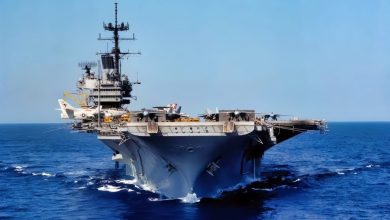
Kiev-Class Aircraft Carrier Rebuilt and Serving in India’s Navy.
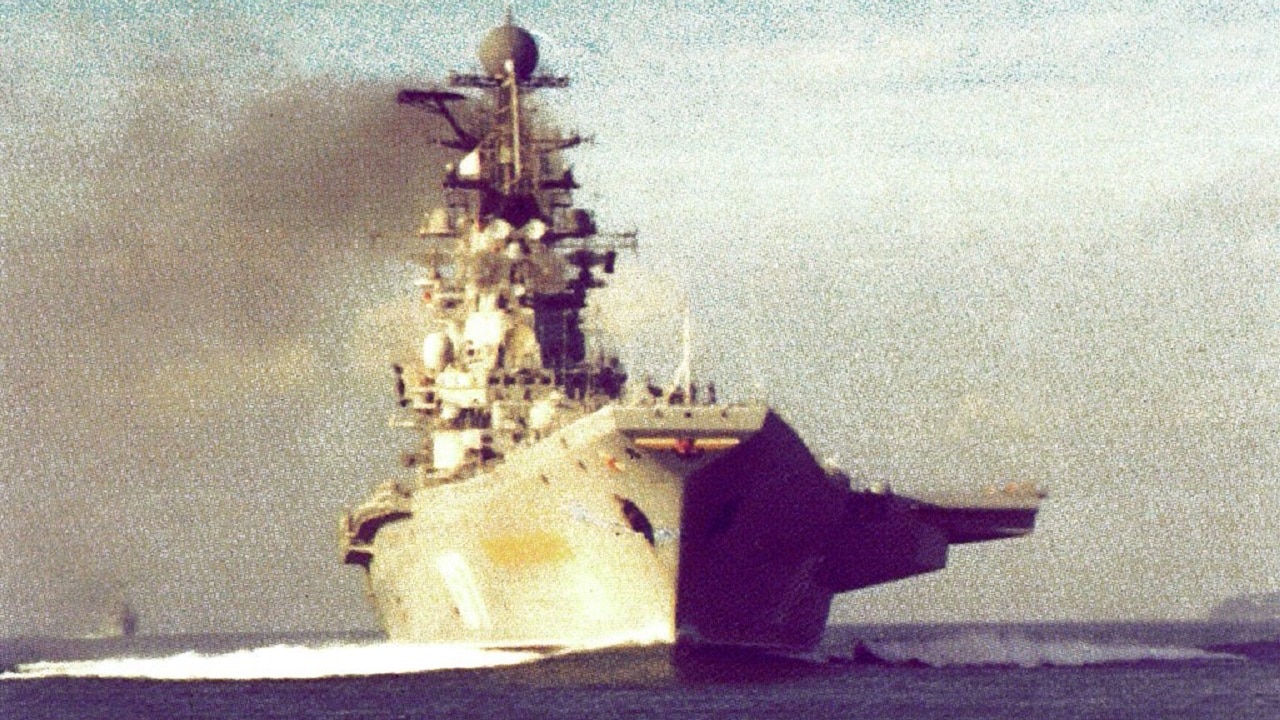
A bow view of a Soviet Kiev-class aircraft carrier (CVHG) underway. Creative Commons Image.
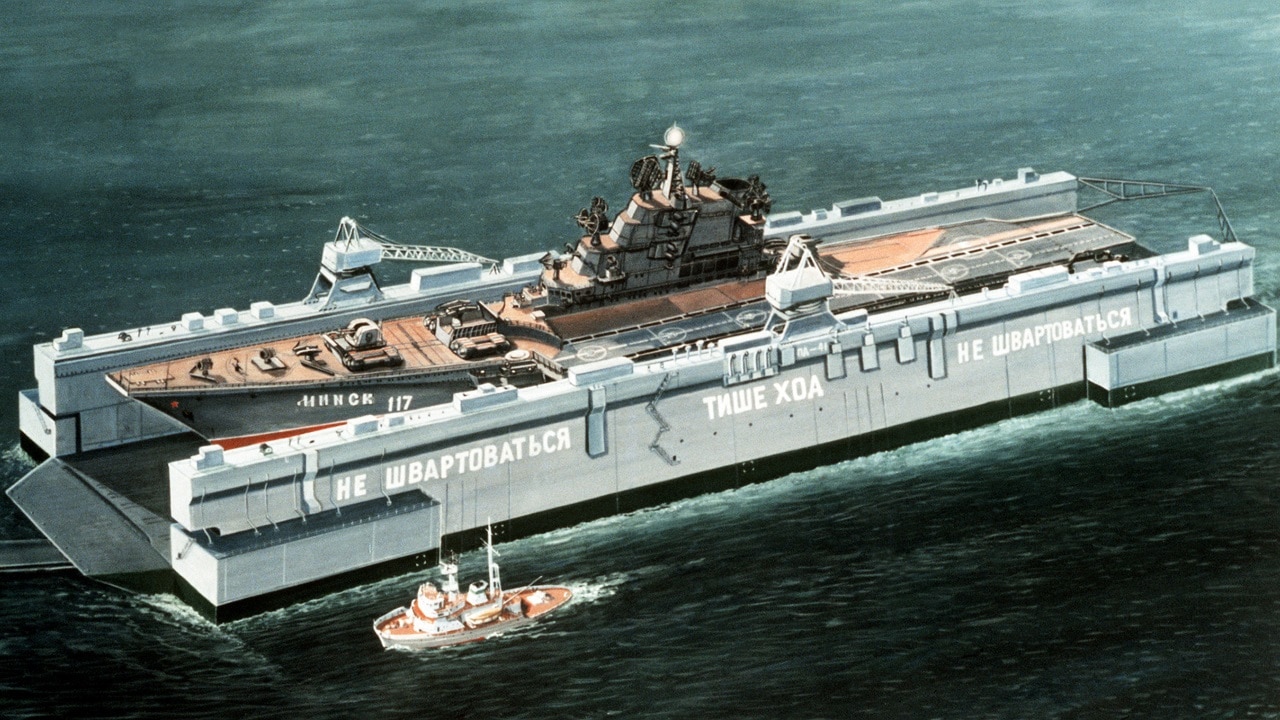
Artist concept of a Soviet Kiev-class aircraft carrier in a floating drydock. “Soviet Military Power,” 1983, Page 82-83
The USSR excelled at building advanced submarines and had some success with its surface fleet, but it could never compete in one area: aircraft carriers.
First, the Soviet shipbuilding industry was not accustomed to building large surface ships, and the USSR had little experience with carrier operations.
As far back as WWII, the Soviets considered several carrier designs, but because of the shipbuilding constraints mentioned above, Moscow opted against larger ship designs.
However, in the 1970s, with the introduction of the larger Moscow, Kirov, and Kiev-class ships, the Soviets finally considered adopting a full-size aircraft carrier that could accommodate conventional take-off and landing (CTOL) aircraft.
One such proposal was Project 1160 Orel (Eagle), a conventional design with a flat flight deck, steam-powered catapults, and a displacement of around 80,000 tons.
The Soviets deemed the Orel design too ambitious and costly, so they shelved it in favor of the Project 1143.5 Kuznetsov-class carriers.
However, as Soviet shipbuilding improved, the Soviets ordered two Project 1143.7 carriers, with Ulyanovsk named as the lead ship.
The Stillborn Supercarrier
Since Ulyanovsk was never completed, her exact size and weight are unknown.
Estimates place the ship’s displacement between 75,000 and 94,000 tons, with a length of around 321 meters (1,054 feet).
She was powered by four KN-3 nuclear reactors, giving her a top speed of around 30 knots and a virtually unlimited range.
The flight deck featured an angled design similar to American supercarriers, enabling simultaneous launch and recovery operations.
Like the Kuznetsov-class, Ulyanovsk had a ski-ramp runway.
Still, its flat secondary runway had two steam catapults, allowing it to launch a wider range of aircraft, including airborne early warning aircraft.
Although it was smaller than its American counterparts, the Ulyanovsk-class was a notable improvement over the Kuznetsov-class in many ways.
Under the Montreux Convention, aircraft carriers are forbidden from transiting the Turkish Straits.
As a result, Soviet carriers have historically been designated as “heavy aircraft-carrying cruisers” to sail from the Black Sea to the Mediterranean.
Despite its more conventional design, the Ulyanovsk would likely have been designated a heavy aircraft-carrying cruiser.
The ship was to be fitted with 12 VLS cells, which could be armed with P-700 Granit surface-to-surface or 3S90 Buk surface-to-air missiles.
The ship also carried eight Kotik CIWS and eight AK-630 CIWS.
The carrier had a larger internal hangar than the Kuznetsov-class.
It could accommodate an air wing of up to 68 aircraft, with the Su-33 Flanker-D serving as its primary fighter, and plans to introduce new Yak-44 early-warning aircraft.
Scrapping Ulyanovsk
The Black Sea Shipyard in Mykolaiv, modern-day Ukraine, laid down Ulyanovsk in 1988.
Her sister ship, which never lived long enough to earn a name, was also laid down on an unspecified date. Ulyanovsk was originally scheduled to launch in 1995, although any chance of her completion vanished with the Soviet Union.
With the Cold War over and the USSR gone, there was some brief confusion over who actually owned the carrier. Russia was widely recognized as the Soviet Union’s successor, but Ukraine was building the carrier.
Ownership issues aside, neither Russia nor Ukraine wanted anything to do with Ulyanovsk. Russia’s economy was in free fall, and Ukraine was no better off.
Although the hull was about 70% complete by 1992, Ulyanovsk was only roughly 40% complete overall.
The Black Sea Shipyard, now an independent company, asked the Russian Ministry of Defense whether it still wanted the carrier, and Russia apparently said no.
To be as fair as possible to the Russians, Moscow did not have nearly enough funds to complete and operate Ulyanovsk.
This is evident based on the experience with Admiral Kuznetsov.
At the same time, the Russian Navy was notoriously corrupt during the 90s and early 2000s (arguably still today).
Many decisions in the immediate Cold War period were made not for the Navy’s needs, but to serve those in charge.
Whatever the reasoning, Ulyanovsk was never completed and was scrapped in 1992.
About the Author: Isaac Seitz
Isaac Seitz, a Defense Columnist, graduated from Patrick Henry College’s Strategic Intelligence and National Security program. He has also studied Russian at Middlebury Language Schools and has worked as an intelligence Analyst in the private sector.