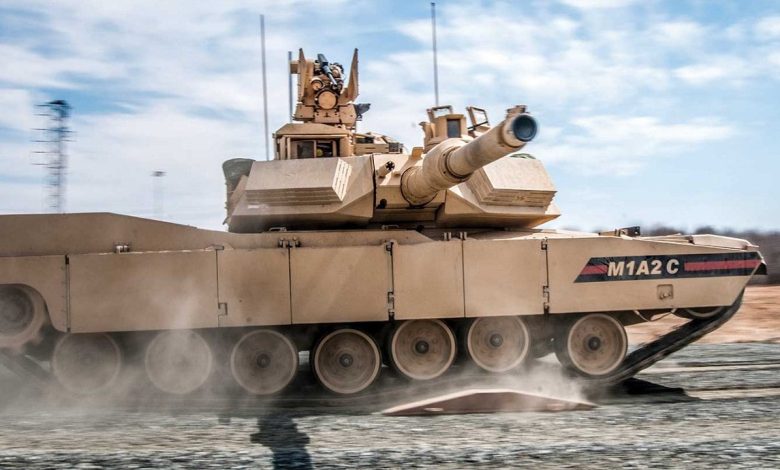
The United States M1A2 SEPv3 Abrams and Russia’s T-14 Armata are essentially different answers to the same operational problem: how to keep a tank effective on a battlefield increasingly shaped by precision weapons, more effective sensor networks, and the threat posed by drones.
The comparison is intriguing, but not completely balanced.
US Army M1 Abrams Tank. Image Credit: Creative Commons.
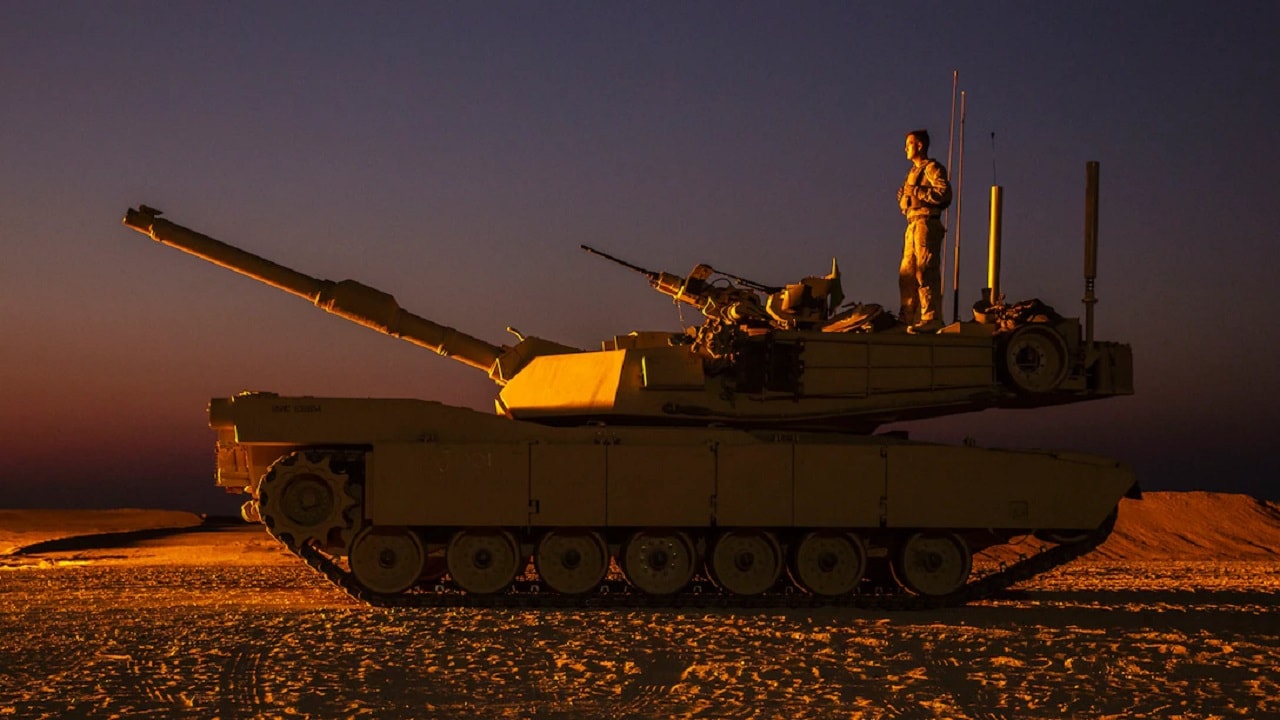
M1 Abrams Tank. Image Credit: US Marine Corp.
While the Abrams is a mature, heavily protected Western tank whose design has been refined over decades of service, the T-14 is a newer Russian attempt to rework Soviet-era tank design, incorporating extensive automation and an unmanned turret.
Firepower and Fire Control
The Abrams sports a 120mm smoothbore main gun and is operated by a four-man crew. Its manual loader creates a heavier workload than the T-14’s autoloader, but it also lets the loader select different ammunition and clear stoppages quickly.
The SEPv3 is designed to employ directed kinetic energy ammunition, including the M829A4 and the programmable Advanced Multi-Purpose rounds.
Additionally, its Ammunition Data Link allows the fire-control system to exchange information with compatible rounds, including an airburst setting against embedded or hidden targets.
In contrast, the T-14 uses a larger 125 mm main gun and an autoloader with 32 ready rounds, plus about a dozen others not immediately available.
It can fire a variety of ammunition, including armor-piercing ammunition, high-explosive, and guided projectiles.
Its larger caliber and autoloader offer a potentially higher rate of fire, while its ability to launch missiles can extend engagement options beyond ordinary direct-fire ranges.
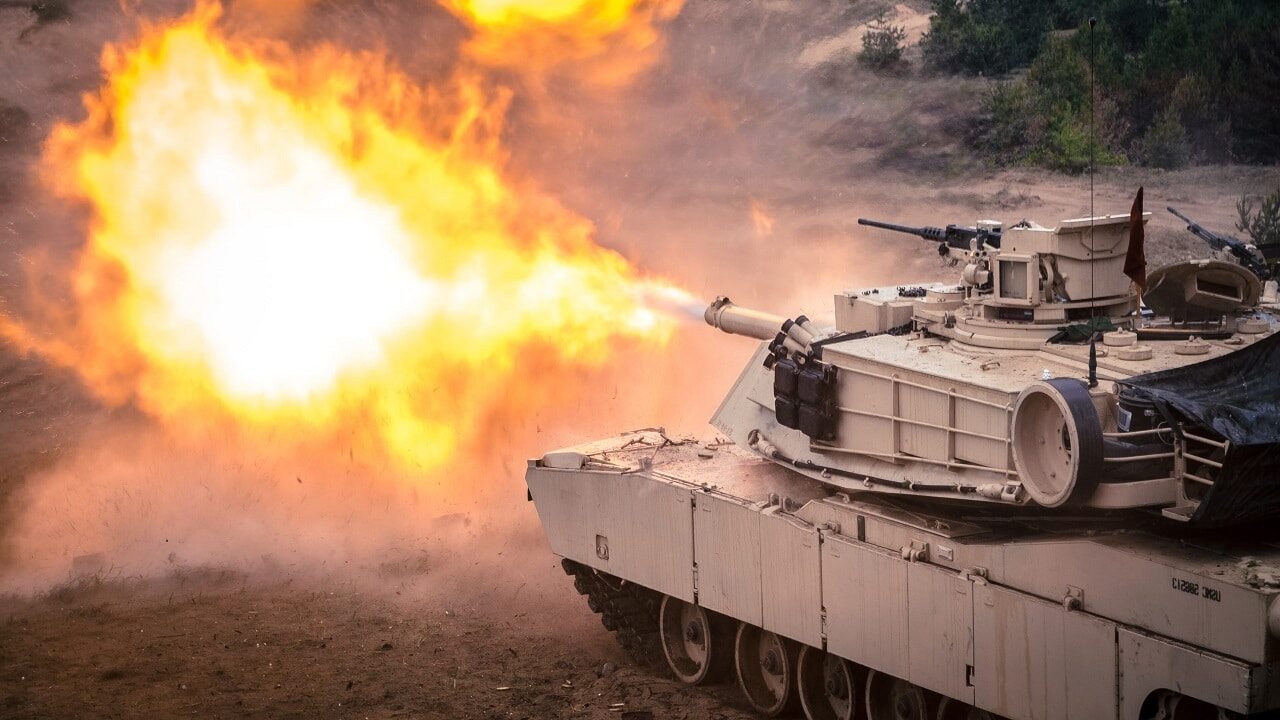
M1 Abrams Tank firing. Image Credit: Creative Commons.
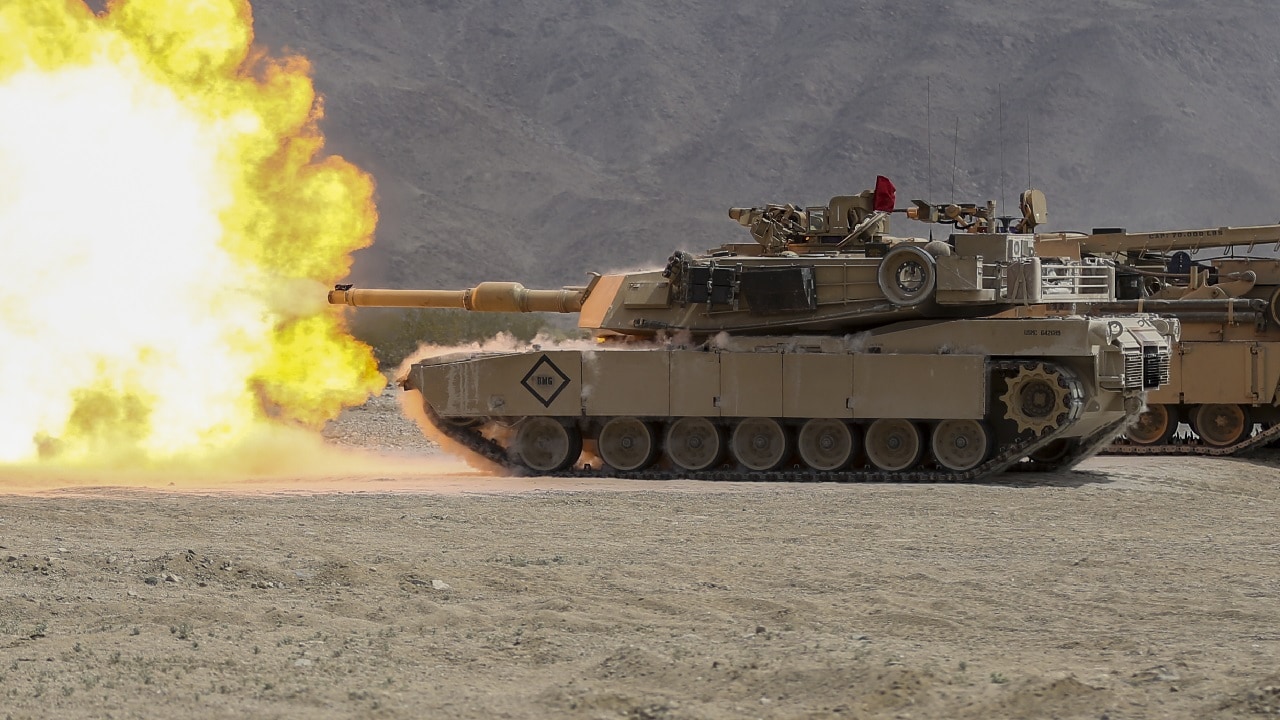
An M1 Abrams Tank fires off a round as a demonstration during 1st Tank Battalion’s Jane Wayne Spouse Appreciation Day aboard the Marine Corps Air Ground Combat Center, Twentynine Palms, Calif., April 3, 2018. The purpose of the event is to build resiliency in spiritual well being, the will to fight and a strong home life for the 1st Tanks Marines and their families. (U.S. Marine Corps photo by Lance Cpl. Rachel K. Porter)
But public information about the T-14’s actual ammunition stocks, software, and accuracy is less reliable and sparse, at least in part due to the tank’s relatively young age.
Protection and Survivability
The Armata’s layout is one of its most distinctive features.
Its three-man crew sits together in an armored capsule at the front of the tank’s hull, while the unmanned turret and ammunition handling equipment are separate.
In theory, this improves crew survival after a turret hit.
The design also uses composite armor and explosive reactive armor as well as the Afghanit active protection system, which combines radar, soft-kill countermeasures, and hard-kill interceptors.
However, the exact performance capabilities of Afghanit remain difficult to assess independently.
In contrast, the Abrams has a more conventional crew of four: the commander, gunner, loader, and driver, with two crew members in the tank’s turret.
Its survivability comes from layered armor, compartmentalized ammunition storage, and armored blast doors that direct an ammunition explosion away from the crew compartment.
SEPv3 also adds armor improvements, including reactive armor paneling, mine protection, and Trophy active protection, which uses radar to detect incoming anti-tank missiles, rocket-propelled grenades, and interceptors, and then intercepts them.
Neither tank is invulnerable, however, particularly against top-attack weapons, mines, loitering munitions, artillery, and attacks to their logistics trains.
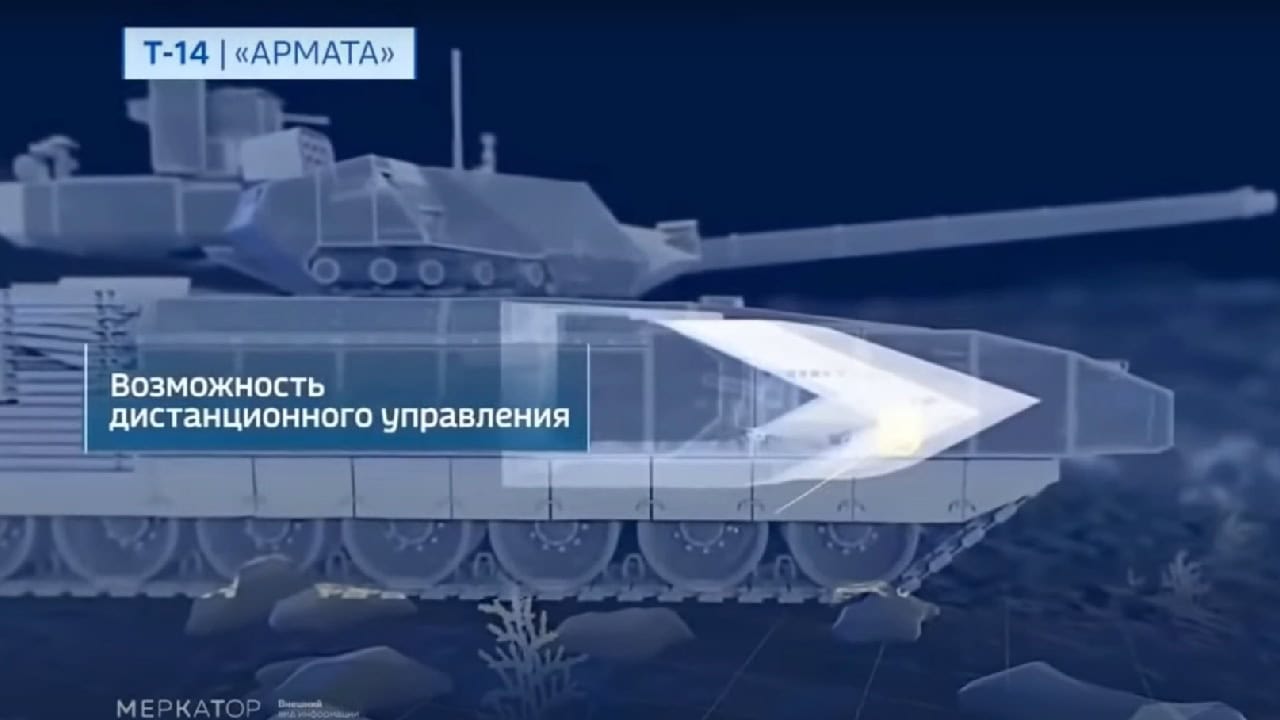
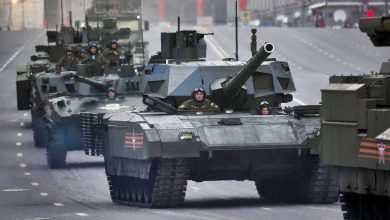
Russia T-14 Armata Tank. Image Credit: YouTube Screenshot.
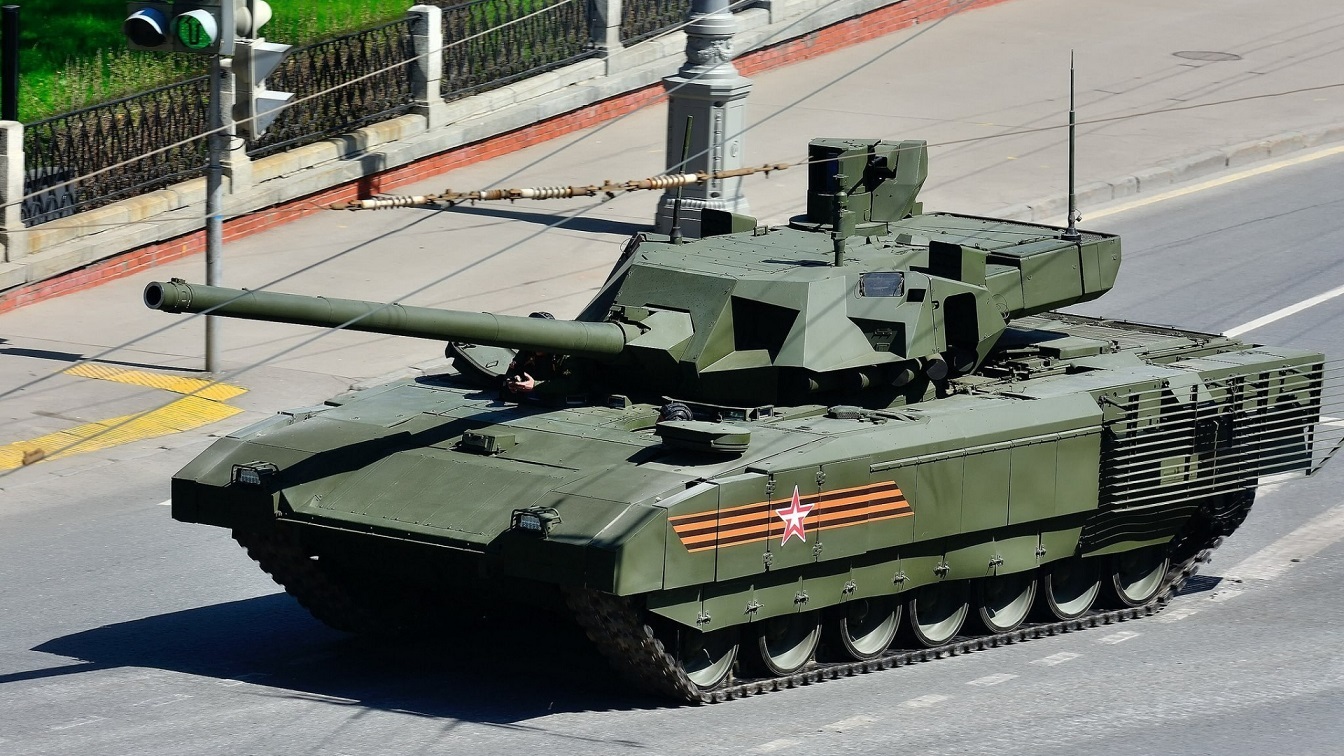
T-14 Armata Tank. Image Credit: Creative Commons.
Active protection is no panacea and depends on the reliability of radar detection and the accuracy of interceptors.
Mobility and Sustainment
The Abrams is one of the heaviest tanks in the world, weighing over 66 tons, depending on the variant and configuration.
While its 1,500-horsepower gas turbine engine produces sufficient power for its weight, the turbine consumes significant amounts of fuel.
Its mass is also a logistical issue, complicating bridge crossings, rail movement, and the recovery of disabled vehicles.
The T-14, by contrast, weighs about 48 to 55 tons and has an approximate 1,500-horsepower diesel engine, making it significantly more mobile.
Over rough, uneven terrain, that is an advantage.
But that statistic alone doesn’t account for reliability or durability, which, for the relatively unproven T-14, remains a question mark.
That is where the Abrams holds a significant edge.
The United States and its allies have established depots, training pipelines, and logistics links to the tank — and have decades to improve the platform.
For example, the SEPv3’s auxiliary power unit reduces the need to run its gas turbine while stationary, lowering fuel consumption.
The T-14 was intended to be part of the broader Armata family of vehicles, thereby reducing costs across the various Armata platforms.
But in practice, its limited production, high cost, technical challenges, and an uncertain industrial base have prevented the development of a complementary support ecosystem.
A tank’s combat value depends not only on what it can do when operational, but also on how quickly damaged vehicles can be repaired and returned into service.
Experience and Uncertainty
The head-to-head comparison of the Abrams and T-14 — indeed, of any platform — should be created cautiously.
Technology alone cannot quantify crew training, leadership, morale, and other intangibles.
Nor does it account for maintenance support, intelligence, integration with other platforms, or combined-arms operations.
These factors, though less flashy, often determine battlefield outcomes rather than minute differences in horsepower or gun caliber.
The Abrams, in its various variants, has served in militaries worldwide and yielded extensive operational lessons. The T-14, by contrast, has almost no verified combat experience.
Russia used a small number of T-14s for fire missions in Ukraine, but they did not participate in direct assault operations, leaving the T-14 virtually untested.
About the Author: Caleb Larson
Caleb Larson is an American multiformat journalist based in Berlin, Germany. His work covers the intersection of conflict and society, focusing on American foreign policy and European security. He has reported from Germany, Russia, and the United States. Most recently, he covered the war in Ukraine, reporting extensively on the war’s shifting battle lines in the Donbas and writing on the war’s civilian and humanitarian toll. Previously, he worked as a Defense Reporter for POLITICO Europe. You can follow his latest work on X.