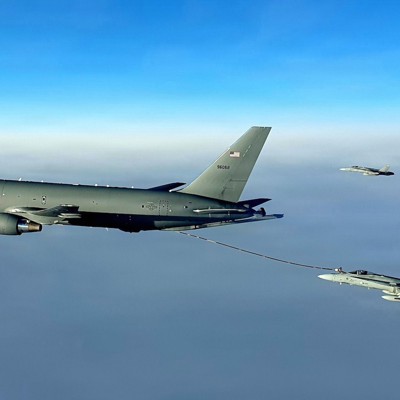
NATIONAL HARBOR, Md.—With an eye on the Navy’s progress toward an unmanned aerial tanker, Air Force planners are asking questions about their own future tanker fleet.
“Thinking beyond the current KC-46 buy and the program extension. Whatever that next tanker looks like—our advanced tanker system—it’s got to be connected. It’s got to be able to defend itself. But it begs the question: Does it need to be manned? Could it be optionally manned, or could it be autonomous, or is there a family of solutions maybe that would answer that question?” Lt. Gen. Daniel Tulley, who leads Air Mobility Command, told reporters at the Air, Space, & Cyber 2026 conference.
The Air Force is currently buying Boeing KC-46 Pegasus tankers and spent $12 million to explore buying a new tanker this year. But it zeroed out funding to continue those explorations in the 2027 budget request and is asking instead for $13 million for “advanced tanker systems.”
Tulley said the Navy’s work on the Boeing MQ-25 Stingray suggests that his own service might eventually not need manned tankers. The Navy announced on Thursday that the MQ-25, which first flew earlier this year, has received approval to enter low-rate production. The service also ordered three more aircraft, bringing its total to 14.
“I do not believe that it has to be manned, a future air-refueling solution,” he said. “But then, how do we, the U.S. Air Force, bring that to bear in scope, scale, and range?”
A drone tanker for the Air Force would need to be a very large aircraft with the capacity for fuel and the ability to fly for a long time. The KC-46, for example, can fly nearly 7,400 miles and carry more than a thousand tons of fuel. The MQ-25 can fly about 500 miles and carry up to 7.5 tons of fuel.
“An optionally manned or an unmanned tanker at the ranges we need it to operate at is a very large aircraft. And we’re not yet to where we’re employing fully autonomous large aircraft,” Tulley said.
“Just about any large aircraft these days made by Boeing can take itself off with very little help, can fly on a programmed route and pretty much land itself on autopilot, bring itself to a stop on the runway. But we don’t employ it that way with a system that’s controlling it and then taxiing it in and making it a part of a more effective, broader system.”
One maker of autonomous-aircraft control systems said the vision of autonomy for large aircraft was getting clearer. And while the technology isn’t there yet, there’s progress, said Matthew George, CEO of Merlin Labs.
“We’re the furthest along in the world on making that real—in our opinion,” said Matthew George, CEO of Merlin Labs. “So we’re going to be implementing autonomy on the C-130J, which is the same general size class” as the Boeing KC-135 Stratotanker.
“And the advantage with those aircraft is you can start to implement autonomy still with human crews aboard, and you can supplement those human crews in a way that’s pretty helpful. That’s a way that you can start to chip away at that without actually going fully to the unmanned tanker right away,” George said. “The goal is that the unmanned tanker is ready, and the autonomy ends up being ready at the same time.”
George agreed with Tulley’s point that many aircraft can somewhat fly themselves, but there are instances, such as emergency situations, when a human needs to make a decision.
“What’s really hard is those edge cases and those emergencies—or those things where there are decisions to be made. So, for instance, if you’re going to a destination and then there’s weather in between, how do you get around the weather?” he said.
And beyond technology, there are policy challenges.
“None of this matters unless it’s certified and safe. So for us, getting certification done is important, and that’s what we’re working really closely with the Air Force on this year,” George said. “We’re taking that [autonomous pilot] brain and putting it onto the C-130J. And as far as we know, that’s going to be the first time autonomy fully takes control of an operational U.S. Air Force aircraft.”
No date was provided for when that flight will occur, but the company’s technology completed a critical design review, George said.