The Navy’s experiment with manufacturing replacement parts at sea during RIMPAC 2026 showed that 3D printers can shorten supply lines. It also exposed a harder problem: The machines accomplish little without qualified operators, reliable materials, sound certification rules and a system capable of moving finished parts where sailors need them.
Morgan Bower, director of the FLEETWERX Innovation Hub, described those lessons in an interview with Military.com following the exercise. FLEETWERX serves as a partnership intermediary between the Naval Postgraduate School, military organizations, universities and private companies, helping the school bring outside technology into operational experiments such as RIMPAC.
The exercise brought together 30 nations, more than 30,000 personnel, 30 surface ships, five submarines and more than 197 aircraft near Hawaii from June 24 through July 31. The biennial exercise, which began in 1971, gives participating forces an opportunity to practice operating together across military services and national boundaries.
Manufacturing Near the Fight
The Indo-Pacific’s distances make equipment sustainment particularly difficult. Replacement parts may need to cross thousands of miles, and ships or aircraft moving supplies could face attack during a conflict. Advanced manufacturing cannot entirely eliminate conventional supply chains, Bower said, but it can give commanders another way to keep equipment operating.
“It’s about giving commanders the ability to manufacture certain parts and certain items aboard their ship,” Bower said in the interview. That capability would allow the military to reserve scarce transportation capacity for munitions, complex components and other supplies that cannot be produced locally.
During RIMPAC, the Naval Postgraduate School’s Consortium for Advanced Manufacturing Research and Education, known as CAMRE, combined distributed manufacturing, artificial intelligence and autonomous transportation into one logistics system.
Military personnel manufactured replacement parts, loaded them onto a digitally crewed surface vessel and delivered them to joint forces in less than 24 hours. The vessel then carried drone components to the Army’s 25th Infantry Division, where Marines and soldiers assembled and tested the aircraft.
The underlying principle matters more than any single delivery. A useful distributed manufacturing network must identify a requirement, select a qualified production site, make and inspect the part, and deliver it to the requesting unit.
The Joint Advanced Manufacturing System developed through CAMRE and the Marine Innovation Unit tracked requests, assigned work among production nodes and monitored the logistics process.
The Ship Is Not a Laboratory
RIMPAC also demonstrated why equipment that functions inside a controlled facility may fail aboard a warship. Bower said a hybrid manufacturing system aboard the aircraft carrier USS Theodore Roosevelt repeatedly developed slight laser misalignments. Investigators eventually traced the problem to vibrations from aircraft landing on the flight deck.
The movement was tiny, but precision manufacturing leaves little room for error. Personnel tightened the equipment and secured its container more firmly to the deck. The episode illustrated the value of operational testing because developers could not easily reproduce those conditions in a conventional laboratory.
“No matter how many years you develop something in a lab or in your manufacturing facility, you’re never going to run into that problem,” Bower said.
Consumable materials create another challenge. Metal printing may require an inert gas, such as nitrogen or argon, to prevent oxygen from weakening a part during production. Gas cylinders consume valuable space aboard ships and eventually run out.
Bower said one printer used during the exercise included a nitrogen generator, allowing it to produce shielding gas aboard the ship. He said future shipboard systems could incorporate that capability as a standard feature.
The demonstration also examined producing metal powder aboard a Canadian vessel before using it to manufacture components at sea. Creating the material when needed could reduce storage demands, but fine metal powder presents respiratory, fire and explosion hazards. Ship movement can also disrupt powder-based printing, forcing designers to account for conditions that land-based factories rarely experience.
The Naval Postgraduate School identified shielding gas and other consumables as limiting factors during earlier deployments, confirming that manufacturing equipment cannot become operationally useful unless its supporting logistics become equally deployable.
Certification Determines Whether a Part Matters
Producing a component does not automatically make it safe to install. The military must determine whether the material, manufacturing process and finished part satisfy the requirements associated with the equipment. The level of review depends heavily on whether failure would cause inconvenience, disable a system or endanger lives.
Bower described an effort to manufacture a hydraulic component for an Apache helicopter. The first version passed a pressure test, but it leaked when connected to the helicopter because its threads did not fit correctly. The team revised the component, repeated the testing and obtained approval for the replacement.
Artificial intelligence may help personnel navigate those requirements, but it cannot erase them. Bower said one tool integrated into the manufacturing network searches policy documents and identifies the inspection, testing and approval steps that apply to a requested part.
Another system compares the part with available machines and materials, then recommends a production method or advises personnel to purchase an ordinary commercial item instead of printing it.
People Remain the Critical Capability
The most consequential lesson did not concern a printer, algorithm or autonomous vessel. It concerned the people expected to operate them.
“You can have as great a gizmo as is available out in the world today,” Bower said. “If you don’t have the people with the skills and the confidence and the ingenuity, and frankly, the perseverance, to make it work…your system is not going to be successful.”
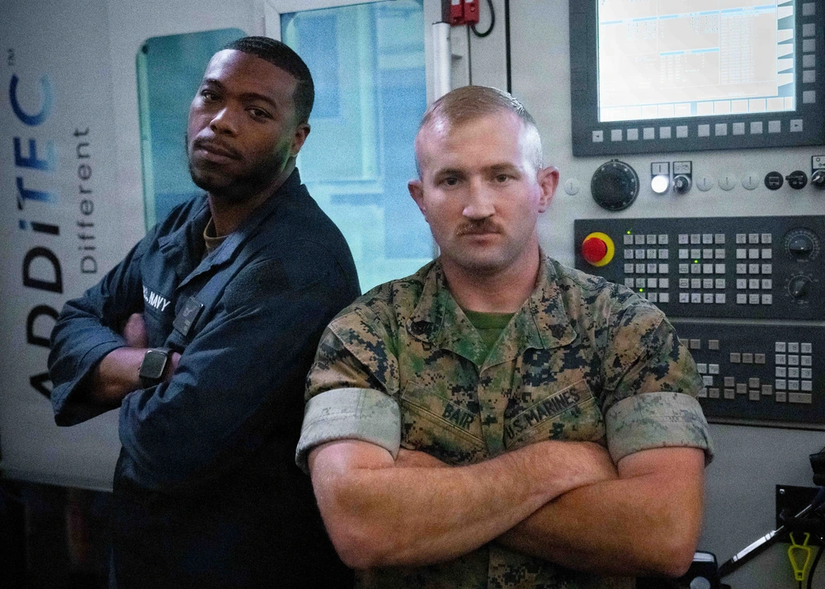
Experienced operators transfer, receive promotions and rotate between sea and shore assignments. Unless the Navy institutionalizes their knowledge, a ship may possess advanced machinery without anyone capable of using it when equipment fails.
Bower said FLEETWERX and its partners plan to develop curricula that can train personnel more quickly and give them access to assistance when problems arise.
RIMPAC demonstrated that distributed manufacturing can compress parts production and delivery into hours under the right conditions. Its deeper lesson was less futuristic: Readiness still depends on trained people, disciplined testing and logistics systems designed around operational reality.
A printer aboard a ship is only a machine. A workforce capable of turning a digital design into a safe, delivered and installed part is a military capability.