If you are a student of survival, I probably don’t have to tell you how important the psychological aspects of survival are. In all but the briefest survival ordeals, most of those who die, do so because they gave up. Once a survivor loses the psychological battle, the loss of the physiological war soon follows. Therefore, it should come as no surprise that leaders who understand this reality go to great lengths to keep morale high and to impart the will to fight and survive to those they lead.
When I think of effective leaders who understood the importance imparting the will to fight and survive and keeping morale high amongst those under their stewardships, Winston Churchill and Earnest Shackleton come to mind.
Both men were effective leaders who looked death right in the eye, gave him what for, and lead their people to safety against all odds. They both led by example, inspired their men in word and deed. They used the power of daily rituals to improve morale and impart the will to live to those in their charge.

They knew that daily rituals impart structure and familiarity and are calming and stave off panic. Daily rituals help us “keep calm and carry on” when the world feels unstable.
Let’s face it. We evolved to survive in the natural world. We aren’t wired for the world we have created. The world is changing fast and we are overstimulated, bombarded by too many faces, too many screens, and too much information.
So, it’s both normal and sane to be concerned about how these changes may affect us and to desire a simpler, more natural existence. By slowing down and doing something that is not mentally taxing which we can control, rituals help clear our minds and slow our breathing. They give us structure and stability and help us calm our minds, and center ourselves. In this state, our parasympathetic can activate and help us rest and repair both our minds and bodies.
Have a Cup of Tea
Churchill and Shackleton were both British, so let’s start with tea.
It’s not what you drink, but the ritual of preparing it, that confers the benefit in this context. You could drink tea, coffee, chamomile, pine needle tea or hot chocolate. It’s the ritual of stopping what you are doing and performing a repetitive task that requires next to no brainpower. You fill the tea kettle, heat the water, get the cup and saucer, mix the beverage and so on. Then you sit and drink a warm beverage, focusing on the warm cup in your hands and tasting and feeling the warm beverage as you drink it.
Most of these decoctions have pharmacological effects on the body. Some perk us up, some clam us down, but setting those effects aside, it is the structure, familiarity of going through the motions that benefits and centers us when the world goes sideways. It gives us a moment to collect ourselves while doing something, anything, other than freezing up, enabling us to work the problem after we finish our beverage.
Tea, coffee and candy are often included in military rations and survival kits for their calming and morale-improving effects. All of these items have additional survival benefits, but I’ll save those for another article.
Walking
Walking releases endorphins, improves mood, reduces stress, reduces anxiety, improves sleep, improves memory, improves cognitive function, and improves energy. In fact, I carry a notebook or a voice recorder when I walk, and when I perform several of the daily rituals in this article, to take advantage of the improved cognitive function. During a regular walk is a productive time to think.
Walking can be a shared experience by bringing your spouse, a family member, friend or pet. You can also listen to music or an audiobook as you walk as long as you don’t let it lower your situational awareness.
Whenever possible, I prefer to walk in natural settings to enjoy the synergistic effects of walking and making use of natural settings. Walking close to dawn and dusk enables you to witness sunrises and sunsets, not to mention the fact that many animals are active during these hours, so morning and evening walks afford the opportunity to enjoy the local wildlife, further improving the psychological benefits of regular walks.
Meditation
Consistent meditation, done properly, in conjunction with biofeedback, breathing exercises and/or visualization and affirmation exercises can center mind and body. Some combination of the aforementioned tools is a component of most martial systems.
Old is new and breathing technique variously referred to as “combat”, “tactical”, “box” or “square” breathing is once again “a thing” in military circles. I learned the same technique studying Aikido in the 80’s and 90’s, then again in dynamic entry in the early 2000’s. and have used it ever since, but the breathing technique itself is truly ancient.
If you force yourself to smile, your capillaries dilate, your pituitary gland and hypothalamus in your brain release endorphins, and so the act of forcing your face to smile physiologically affects your mood. Similarly, when you meditate and control your breathing, your emotions stabilize, and your mind calms and clears.
This is useful when you are preparing to execute a dynamic entry, and it is also useful if you want to do respond in the best possible way to your 4-year-old who is screaming at you because he doesn’t want to go to bed. Whatever you happen to be doing right now, there is an argument for being fully present while you do it and doing it well.
Prayer
Prayer can help you feel loved, that you are not facing your challenges alone, and that you will not be given a burden greater than you are able to bear. Therefore, prayer is often the difference between giving in to depression, anxiety or despair, and soldiering on in the faith that God will prepare a way for you.
Praying for others can help put our own problems in perspective and can reduce anxiety about our problems by focusing on serving others. We can also pray, not for God to solve our problems for us, but instead to help us put our lives in order so we can adapt to, or to overcome the challengers that we face.
Even for the non-believer, the process of stating your goals in prayer is meditative, clarifying and provides focus.
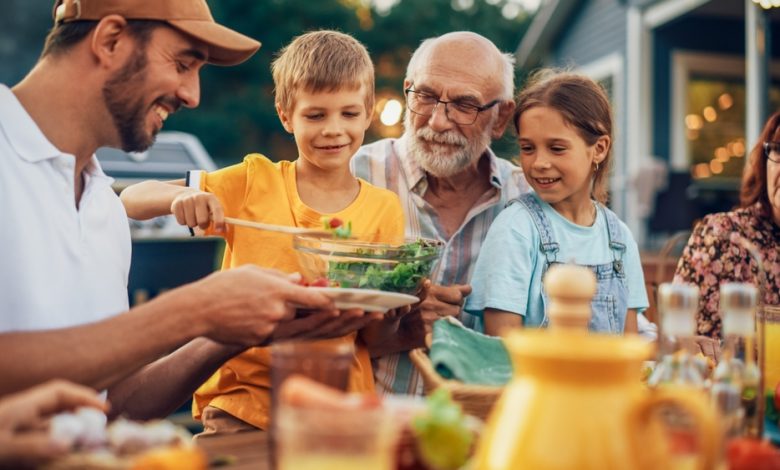
Family Dinners or Shared Meals
Prayer and eating meals together as a family are heuristic traditions. They are traditions that cultures benefit from for untold generations, even though they may not be able to explain to you exactly how and why. Then some person or organization comes along and thinks they know better and they start changing things that they were benefiting from but didn’t understand how. I wouldn’t stop praying or eating together as a family just yet.
We benefit from eating meals together as a family.
- Studies show that our diet is healthier because we eat better quality food. Kids and adolescents are also more likely to keep their weight in the healthy range and not develop bad eating habits if they eat at least 3 family dinners together per week.
- Shared meals reinforce the family structure. We engage in discussions and relate as a family at shared meals. This results in kids engaging in fewer risky behaviors, such as violence, early sexual activity, substance abuse, and delinquency.
- Kids in family that share meals have fewer mental health problems such as self-harm, suicidal thoughts, stress, depression and anxiety.
- Improved academic performance. Mealtimes are important for kids to improve their vocabularies by speaking with adults and older siblings. It also provides the opportunity for them to acquire additional knowledge and give parents the opportunity to emphasize the importance of schoolwork by asking children about their studies and the act of telling their parents what they learned, reinforces the subject matter in children’s memories.
- Stronger family relationships. Eating together reinforces family bonds and fosters communication and support.
- Parents also benefit. They have better self-esteem, they eat better, have less incidence of depression and better family relationships.
While the benefits of family meals may not be evident to everyone at first glance, multiple studies prove their extreme importance. Family dinner is one of several traditions that families cannot afford to dispense. (Larson, Daines, M.P.H, Bevan, M.S., R.D, Gupta, Ph.D., & Savoie Roskos, 2024)
Make Your Bed
It might sound like small thing, but making your bed when you wake up starts your day off with a small subconscious win and that can help set the tone. Organization is calming. Reducing visual clutter reduces mental clutter. For this reason, it’s easier to get to sleep in made bed and good sleep is not a small thing. It also affects your identity. You identify as the type of person who makes their bed as opposed to type who doesn’t. It also teaches by example. If you have kids and you want them to make their beds, then make your bed.
Make Use of Natural Settings
Rituals are more relaxing and powerful out on the deck, on a blanket in the grass, on a boat, in the mountains, in the desert or on the beach. We evolved in the natural world. Natural settings feel like home to us because they are our home. The white noise of waves, wind in the trees, running water, birds and insects.
So many of us live for the weekends so we can spend them outdoors. Any expendable income is spent on backpacking, boating, camping, hunting, fishing, rock hounding, climbing, mountain biking, horseback riding … you name it. They’d rather spend it on that than on a therapist. They say it keeps them sane.
The thing is … outdoor recreation doesn’t have to cost a lot of money. Once you’re at the lake, it doesn’t matter if you’re in an expensive boat or on an inner tube you got for free. What you are really there for … the water temperature, sun, breeze, stars, landscape, sky, clouds, fish, birds, and animals are all the same. Feeling the sand under your feet and the wind on your face is what calms you and returns your sanity.
When you can’t get out, invite nature in. House plants, stone, aquariums, pets, atriums, green walls, open windows, vegetable gardens, balconies … all these things bring nature inside our homes. In the yard, pets, pods, fountains, lush gardens, edible landscaping, plants that attract pollinators, bird baths, bird feeders, and hummingbird feeders all help invite nature in for your enjoyment.

Summary
Small daily routines like hot drinks, shared meals, meditation, prayer, walks, and making your bed give structure, comfort, and meaning in uncertain times and the benefits the provide can often be amplified by incorporating nature into them where you can.






References
Larson, H., Daines, S., Bevan, M. S., Gupta, P., & Savoie Roskos, M. R. (2024, December 12). Improving Health and Well-Being Through Shared Family Meals. Retrieved from usu.edu:
https://extension.usu.edu/nutrition/research/improving-health-and-well-being-through-shared-family-meals