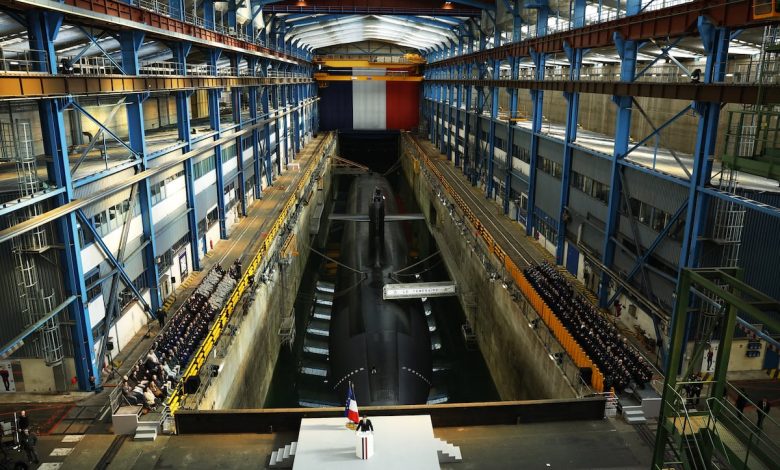
PARIS — France will expand its nuclear arsenal and implement a policy of “advanced deterrence” that could include deploying nuclear-capable forces to the territory of European allies, President Emmanuel Macron said Monday in a long-awaited speech on the country’s nuclear doctrine.
The plan is a “major evolution” of France’s deterrence posture, Macron said at the Île Longue naval base in Brittany, the home of France’s nuclear-powered ballistic missile submarines. The president said that in addition to Germany and the United Kingdom, another six European countries will join talks about greater nuclear cooperation.
“We must strengthen our nuclear deterrence in the face of the combination of threats, and we must consider our deterrence strategy in the depth of the European continent, with full respect for our sovereignty, with the gradual implementation of what I would call advanced deterrence.”
With an aggressive Russia on Europe’s borders and growing uncertainty about the solidity of American security guarantees, countries including Germany and Sweden have expressed interest in how France’s nuclear deterrence might be expanded. Successive French presidents have said the “vital interests” covered by French nuclear deterrence include a European dimension.
France will not share what it considers its “vital interests” and is therefore not providing a guarantee “in the strict sense of the term,” according to the president. Macron said in any case France will not share “the ultimate decision” to use nuclear weapons, which under the French constitution remains solely with the president.
General Charles de Gaulle, whose concept of strategic autonomy continues to frame France’s deterrence doctrine, first invoked the concept of vital interests, without ever defining exactly what those were. That ambiguity has remained a part of the French doctrine, leaving a potential adversary uncertain about what would trigger a response.
Macron said providing a rigid guarantee would be imprudent, lowering the nuclear threshold and reducing the uncertainty of adversaries. France will reserve its right to deliver a nuclear “final warning” to signal “very concretely” to an adversary that the nature of the conflict has changed, as a last chance to restore deterrence, the president said.
“France will therefore always take on alone, taking into account the interests of our allies, the deliberate crossing of the nuclear threshold,” Macron said.
The president said advanced deterrence will be a gradual process, first of all by allowing France’s partners to join in deterrence exercises, as well as what Macron called signaling, beyond French borders or with conventional participation by allies in France’s nuclear activities.
Ultimately, advanced deterrence could include the deployment of France’s strategic forces to allies, Macron said. That would allow France’s airborne nuclear deterrent to disperse across Europe, which “will complicate our adversaries’ calculations and give this advanced deterrence great value for us,” while giving French defenses “new strategic depth, consistent with the security challenges in Europe.”
“I believe it will also be of great value to the partners who join us in this approach, whose territory will gain a strong link with our deterrence,” Macron said. Any French effort would be a complement to NATO’s nuclear mission, the president said.
The airborne part of the French deterrent consists of nuclear-tipped cruise missiles carried by Rafale jets. The country got rid of its land-based intercontinental ballistic missiles in 1996.
The work on advanced deterrence with European allies is being carried out “in full transparency” with the United States and in close cooperation with the U.K., Macron said. Germany will be a key partner, while Poland, the Netherlands, Belgium, Sweden, Portugal and Denmark are also joining, the French president said.
“This is a genuine strategic convergence between our countries that will give real depth to the defense of our continent,” Macron said. France has opened talks with several other countries, and will continue in the coming weeks and months, he said.
With France creating “new strategic dilemmas” for Europe’s adversaries through advanced deterrence, partner countries can help strengthen European capabilities in early warning, expanded air defense and deep strike, according to Macron, who said that would be “a fair distribution of efforts” from which France would benefit.
“To be strong in our nuclear deterrence, we must be strong in our conventional capabilities, in all their dimensions,” Macron said.
The president said he has ordered to increase the number of nuclear warheads in the French arsenal, and France will no longer communicate on the size of its arsenal. The country previously said it has reduced its arsenal to less than 300 nuclear warheads, and the Stockholm International Peace Research Institute lists France as having 280 deployed warheads and about 10 in reserve.
France adheres to a principle of “strict sufficiency,” keeping its nuclear arsenal at the lowest possible level fitting the strategic context. France has been a nuclear power since 1960, when the country tested its first A-bomb in the Sahara, and first tested a hydrogen bomb on Mururoa atoll in French Polynesia in 1968.
France needs to increase its nuclear warhead count in the face of evolving defenses of competitors, emerging regional powers, possible coordination between adversaries and risks of proliferation, according to Macron, who said this is not about entering an arms race. He said France’s nuclear weapons remain exclusively strategic.
The key point “is that no adversary or combination of adversaries can contemplate the possibility of striking France without the certainty of suffering damage from which it would never recover,” Macron said. “There is no need for symmetry of arsenals to achieve this.”
Macron cited the threat from Russia developing new weapons, including hypersonic nuclear weapons, nuclear torpedoes and with plans to send nuclear weapons into space. The president also cited China’s military expansion, saying the country produces more weapons than any other nation.
There is an increased risk of conflicts going nuclear, as well as an increased intensity of conflict below the nuclear threshold, Macron said. He cited nuclear saber-rattling by Russian officials, with a trivialization of the discourse on nuclear weapons and reckless threats, and Russia’s use of dual-capable missiles such as the Oreshnik close to European borders.
“All of this is a major change that makes the risk of crossing the threshold more tangible,” Macron said. “At the same time, nuclear powers such as France must also become accustomed to the possibility of major conflicts below the nuclear threshold in their immediate environment.”
France’s four Le Triomphant-class strategic nuclear missile submarines make up the ocean-based part of the country’s nuclear deterrent, with doctrine prescribing a continuous-at-sea presence with at least one of the boats on patrol at any given time.
France has developed its ballistic missile technology domestically through ArianeGroup, while the French nuclear cruise missile was developed by MBDA. The United Kingdom relies on American-built Trident missiles for its ocean-based deterrent.
The country is in the midst of modernizing its nuclear deterrent, with a next-generation ballistic-missile submarine set to enter service starting in 2035. France is also developing the ASN4G hypersonic air-launched nuclear-tipped cruise missile to replace the current ASMPA, and preparing the next update of the M51 submarine-launched strategic ballistic missile.
France introduced the latest version of the M51 missile in October, with new nuclear warheads and greater range, accuracy and capability to penetrate enemy defenses. French on-duty ballistic missile submarines are equipped with 16 of the missiles, each consisting of a solid-propellant, three-stage launcher weighing more than 50 metric tons and 12 meters long, according to ArianeGroup.
While the exact range of the missile is undisclosed, ArianeGroup says the M51 reaches an altitude of more than 2,000 kilometers before reentering the atmosphere at a speed of Mach 20, carrying its payload of multiple nuclear warheads over a distance of “several thousand kilometers.”
The latest M51.3 version is estimated to have a range of more than 9,500 kilometers, compared to more than 9,000 kilometers for the prior model, according to the Bulletin of the Atomic Scientists.
Rudy Ruitenberg is a Europe correspondent for Defense News. He started his career at Bloomberg News and has experience reporting on technology, commodity markets and politics.