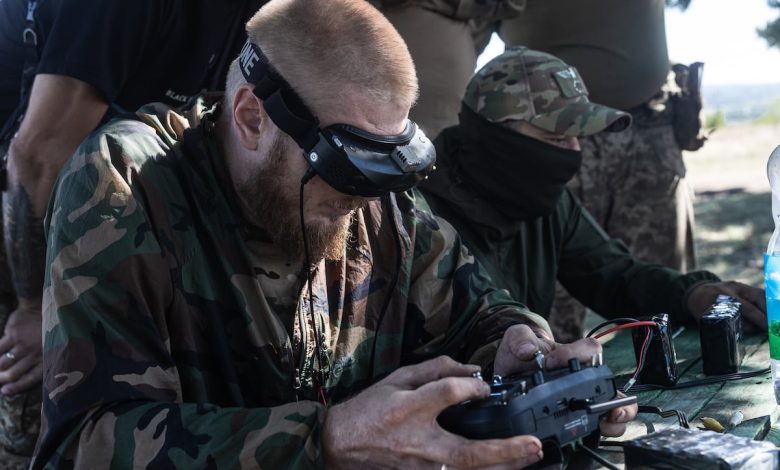
Ukraine is giving international partners and defense companies access to its vast trove of real combat data to train artificial intelligence models for autonomous drone systems — a move Kyiv is calling “the first initiative of its kind in the world.”
Officials approved a resolution this week launching a new cooperation framework between the state, domestic defense companies and foreign partners, the Ministry of Defense announced Thursday.
“The future of warfare belongs to autonomous systems,” Ukrainian Defense Minister Mykhailo Fedorov wrote in a release announcing the program.
“Our objective is to increase the level of autonomy in drones and other combat platforms so they can detect targets faster, analyze battlefield conditions, and support real-time decision-making.”
The resolution comes as over a dozen countries are enmeshed in the war that started in Iran late last month, and as militaries globally accelerate investment in autonomous defense systems.
For companies building autonomous systems or target recognition software, the value is straightforward: Validated, real-world training data compresses development timelines and improves model performance in ways no laboratory environment can replicate.
For allied governments, it offers a faster path to fielding AI-enabled defense capabilities — without having to generate their own combat datasets from scratch.
Fedorov framed it as a “win-win” — partners get better training data, and Ukraine gets faster development of autonomous capabilities for its own front lines.
At the center of Ukraine’s new program is a dedicated AI platform built inside Ukraine’s Ministry of Defense Center for Innovation and Development of Defense Technologies.
The platform allows partners to train AI models on real battlefield data without gaining direct access to other sensitive military databases linked to the country’s digital control system, DELTA — a significant security safeguard.
Deputy Defense Minister Lt. Col. Yuriy Myronenko told Military Times last month that the platform’s security is built on the American National Institute of Standards and Technology standards and audited annually by Big Four consulting firms.
Ukraine’s datasets already power the DELTA battlefield management system, which uses neural networks to automatically detect ground and aerial targets in real time.
That kind of data backbone is essential in a war increasingly defined by scale, speed and AI.
“You can control only with data,” Myronenko said. “Otherwise, I don’t even know how you can control such a number of drones, people, front lines and such a number of resources. And so fast.”
Through the platform, partners can work with large volumes of labeled photo and video data collected during active combat operations, and draw from datasets that are continuously updated in almost real time as Russia’s full-scale invasion moves into its fifth year.
As a result, the country’s data may be the most operationally rich in the world right now — no other country has ever been able to offer this volume of labeled, real-world combat imagery delivered directly from the soldiers fighting an ongoing, high-intensity conventional war.
“We have built our system in such a way that the data is brought in directly by the people who are fighting,” Myronenko said. “They bring the data there, and this data is aggregated in certain forms, then centralized for us.”
Ukraine currently holds millions of annotated frames and databases gathered across tens of thousands of missions using hundreds of different types of weapons, unit formations and combinations and targeting techniques.
“We have more than 5 million drones,” the deputy minister explained. “And it’s a very difficult job to coordinate everything on such a big front line.”
Under the new framework, partners can conduct joint analytics, train their own AI models and codevelop new technological solutions using live, granular operational data.
The central challenge in military AI is not creating algorithms but testing them against real operational conditions and mission outcomes to prove they can improve decision-making in combat, according to the Center for Strategic and International Studies.
That’s the gap Ukraine’s new data-sharing program fills — and international defense companies and allied governments have already asked for access, according to the Ukrainian Ministry of Defense.
The timing also lands as nations across the world grapple with how to integrate artificial intelligence into defense networks securely and quickly — before their enemies do.
The United States is still working out its own rules of the road for military AI.
In January, Defense Secretary Pete Hegseth issued a memo calling for widespread AI integration across the military and demanding that AI companies make their technology available for unrestricted use, according to The Associated Press.
The high-profile battle over the use of AI in military operations and analysis is just getting started, Myronenko predicted, as warfare becomes more and more a battle of technology over all else.
“The highest risk is the absence of information,” he said.