Natural gas futures have hit a three-year high, as analysts predict a long, cold winter. Several forecasters are also warning of a potential polar-vortex-driven Arctic blast event later this month, which could drive temperatures even lower.
Currently, there are winter storm alerts across the Northeast.
According to a report by ZeroHedge, natural gas futures are on track for their largest quarterly gain since the first quarter of 2022. Prices on Tuesday morning were trading near $5 per mmbtu, the highest level since December 2022. The rally is being fueled by a rapid shift toward colder early-December temperatures across the Midwest and East, which has boosted heating demand expectations.
Weather models turned colder across the eastern two-thirds of the country from December 6th to 10th, with additional cooling expected from December 11th to 15th. These forecasts merely reinforce expectations for a near-term spike in residential and commercial heating loads.
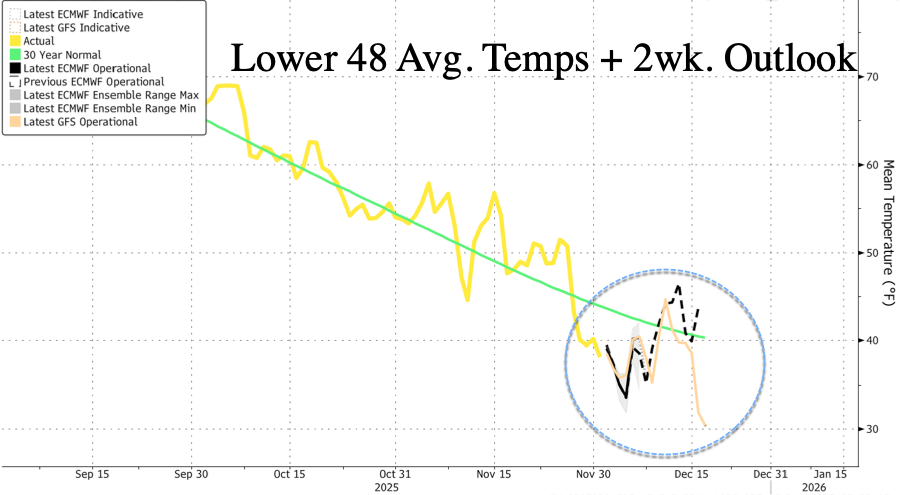 A polar vortex could also instigate a warming period in the next two weeks, accoridng to meteorologist Ryan Maue as posted on X (formerly Twitter.)
Meteorologist Judah Cohen stated on X, “IMO next PV stretch keeps cold train coming in Eastern US up to the holidays.”
The sudden stratospheric warming event has already begun, leading to the collapse of the polar vortex and resulting in the displacement of cold Arctic air into the United States, Canada, and Europe. This disruption, which started in late November 2025, is forecast to peak around December 25, 2025, bringing significant cold weather and snowfall to these regions.
Disruptions to the polar vortex can communicate down to the troposphere and disrupt the jet stream. These disruptions to the jet stream can bring colder-than-normal Arctic air down into the eastern United States, according to the government’s website, climate.gov. It’s too soon to tell whether this vortex disruption will make its way down to the troposphere, as the latest forecast doesn’t show much stratosphere-troposphere interaction after the onset of the warming event.
Additionally, though the impacts of March’s sudden warmings are very similar to those in mid-winter, spring is coming during that time, so any Arctic air brought down to the US won’t “feel” as cold as it would in January because we are in a warmer part of the year.
Preparedness: A Winter Survival Kit for your Car
Prepare For Winter Driving
This is interesting timing, considering the cost of natural gas is rising quickly. Supply constraints and exports are taking their toll on the costs consumers are expected to pay.