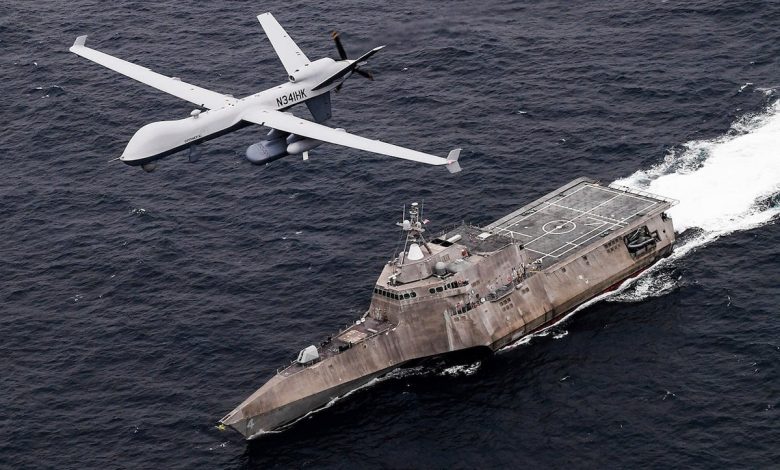
BERLIN — Germany has ordered eight MQ-9B SeaGuardian remotely piloted aircraft from General Atomics Aeronautical Systems in a €1.52 billion ($1.77 billion) contract executed through the NATO Support and Procurement Agency.
The procurement, approved by the parliamentary budget committee on Dec. 17 and announced on Monday, includes four complete systems − each comprising two aircraft − along with four “certifiable” ground control stations that will allow the aircraft to operate alongside civilian traffic. First deliveries are expected in 2028, with the German Navy’s Marineflieger planning to operate the platforms from Naval Air Wing 3 Graf Zeppelin in Nordholz.
The SeaGuardians will focus on maritime surveillance and anti-submarine warfare across the Baltic Sea and North Atlantic, missions that have gained urgency amid heightened concerns over Russian underwater activity and critical infrastructure security in European waters.
The drones will complement Germany’s fleet of eight P-8A Poseidon maritime patrol aircraft, the first of which arrived in Germany in November 2025. Together, they mark a notable shift in German focus toward maritime surveillance and counter-submarine warfare capabilities in recent years.
RELATED
General Atomics markets the MQ-9B SeaGuardian as being capable of over 30 hours of endurance with a mission radius of 1,200 nautical miles, or over 2,000 kilometers. The platform features pole-to-pole satellite control, de-icing capability for cold-weather operations, and an integrated Detect and Avoid System designed to enable operations in unsegregated civilian airspace.
The aircraft can be equipped with maritime surveillance radars and configured with anti-submarine warfare mission kits capable of deploying up to 40 ‘A’-size or 80 ‘G’-size sonobuoys. Germany has indicated the systems will initially focus on reconnaissance missions.
“The proliferation of MQ-9B in Europe delivers commonality between NATO countries and for Germany, it will provide opportunities for interoperability with their fleet of P-8As,” said Linden Blue, CEO of General Atomics Aeronautical Systems.
Interoperability with allies was an important factor in the purchase decision, the German military said, adding that they would benefit from learning from British and Belgian experience with the aircraft type.
Poland will soon join the club, too, after signing a $310 million contract for MQ-9B SkyGuardian systems in December 2024.
Berlin’s new focus on maritime surveillance comes at a time of heightened presence of Russian naval assets, both military and ostensibly civilian, in the waters of the North and Baltic Seas near Germany. In July of last year, the government announced a new mission to put pressure on the Russian shadow fleet of tankers used to circumvent EU sanctions and continue financing the war in Ukraine.
“The more complete the picture, the sooner we can cooperate with our partner countries in the Baltic Sea region to take appropriate measures,” said German Transport Minister Patrick Schnieder at the time.
Linus Höller is Defense News’ Europe correspondent and OSINT investigator. He reports on the arms deals, sanctions, and geopolitics shaping Europe and the world. He holds a master’s degrees in WMD nonproliferation, terrorism studies, and international relations, and works in four languages: English, German, Russian, and Spanish.