Chinese corvette recently trained its weapons on Philippine frigate, officials confirm

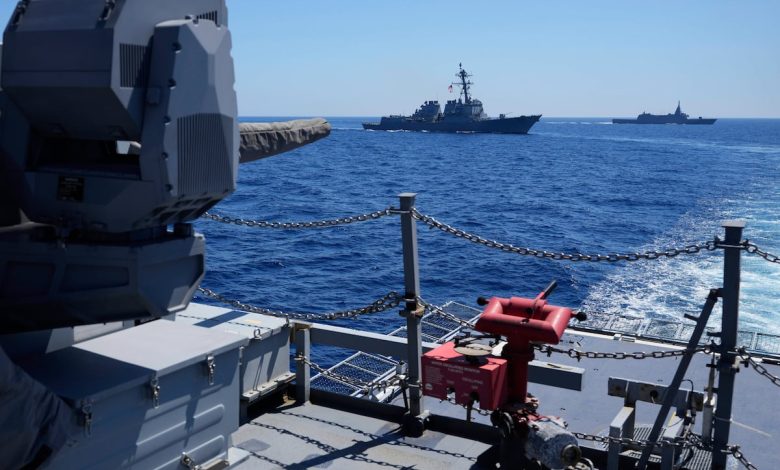
MANILA, Philippines — The Philippine Navy has confirmed that an armed Chinese corvette engaged its fire control radar against a Philippine frigate this month, marking the latest escalation between the two nations in contested areas in the South China Sea.
The guided missile frigate BRP Miguel Malvar was conducting a routine sovereignty patrol near Sabina Shoal, located 75 nautical miles from Palawan province, on March 7 when a People’s Liberation Army-Navy vessel with bow number 622 directed its sensor toward the Philippine ship.
“In accordance with standard procedures, the Philippine Navy immediately issued a radio challenge, prompting the PLA-Navy vessel to deactivate its radar and reduce tensions,” the sea service said in a statement.
Philippine military chief of staff Gen. Romeo Brawner Jr., speaking to reporters on the sidelines of a Japan-Philippines conference organized by the Manila-based Stratbase ADR Institute think tank on Tuesday, said: “Our sailors responded appropriately by challenging the actions of the Chinese vessel.”
“China’s conduct is comparable to aiming a firearm at a person, and we addressed them directly for this behavior. After we challenged them, they stopped,” Brawner said.
This recent confrontation is the latest episode in a long-running conflict in one of the world’s busiest sea lanes, which China claims in its entirety. Chinese ships loitering in the West Philippines Sea have used water cannons, pointed lasers, and engaged in dangerous maneuvers to block resupply missions and impede fisherfolk access to fishing grounds in the area.
RELATED
The radar lock incident is not the first time China has directed its systems against Philippine ships. In 2020, a PLA Navy ship with bow number 514 targeted BRP Conrado Yap, an anti-submarine corvette, with its gun control director in the Spratly Islands.
BRP Conrado Yap was not equipped with electronic capabilities to accurately verify the Chinese vessel’s actions, but officials told Defense News the 2020 incident underscored that the government’s pro-China policy at the time will not shield vessels from coercive in the South China Sea.
“We have to understand Chinese warfighting thought, which is to force us to fire the first shot, to force us to escalate the situation,” Navy inspector general Rear. Adm. Roy Vincent Trinidad told reporters during a military press briefing in Camp Aguinaldo on Tuesday.
He stated that the navy will continue to act with restraint and respond only within the bounds of international law.
Tokyo and Beijing had earlier traded barbs over a similar incident in December last year, when Japanese minister Shinjiro Koizumi said Chinese fighter jets directed their fire-control radar against Japanese F-15 jets in two separate incidents near Okinawa.
Leilani Chavez is an Asia correspondent for Defense News. Her reporting expertise is in East Asian politics, development projects, environmental issues and security.