According to the new U.S. National Security Strategy, one of America’s policy priorities for Europe should be “ending the perception, and preventing the reality, of NATO as a perpetually expanding alliance.”
By opposing NATO membership for Ukraine, the Trump administration has already expressed its doubts about the wisdom of NATO’s enlargement policy. However, other allies continue to adhere to NATO’s agreed-upon stance that the door remains open and Ukraine is on an “irreversible path” to membership.
This could turn into another transatlantic train wreck, but it doesn’t have to.
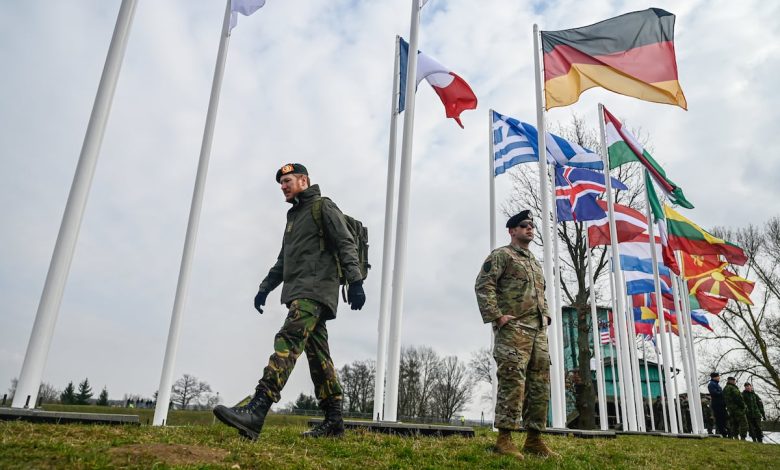
European allies should also recognize that NATO’s enlargement process has become counterproductive. Doubling NATO’s membership from 16 to 32 countries since the end of the Cold War is a resounding testimony for the undiminished attractiveness of a transatlantic defense framework. However, maintaining the enlargement process on autopilot risks squandering many of its past achievements.
NATO’s expansion, based primarily on the right of all European states to freely choose their alliances, was successful as long as the interests of key actors, including Russia, could be reasonably balanced. Consequently, in 1997, NATO agreed with Russia on key principles of their cooperation, even before officially inviting Poland, the Czech Republic, and Hungary to join the alliance. These three states were admitted to NATO in 1999, followed by seven more Central and Eastern European states, including the three Baltic republics, in 2004. Many observers saw the fact that Moscow remained calm as confirmation that Russia was beginning to accept NATO enlargement.
But Russia never really did. Even if the military dimensions of enlargement were rather “soft” — no major combat units or nuclear weapons were stationed in the new member states — the accession of numerous former Warsaw Pact countries and even former Soviet republics signified an enormous geopolitical power shift. Furthermore, since the West viewed NATO enlargement as an open-ended process with no clearly defined endpoint, Russia had to contemplate that its shrinking sphere of influence could be lost altogether.
NATO’s geopolitical sin occurred in 2008, when the allies declared that Ukraine and Georgia “will become members.” Although these invitations were extended without a specific timeframe for accession, the West had crossed “the brightest of all red lines” for Moscow, as William Burns, then U.S. ambassador to Russia, had warned. A year after Putin’s speech at the Munich Security Conference, in which he had complained that the West was ignoring Russian security concerns, NATO invited two states that Moscow regarded as part of its “zone of privileged interests.”
As Russia slipped further into authoritarianism and relations with the West continued to deteriorate, some observers argued that the alliance should only accept countries it could realistically defend. However, such a change in direction would have left several aspiring members stuck in a geopolitical no man’s land between NATO and Russia. It would also have given Russia a veto over decisions that were the alliance’s sole prerogative. Consequently, the West stuck to its narrative that NATO enlargement was a kind of post-Cold War family reunion – a moral duty that could not be questioned.
By continuing to insist that NATO’s door must remain open, the West is cornering itself. A deal with Russia to end its war against Ukraine would become impossible. Furthermore, given Russia’s recent belligerence, inviting countries that one is unable or unwilling to defend seems increasingly hazardous. It is true that denying Ukraine and other candidate countries the right to freely choose their alliances could be perceived as a betrayal. However, the West should not feel obliged to adhere to a policy that is now causing more problems than it solves. While NATO enlargement started out as a morally sound policy, new geopolitical realities now risk producing immoral results.
The tragedy of NATO expansion lies not in beginning it, but in never considering when and where it might end.
Michael Rühle worked for over 30 years in NATO’s International Staff, including as a speechwriter for six secretaries-general, as well as in policy planning, climate and energy security, and hybrid threats.