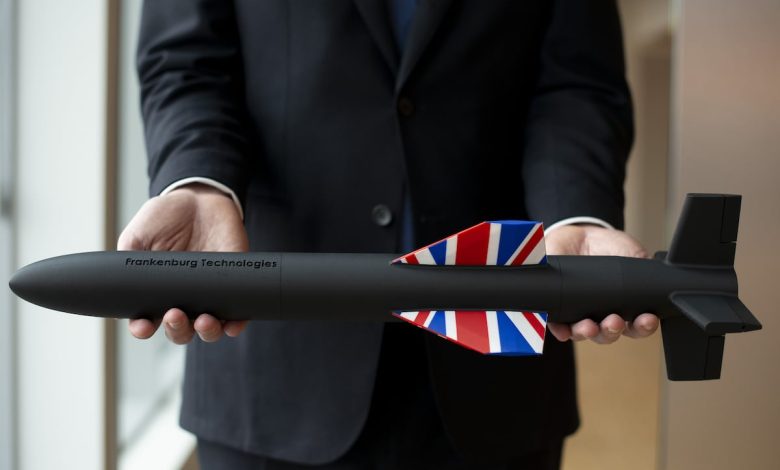
PARIS — British defense firm Babcock plans to develop a containerized launch system for low-cost missiles manufactured by Estonian startup Frankenburg Technologies, with the goal of providing cheap maritime defenses against one-way attack drones.
Babcock and Frankenburg signed a memorandum of understanding to explore development of a “new and affordable” maritime counter-drone air-defense system, with engineering led from the United Kingdom in order to provide a “new sovereign capability,” the companies said in a joint statement on Wednesday.
Tallinn, Estonia-based Frankenburg says it aims to develop missile systems that are ten times cheaper and a hundred times faster to produce than current industry capabilities. The company is run by CEO Kusti Salm, a former Estonia Ministry of Defence official, while former Diehl Defence executive Andreas Bappert is in charge of technology and engineering.
“The drone threat has changed the character of warfare, and every layer of defense now needs to be designed for mass and speed from the outset,” Salm said in the statement. Partnering with Babcock will allow for “accelerating the delivery of an operational maritime capability,” the CEO said.
The jointly developed air-defense capability will provide “more affordable, scalable and kinetic solutions” to protect military personnel and critical infrastructure sites across Europe, according to the companies, which said the cooperation will open up global export opportunities.
The move comes as armed forces across Europe are scrambling for cost-effective counters against the cheap drones that have become ubiquitous over the battlefield in Ukraine.
Salm has said Frankenburg’s Mark 1 missile is the world’s smallest guided missile. The company was picked by Estonia in October as one of four companies to set up production facilities in the country’s new Defence Industry Park, with plans for production capacity of 100 short-range air-defense missiles a day in a first phase.
The Mark 1 is around 60 centimeters long and was designed for mass production, powered by a solid-fuel rocket motor and built from commercially available components, with Frankenburg saying the missile was went from concept to live firing in 13 months.
The company in December announced its first “full kill-chain hard-kill intercept” against a fast-moving aerial target at Ādaži NATO base in Latvia, calling the test a “true “SpaceX moment” for the missile industry.”
“Defense has entered a new era with the rapid development of drone warfare and industry needs to respond to this growing threat,” Babcock CEO David Lockwood said in the statement.
Frankenburg signed an MoU with Polska Grupa Zbrojeniowa in November to integrate the Estonian company’s missiles on PGZ platforms, with plans to establish local missile manufacturing capacity of up to 10,000 units a year.
Rudy Ruitenberg is a Europe correspondent for Defense News. He started his career at Bloomberg News and has experience reporting on technology, commodity markets and politics.