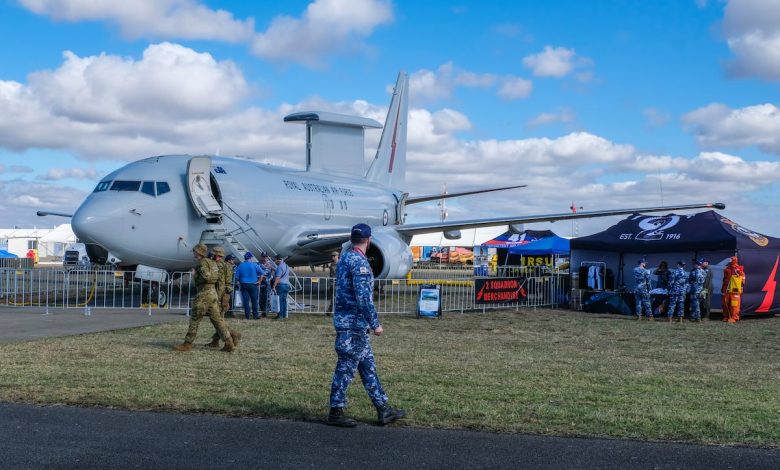
CHRISTCHUCH, New Zealand — The Australian government announced on March 10 it would send an E-7A Wedgetail early-warning aircraft to the Middle East and help replenish United Arab Emirates stocks of AIM-120 air-to-air missiles.
Officials in Canberra said the Wedgetail from the Royal Australian Air Force’s (RAAF) No. 2 Squadron would provide a “long-range reconnaissance capability which will help secure the airspace above the Gulf” for an initial four-week period.
No details on its planned basing were provided, but Al Minad Air Base near Dubai is a likely locale, as the Australian military has maintained a presence there since 2003.
Twelve Gulf nations have been targeted by Iran so far since the United States and Israel launched strikes against the Tehran regime on Feb. 28.
Australian E-7A airborne early warning and control (AEW&C) aircraft are no strangers to overseas deployments. One was in Europe for six months to support Ukraine, where it flew 45 sorties – including a record 17.1-hour mission.
The platform also supported U.S. operations against Islamic State in Syria from 2014-2020.
The aircraft is expected to provide a “huge boost” to the region’s defenses against Iranian drones and missiles, Malcolm Davis, senior analyst at the Australian Strategic Policy Institute, wrote on the social media platform X, formerly Twitter.
The UAE, home to 24,000 Australians, has defended itself against 1,500 Iranian rockets and drones so far. To help replenish weapon stocks, Australia will dispatch an unknown quantity of AIM-120 Advanced Medium-Range Air-to-Air Missiles (AMRAAM) to the country.
The U.S. approved the sale of 200 AIM-120C-8 and 200 AIM-120D-3 AMRAAMs to Australia in April 2025, so the UAE will probably receive older missile variants still held in stock. The missiles will arm UAE Air Force F-16 Block 60 fighters that can fire the beyond-visual-range missile.
Australia stated it “supported action aimed at preventing Iran from getting a nuclear weapon, and preventing Iran from continuing to threaten international peace and security.”
However, Australian leaders have said the country won’t be a protagonist in Israel and U.S. combat operations.
“The Albanese government has been clear that we are not taking offensive action against Iran, and we have been clear that we are not deploying Australian troops on the ground in Iran,” reads a government statement, referring to Prime Minister Anthony Albanese.
Eighty-five Australian troops will deploy to the Middle East, and last week Canberra announced the deployment of a C-17A transport aircraft and KC-30A aerial tanker to the Gulf.
Gordon Arthur is an Asia correspondent for Defense News. After a 20-year stint working in Hong Kong, he now resides in New Zealand. He has attended military exercises and defense exhibitions in about 20 countries around the Asia-Pacific region.