The Shah of Iran bought 79 F-14 Tomcats from the United States in 1976, three years before the revolution; after 2006 they were the last of the type still flying, the Pentagon shredded its own so parts could not reach Tehran, and this March Israel said it had destroyed the remainder on the ground at Isfahan

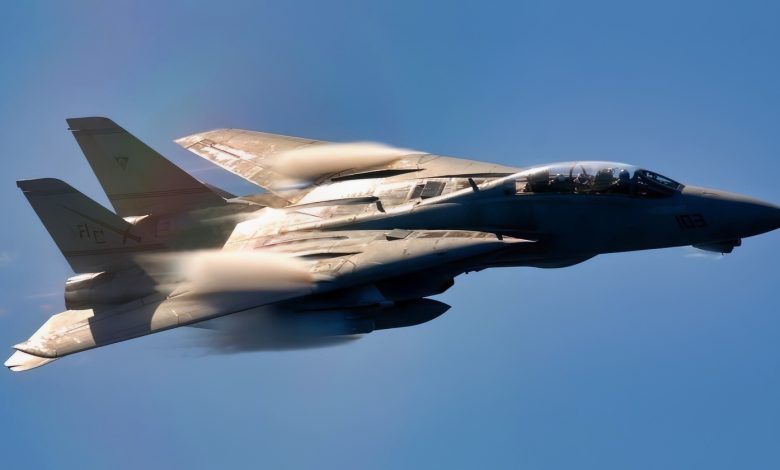
The Grumman F-14 Tomcat was first deployed at the height of the Cold War, in 1974. Grumman proudly presented the Tomcat to the Air Force as an alternative to the F-106.
Iran’s Last Batch Targeted
This March, Israel said that it had managed to destroy a slew of Iranian F-14s at Isfahan in Central Iran. The jets were sold to Tehran in 1976, three years prior to the country’s Islamic Revolution, which soured its ties with the West.
They were believed to be the world’s final operational F-14s.
However, it is unclear whether all the planes in the photos were legitimate, but the damage was done.
Legislation has allowed the transfer of three used F-14Ds to the U.S. Space and Rocket Center Commission in Huntsville, Alabama.
Moreover, the U.S. Senate has approved this transfer, while at least one plane could be flown again in airshows.
Another plane was recently transported from Florida to Colorado. It didn’t make it on its own.
A truck moved it about 2,500 miles from the Pensacola area to the Pueblo Weisbrod Aircraft Museum.
The volunteers will restore this fighter alongside the F-15 Eagle and F-16 Fighting Falcon.
In the early 1970s, the Aerospace Defense Command needed an interceptor.
The Convair F-106 Delta Darts had performed their role of guarding against Soviet bombers.
But with the introduction of standoff weapons, enemies would no longer need to fly over American airspace to threaten it.
An interceptor would therefore have to contact them long before the missiles would be launched.
Model Rivalry?
Grumman developed a full-scale ADCOM F-14 mock-up in Air Force markings in 1972 as a potential replacement for the F-106.
Did the Air Force actually pit the two against each other and plump for the F-15? When Grumman made its ADCOM Tomcat public, work on the F-15 was well underway, and the jets were being made to suit the needs of their service.
The F-14 is a carrier-based aircraft suited to this context.
Its variable-sweep wings let it handle high-speed runs and carrier approaches with ease, along with the matching airframe and landing gear.
Not to mention a second crew member to run the radar and weapons, and the endurance to last.
An interceptor on land would have been burdened with the weight and upkeep of such naval accouterments for nothing.
Baranek would tell you that the Tomcat was lauded for its size and complexity.
And then there were the TF30s from Pratt & Whitney, which could be a liability, liable to compressor stalls when you put them through hard maneuvers.
The expense of maintaining the swing-wing and its tightly integrated systems was no small matter even with the General Electric F110s fitted to the later B and D versions.
How Iran Made the F-14 Last
Before the Islamic Revolution of 1979, Shah Mohammad Reza Pahlavi ordered 80 F-14As; 79 of them found their way to Iran.
According to NPR, the deal was comprehensive, covering Phoenix missiles, a decade’s worth of spares, and American training.
All of that changed with the revolution.
An ally became an enemy, and the U.S. withdrew official backing for the planes.
Yet when Iraq made its move in 1980, Tehran was not about to let go of such valuable assets, even if it meant calling back some U.S.-trained personnel who had been purged.
Farzin Nadimi of the Washington Institute put the number of operational Tomcats at 20 to 30 during the war with Iraq.
Some will have you believe Iranian F-14s were responsible for the destruction of over 160 Iraqi planes, but the numbers are up for debate.
This smuggling activity dictated U.S. policy regarding its own retired stock.
The Pentagon would not leave intact Tomcats sitting in the desert where parts might be siphoned off to Iran; they had the airframes dismantled.
Congress put a stop to any thought of the Defense Department moving surplus F-14s. After 2006, Iran was the sole operator of the type, and likely the last to ever be.
About the Author: Georgia Gilholy
Georgia Gilholy is a journalist based in the United Kingdom who has been published in Newsweek, The Times of Israel, and the Spectator. Gilholy writes about international politics, culture, and education.