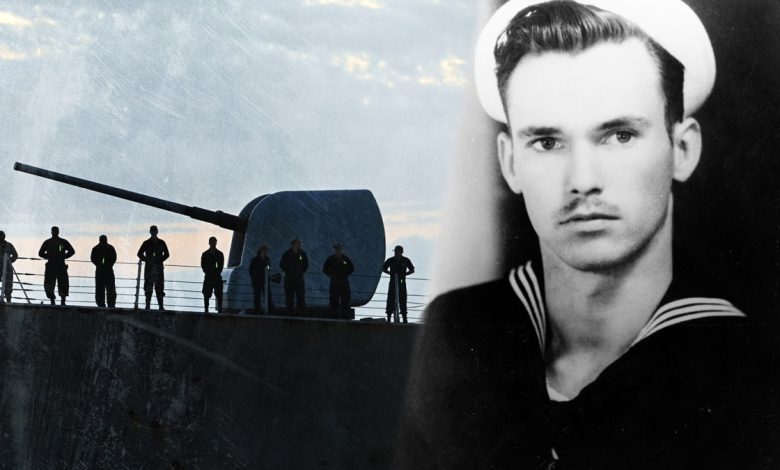
Former Marine Joseph Barna carried the memory of the Navy corpsman who saved his life and the lives of many other Marines during vicious fighting in the Korean War. In interviews and a book he later wrote on corpsmen who served in the war, Barna told the story of a deep stab wound he suffered and the sailor who pulled him into a hut to stitch it closed.
“I was bleeding, ready to fall asleep, and I hear a voice say ‘Joe, Joe, if I don’t stop that bleeding, you’re gonna bleed to death,’” Barma recalled in a 2015 interview, one of many he gave on Kilmer and his time in Korea. “So here was Doc Kilmer, this Navy corpsman, 21 years old. He said, ‘I’m going to stop that bleed.’ So he took the flamethrower off my back, carried me into a bunker, and there was one Marine there. He held a candle, and Doc Kilmer sewed me up with a needle and thread.”
Barma died Aug. 19, at 96. In his final years, he saw the start of construction on a Navy ship named after that same Navy corpsman, John Kilmer, who was awarded the Medal of Honor in 1953 for using his own body to cover a wounded Marine in a vicious firefight just weeks after he tended to Barna.
Last week, the ship crossed a major milestone when shipbuilders in Bath, Maine, laid down the keel on the future USS John E. Kilmer, an Arleigh Burke-class destroyer
Kilmer’s Medal of Honor action came less than a month after he patched up Barma at the Battle of Bunker Hill, an elevated position that took its name from the Revolutionary War battle. There, Kilmer was assigned to Company H, 3rd Battalion, 7th Marines, 1st Marine Division, who fought to defend the hill from a larger attacking force. As artillery fire fell on the Marines, Kilmer moved between fighting positions to tend to wounded Marines, taking shrapnel wounds as he did, according to his Medal of Honor citation.
“Painfully wounded himself when struck by mortar fragments while moving to the aid of a casualty, he persisted in his efforts and inched his way to the side of the stricken Marine through a hail of enemy shells falling around him,” the citation reads. “Undaunted by the devastating hostile fire, he skillfully administered first aid to his comrade and, as another mounting barrage of enemy fire shattered the immediate area, unhesitatingly shielded the wounded man with his body.”
Today, Kilmer is a key figure in Navy medical history. Every August, students and instructors at the service’s Hospital Corps A School at the Navy Medicine Training Support Center in San Antonio, Texas, gather for a ceremony at the local cemetery where Kilmer is buried.
Barma spoke frequently in recent decades of his time in Korea and of Kilmer’s actions. He dedicated a book on Navy corpsmen, “God Makes Angels and Navy Corpsmen, A Korean War Veteran’s Memories of the War and Life,” to Kilmer.
“His face is forever cemented in my mind and my heart,” Barna told the Times-Leader in Wilkes-Barre, Pennsylvania. “Jackie was tall, maybe 6 feet 2 inches, and very thin. He had a high squeaky voice, like the Wally Cox TV character Mr. Peepers. In those few quiet times between battles, I shared a bunker with Jackie, and we became good friends.”