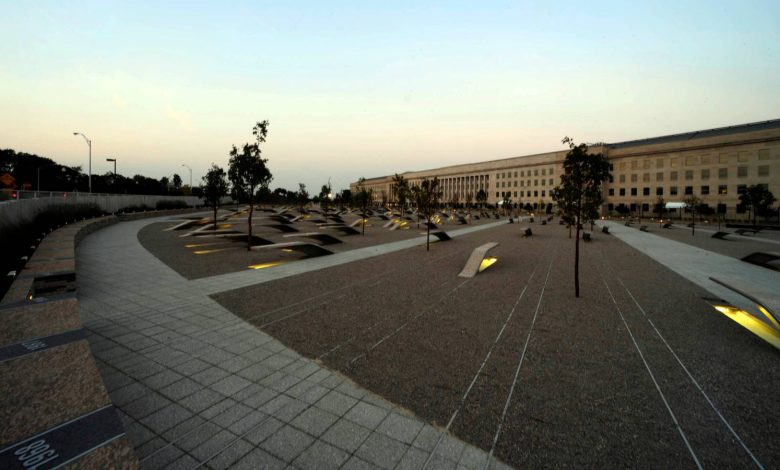
American Airlines Flight 77 struck the western face of the Pentagon at 9:37 a.m. Sept. 11, 2001, killing 184 people — 125 inside the building and 59 aboard the aircraft, according to the Department of Defense’s account published for the 2008 dedication of the Pentagon Memorial.
Unfinished construction work saved an untold number of lives that morning in 2001, and the people who ran back into a burning building to pull colleagues out were, in many cases, service members.
The Renovation That Saved Lives
The section of the Pentagon that Flight 77 struck had just emerged from a three-year, $258 million renovation, according to a historical monograph on the Army Reserve’s response to the attack, published by the U.S. Army Reserve. The improvements included steel reinforcement, Kevlar cloth lining and blast-resistant windows, upgrades the Army Reserve account credited with ultimately saving many lives inside the building.
The renovation had an unintended second effect: The newly finished section was still mostly unoccupied on the morning of the attack. According to reporting by the Defense Media Network, roughly half of the stricken area was in the first phase of reoccupation, meaning a section of the building that on a normal day might have held thousands of people held only a fraction of that number when the plane hit. Structural engineer Donald Dusenberry, who co-wrote a landmark American Society of Civil Engineers report on the Pentagon’s structural performance that day and later toured the crash site, has pointed to that same renovation as central to understanding why the death toll wasn’t dramatically higher, according to an account published by History.
Related: How 9/11 Reshaped the US Military From the Ground Up
Survivors Who Wore the Uniform
Col. Craig Duehring, then serving as acting assistant secretary of defense for reserve affairs, had left the Pentagon that morning for a meeting nearby and was spared by the same renovation that displaced his office. “Somebody came in and whispered to me that the Pentagon had just been hit,” Duehring recalled in an interview published by the Arlington Catholic Herald this month. His driver told him the hijacked plane had flown directly overhead on its way toward the building. When Duehring and his boss tried to return to the Pentagon, security had already sealed it off, and the two set up instead at a nearby Marine Corps command post.
Lt. Col. Dan Bolas had been sitting at a new desk in a recently renovated section of the Pentagon’s E-Ring that morning, an office that had only recently become occupied again after construction, according to the same Arlington Catholic Herald account. Like Duehring, Bolas’s presence, or absence, from a specific part of the building that morning came down largely to which offices had or hadn’t yet reopened after the renovation work.
The Ones Who Went Back In
Some of the most consequential decisions that morning were made by people who had already made it out safely and chose to turn around. According to History’s account of Pentagon survivors and evacuees, one worker, hearing no gunfire outside, opened emergency doors to help others escape and personally escorted a pregnant coworker to safety before the building was fully evacuated.
Defense Media Network’s oral history of the Pentagon’s first responders captured a similar pattern repeating across the building that morning. “A lot of the military people who ran out, because that was the right thing to do, turned around and went back in to get their colleagues,” a witness recalled. “But the fire was so intense, and there was so much heat, that there were limited things they could do.”
Those rescue efforts were hampered by the very renovation that had likely saved lives elsewhere in the building. According to Defense Media Network, new blast-proof windows and automatic fire-protection doors installed during the recent construction, effective at containing the initial blast, also slowed firefighters’ access to trapped survivors, and a series of confusing evacuation orders triggered by reports of additional inbound aircraft repeatedly halted rescue efforts already under way. The damaged section of the building collapsed at 10:10 a.m., roughly half an hour after impact, according to the same account.
The Reservists Who Searched the Wreckage
Once the fire was contained enough to allow entry, the physical search for survivors and remains fell largely to specialized military and civilian rescue units. Soldiers from the Army’s 911th Technical Rescue Engineering Company, made up of combat engineers, firefighters and construction specialists trained and certified as rescue technicians, were among the units that responded, according to a 20th-anniversary retrospective published by the Army. “There was a bit of chaos,” said a member of the unit, describing the scene on arrival in the Army’s account.
His squad went in to begin an initial search once the building’s occupants who could get out on their own already had.
Soldiers from the 3rd U.S. Infantry Regiment, known as the Old Guard, also played a role in the response, according to Department of Defense historical records, helping maintain security and cohesion among the volunteers, construction crews and public safety personnel who converged on the site in the hours and days that followed.
Arlington County Fire Department firefighter Gregg Karl, among the first civilian responders on scene, described the scale of what he encountered to Al Jazeera a decade after the attack, recalling the destruction as unlike anything in his career up to that point.
Related: 9/11 Documentaries to Watch on the 25th Anniversary
A Recovery That Took Nine Months
The last survivor was pulled from the Pentagon’s wreckage at 12:30 p.m. Sept. 12, according to the 9/11 Pentagon Memorial’s historical account. What followed was a recovery operation that continued for more than nine months, supported by thousands of volunteers, construction workers and public servants. Forensic teams relied on DNA technology to identify victims, though remains for nearly half of those killed at the Pentagon were never recovered.
A support encampment nicknamed Camp Unity, organized by the Red Cross and Salvation Army, provided meals, warm clothing and chaplain support to the rescue and recovery workers, including service members, firefighters, police and FBI agents, who spent months at the site, according to the Army Reserve’s historical monograph.
The physical damage to the building was repaired in under a year through a rebuilding initiative known as the Phoenix Project, according to the Pentagon Memorial. The emotional weight of that morning, for the survivors, first responders, and reservists who ran toward the fire rather than away from it, has proven considerably harder to rebuild around.