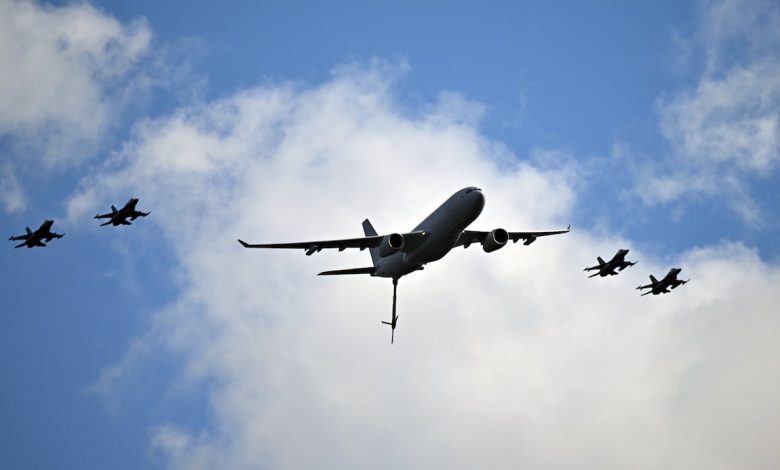
WARSAW, Poland — As the Polish government is advancing plans to purchase multi-role tanker transport aircraft for the country’s Air Force, aiming to buy Airbus A330 MRTT planes, the nation has teamed up with Spain to implement the acquisition.
Poland initially planned to procure two aircraft using loans from the European Union, but the agreement with Madrid will allow Warsaw to increase its tanker order to four units.
A spokesperson for the Polish Ministry of National Defence told Defense News that Poland and Spain have signed a memorandum that obliges the two countries to carry out the acquisition together. The deal enables the Spanish government to share its delivery slots with the Polish ministry.
By joining forces with Madrid for the procurement, Warsaw will receive the MRTTs by 2030. The agreement was signed in late June 2026 during an official visit to Spain by Władysław Kosiniak-Kamysz, Poland’s Deputy Prime Minister and National Defence Minister. During the visit, Kosiniak-Kamysz met with his Spanish counterpart, Margarita Robles.
The Polish minister has announced “that, within two weeks’ time, Poland will arrange with Madrid the details of the contract to buy tanker and transport aircraft. Poland will order four A330 MRTT tankers,” the spokesperson said. “We are currently at the final stage of talks.”
Under the EU’s Security Action for Europe (SAFE) scheme, the Polish defense budget is to absorb funds of around €43.7 billion ($49.9 billion) in low-cost loans. The program is designed to allow member states to bolster their defense capabilities amid Russia’s ongoing invasion of Ukraine, and Poland is to receive the largest share of the funds. The program stipulates that the loans must be disbursed by the end of 2030.
“The order from European group Airbus will be financed through the SAFE mechanism,” according to the defense spokesperson.
The value of the planned purchase was not disclosed by the Polish ministry. In May 2026, Italy unveiled plans to acquire six A330 MRTTs in a deal worth some €1.4 billion ($1.6 billion).
Fighter jet race
The latest development confirms that Poland has chosen the Airbus aircraft over the only competitor that had also been considered, Boeing’s KC-46.
Meanwhile, U.S. and European manufacturers continue to compete for another major aircraft order in the pipeline. Poland’s government is mulling plans to buy up to 32 new fighter jets, with some of the evaluated options including: Lockheed Martin’s F-35; Boeing’s F-15EX; and the Eurofighter Typhoon, a jet manufactured by a consortium of Airbus, BAE Systems and Leonardo.
With deliveries of the first of the country’s 32 ordered F-35s initiated last June, Lockheed Martin is encouraging officials in Warsaw to double down on the Polish military’s commitment to fifth-generation jets. At the same time, the manufacturers of the two air superiority aircraft that are also in the race are looking favorably at recent statements by Brig. Gen. Tomasz Jatczak, the inspector of the Polish Air Force.
On June 19, Jatczak and Kevin Fesler, Boeing’s executive director overseeing business development and strategy for air dominance, participated in a panel discussion during the annual Warsaw Defense Fair event. The general stated he is “an advocate for air superiority” as securing this capability could provide Poland with “a key element of deterrence” against Russia.
Meanwhile, in its campaign for the potential Polish deal, the consortium behind the Eurofighter is benefiting from the recent move by Business Centre Club, a Polish employers’ organization, which backed the jet in the race. On June 23, the group issued an open letter to a group of decision-makers including Poland’s president, prime minister and national defense minister, calling on them to select the Typhoon.
“A mixed fleet, combining the stealth capabilities of the F-35 with the kinematics and missile count of an air superiority aircraft such as the Eurofighter offers greater freedom of rational use, resistance to the exhaustion of combat assets, and greater operational flexibility than 64 aircraft of the same type,” the Business Centre Club said in its missive.
The open letter also argues that Poland’s defense and aerospace industries could gain considerable benefits from involvement in the European jet’s supply chain.
“Another F-35 contract is one in which the Polish industry remains a customer, not a partner. The Eurofighter consortium … has already declared that Poland’s participation in the program would mean that approximately 40 percent of the investment value would remain in Poland through the supply chain, not just the purchase of a finished aircraft,” according to the organization.
Meanwhile, the Polish authorities are also considering joining the Global Combat Air Programme (GCAP), a tri-nation initiative spearheaded by Italy, Japan and the United Kingdom to develop a sixth-generation fighter jet.
Włodzimierz Usarek, a retired major general of the Polish Air Force, told Defense News that by joining the Eurofighter’s supply chain alongside European partners, Poland’s defense industry could gain access to technologies and capacities that would otherwise not be available to local companies.
“Buying the Eurofighter will put Poland in a preferential position to develop the sixth-generation fighter and jointly produce it with other countries instead of continuing to be other countries’ client,” Usarek said. “With the F-35, we will have the stealth capacity that is necessary to open up the enemy airspace to other aircraft. With air superiority fighters such as the Eurofighter, Polish pilots will be able to fight the adversary at an altitude that only such aircraft can access.”
Jaroslaw Adamowski is the Poland correspondent for Defense News.