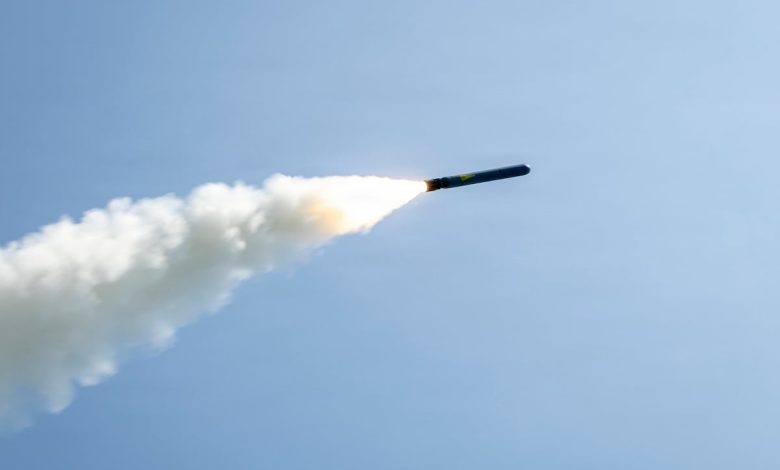
Last week, the Washington Post reported that the United States has launched at least 850 Tomahawk long-range cruise missiles just over one month into Operation Epic Fury, the joint U.S.-Israeli war on Iran. That number far exceeds the missile’s use in previous conflicts, according to an assessment from the Center for Strategic International Studies by Mark Cancian and Chris Park.
Though the Department of Defense does not divulge the precise number of Tomahawks in the U.S. arsenal, the CSIS analysis estimates the U.S. still has around 3,000. It is a highly advanced weapon; in addition to its impressive 1,000-mile range and precision, it can also be controlled via satellite and can find a target while in flight.
As Cancian told Military Times, the concern from some in the Pentagon about burning through the Tomahawk stockpile is less about what will happen in Operation Epic Fury, and more about U.S. security commitments in other parts of the world — namely as a counter to China.
The below interview has been edited for length and clarity.
Military Times: Let’s talk first about what the Tomahawk does — how it’s launched, the mechanics of its use in this conflict and why it’s so important.
Mark Cancian: Tomahawk is a ship-launched ground attack missile. It’s very long range and very accurate. It’s been around for a long time, but it’s been upgraded continuously over time, and now the Block V is the current version. Its long range and accuracy have always been its great strength. Plus, the fact that it can be launched from sea means that you can move ships around and launch it. You don’t have to have aircraft coming from the United States, and you don’t have to have a base in the region.
They’re very flexible, and the fact that they’re long range means that if the opposition has some defensive capabilities, [U.S. forces] can stay out of those defensive capabilities. That’s why it was used in the early stages of Epic Fury, until the United States and Israel had beaten down what was left of the Iranian air defense system.
Once we established air superiority, the number of Tomahawks fired declined. It didn’t go to zero, but it came down because they’re so expensive and scarce that if we can use shorter range munition, then we’ll use that because those are much cheaper. To give you a little sense about that, a Tomahawk costs something like $3.5 million apiece and has a range of 1,000 miles, depending on the version.
A JDAM, which is a guidance kit put on a dumb bomb, has a range of maybe 20 miles, but cost $80,000 and has the same explosive effect and the same accuracy. So if you can use a JDAM, much better, but that means you have to get close.
MT: What does this do for weapons capabilities in other theaters, especially those with U.S. involvement?
Cancian: This is the key concern with the inventories because we have enough of everything, including Tomahawks and Patriots and THAADs to fight the current conflict, that is, Epic Fury. The problem is the effect on other theaters like Ukraine and the Western Pacific, a conflict against China. And strategists are very worried that depletion of inventories will weaken our ability to deter or to fight a conflict there.
MT: What role does the Tomahawk play in deterrence?
Cancian: With China particularly focused on Taiwan it’s very helpful because China has a tremendous number of missiles. We want to stand back as far as we can, but still be able to shoot in against any Chinese invasion force or any Chinese force that has established itself on Taiwan.
I should note that there’s what’s called a maritime strike Tomahawk, which is the relatively new version that could hit ships. The original version could only hit ground targets, but this other version can hit ships and [in the event of a] Chinese invasion of Taiwan, that would be very helpful.
MT: What is the level of damage that this munition can do? And where have we seen that in Operation Epic Fury?
Cancian: It does a lot of damage — it has a 1,000-pound warhead. The drones that we’ve used and that the Iranians have used, they have warheads that are between 50 and 100 pounds. So it’s somewhere between 10 to 20 times the effect of a drone. Whatever it hits, it’s going to cause a lot more destruction.
MT: How long will it take for the U.S. to recuperate its stockpile, and what does that entail?
Cancian: The Department of Defense has been talking with [defense contractors] for several years to get production rates up. It began in the Biden administration. It’s continued in the Trump administration. Hegseth has been going on this Arsenal of Freedom tour, plant to plant, to talk to workers and management about speeding up production. Bottom line, I think currently, to replace the 850 to 1,000 that we’ve expended, you’re talking two or three years.
MT: If we’re firing fewer Tomahawks how does that shift the strategy?
Cancian: It doesn’t shift the strategy. But what it does mean is that we don’t have to use these very expensive and scarce missiles as much, but can use the much less expensive short range munitions. That means we can keep the fighting going much longer, in fact, essentially indefinitely. And although we put a big dent in the inventories, you know, we’re not going to go down to zero Patriot and Tomahawks.
MT: There’s also been a very significant use of the Patriot system in the Gulf. Do you have concerns there about our ability to protect U.S. installations, or to assist our allies with those kinds of defenses?
Cancian: Right now, we have enough Patriots to defend in the Gulf against the Iranian ballistic missile attacks, and that’s what the Patriots do. They’re not used against drones. We estimated there were about 4,000 [Patriot missiles] at the beginning of the war. We’ve maybe used 1,000 now, so we’ve used a quarter, which is, on the one hand a lot. On the other hand, that means you still have three-quarters left.
But again, you have this strategic problem, and you have the same problem about rebuilding the inventories. We’re producing [about] 600 Patriots a year. About half of those go to the United States, and half go to allies, and that’s going to continue. I wouldn’t be surprised if there were some discussions about maybe reallocating some of that production to other countries, shifting people around in the queue so that maybe the Gulf states would get up to the front, and maybe some others would be moved back.