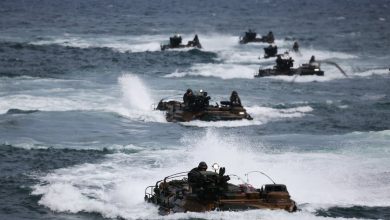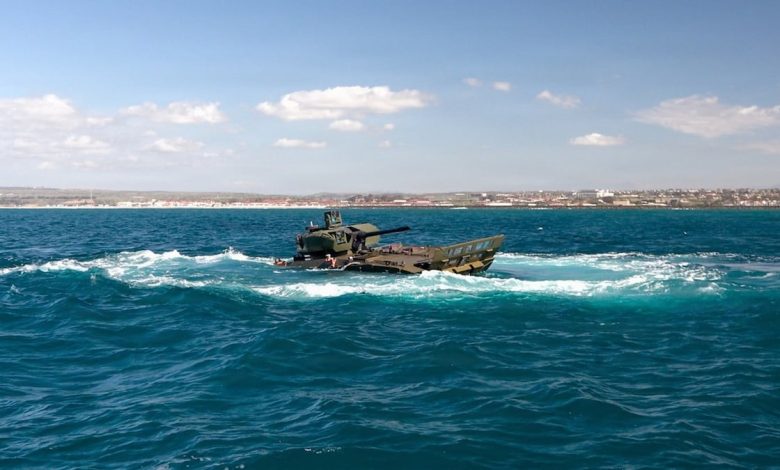
The vehicles vying to replace the Marine Corps’ aging light armored vehicle fleet hit the water for the first time earlier this year, completing a series of tests to demonstrate safety and performance across a spectrum of sea conditions and highlighting some new features in the process.
The testing, which involved the variant of the future advanced reconnaissance vehicle, or ARV, equipped with a 30mm autocannon, took place in January and February at Camp Pendleton, California, according to a recent Marine Corps news release.
Prototypes by two designers, Textron Systems and General Dynamics Land Systems, underwent the water entry, swim and firing drills ahead of an upcoming competition period set to end with a down-select to one company around 2030.
In an exclusive interview with Military Times this month, Phil Skuta, GDLS’s director of Strategy and Business Development for the Marine Corps and Navy, described some of the challenges the new vehicle must overcome, including high-speed water entry and firing the autocannon on the water, both of which can involve weathering large and unpredictable waves.
He also described a new feature GDLS is asking the Marine Corps to evaluate: an “autotrim function” that would allow the ARV’s crew to outsource some of the work of driving the vessel in the water.
“You can set the course, the azimuth that you want to follow, and the vehicle will automatically stay on that course,” Skuta said. “So, we’re starting to build in a level of automation so that, while they’re doing, say, a long water-borne movement, that’s just one less thing the crew has to think about.
“They can think about the other activities involved in not only operating the vehicle but most importantly focusing on the enemy, so they don’t have to focus so much on, ‘Am I going in the correct direction? And is the vehicle being stable in the water?’”
Skuta said the function was somewhat similar to an aircraft autopilot function, but also like cruise control and automated lane-keeping in a ground vehicle.
“If you’re out of the lane, you might get a little buzz, so to speak,” he said. That’s more what this is right now — the first step.”
That’s particularly useful, from GDLS’ perspective, because the ARV’s swim system, separately from the ground automotive system, is piloted via a “small joystick” by a driver looking at internal screens, underscoring what a chore it is to do manual course corrections. The feature could also help the vehicle adapt to the increasingly automated future, Skuta said.
“We’re demonstrating by [incorporating] the automated trim course and azimuth function that we can eventually, in anticipation of future requirements, put more automation into the system, as well as robotic controls,” he said.
The ARV is expected to come in three variants: in addition to the ARV-30 autocannon platform there will be a Command, Control, Communications and Computers/Unmanned Aircraft Systems model, or C4/UAS, which has previously undergone testing; and a logistics variant, which will be featured in upcoming swim tests, Skuta said.
Textron and GDLS are both set to contract with the Marine Corps as soon as this fiscal quarter for 16 additional prototypes that will enable testing in coming years ahead of the final down-select.
Textron’s vehicle, which it calls the Cottonmouth, has six wheels compared to GDLS’ eight.
During the recent evolution, Skuta said, shoreside testing included a bilge pump demonstration, in which the ARV-30 was flooded with water, triggering safety sensors that automatically pump it out “like a water fountain.”
Water safety has been an increased focus since a July 2020 assault amphibious vehicle sinking off the coast of Pendleton, resulting in the deaths of nine service members. A malfunctioning bilge pump was found to have contributed to the tragedy.
Once in the water, the new vehicle was put through its paces on a five-kilometer swim course to test its maneuverability and stopping distance in calm conditions.
“You’re just kind of pivoting in the water to show the characteristics of how you can do very tight maneuvering in water spaces,” Skuta said. “And you know, that’s pretty important, because the Marines will find themselves crossing rivers and water obstacles while they’re in combat zones. And they need to have a good appreciation for how tight a turning radius the vehicle has in the water.”
Crews also practiced moving the turret around as if preparing for live fire on the water, which affects the vehicle’s center of gravity, he said.
“In a river-crossing scenario, [if the] enemy presents themselves on the far shoreline the Marines would fire from the vehicle in the water,” Skuta said. “So, that gives a good indication of how the turret and the fire control system will stabilize on a target while they’re in that water environment.”
Another tested skill, high-speed water entry, made for one of the “more fun” events to observe, he said.
The ARV-30 entered the water at progressively higher speeds, topping out at 25 miles per hour and sending a massive water plume into the air.
Notably, for all the testing with GDLS and Textron, Marines from the amphibious vehicles community were able to observe and monitor testing, Skuta said.
While the Marine Corps has not released any specific feedback from the demos, he said the onsite response from the Marines was encouraging.
“A lot of smiles, a lot of thumbs up from what they saw,” Skuta said.