The U.S. will soon have the ability to deploy a new type of hypersonic missile that can be shot from fighter planes, bombers, ground-based launchers — and can even be fired from space.
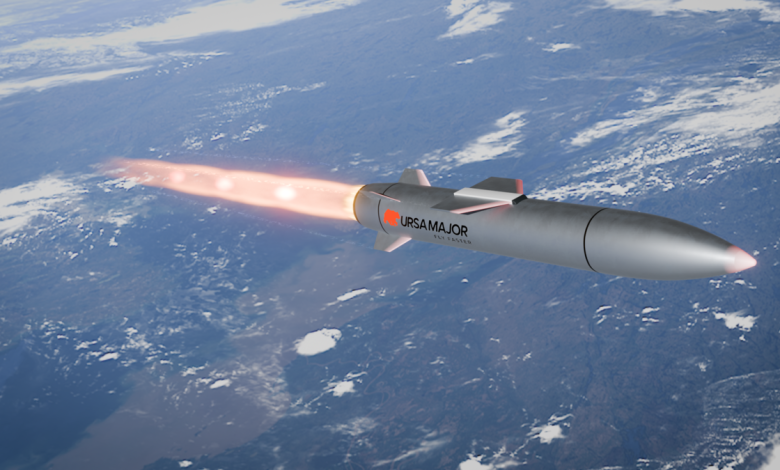
Ursa Major, a Colorado-based defense manufacturer, debuted the HAVOC missile system on Tuesday.
The medium-range hypersonic system is powered by a liquid rocket engine, is able to alter its speed in flight and can be adapted for use with a wide variety of rocket motor systems from warplanes to vertical launch systems.
Additionally, the system can be deployed outside of Earth’s atmosphere, according to the company.
“Keeping pace with our adversaries requires more than exquisite systems. It requires speed to delivery, affordability, and the ability to build at scale,” Chris Spagnoletti, CEO of Ursa Major, said in a statement.
“The Ursa Major HAVOC Missile System delivers a highly capable hypersonic weapon designed from the start to be produced rapidly and in quantity, giving the warfighter a credible and adaptable capability.”
The system has a core module that makes it suitable for striking hypersonic targets as well, the company adds.
Hypersonic missiles, which fly at roughly five times the speed of sound, have become a priority across all U.S. military branches.
The Army, Air Force and Navy are all developing hypersonic missile programs, including: the Army’s Long-Range Hypersonic Weapon; the Air Force’s Hypersonic Attack Cruise Missile; and the Navy’s Conventional Prompt Strike programs.
While the services have aimed for hypersonic weapons since the early 2000s, development has lagged while Russia and China have gained advantages in this arena.
In a notable divergence, Russian and Chinese hypersonic missiles are designed to field nuclear warheads, while U.S. hypersonics are not.
“Most U.S. hypersonic weapons, in contrast to those in Russia and China, are not being designed for use with a nuclear warhead,” according to a Congressional Research Service report published last August.
The report predicted that U.S. hypersonics would “likely require greater accuracy and will be more technically challenging to develop than nuclear-armed Chinese and Russian systems,” while also noting that Russian and Chinese systems would have a potential advantage since nuclear weapons can inflict devastating damage without need for accuracy.
China has a robust hypersonic program and has conducted up to 20 times as many hypersonic missile tests than the U.S., and is also investing in underground facilities, per the report.
“Analysts disagree about the strategic implications of hypersonic weapons,” the report notes, adding that Congress has previously restricted funding due to concerns of nuclear escalation.
“Differences in threat perception and escalation ladders could thus result in unintended escalation,” the report concluded.
Zita Ballinger Fletcher previously served as editor of Military History Quarterly and Vietnam magazines and as the historian of the U.S. Drug Enforcement Administration. She holds an M.A. with distinction in military history.