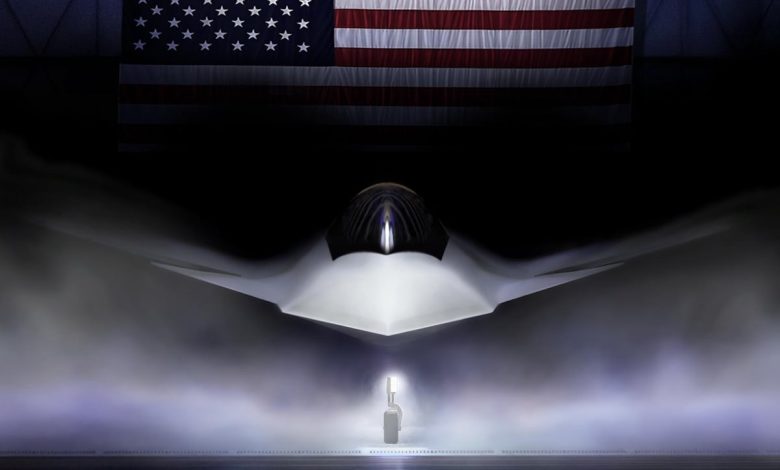
The House and Senate’s conferenced version of a fiscal 2026 defense budget would restore funding for the Navy’s next-generation F/A-XX fighter and up the Pentagon’s spending request on the Air Force’s F-47.
In materials released Monday, the House Appropriations Committee said the compromise $839 billion spending bill would provide $3.9 billion for the military’s sixth-generation aircraft. That would include $3 billion for the Air Force’s F-47 fighter, which will be built by Boeing, and $972 million for the Navy’s F/A-XX, the House committee said.
That would be hundreds of millions more than the Pentagon requested in its original proposed 2026 budget last summer, which requested nearly $2.6 billion for the F-47 and just $74 million for the Navy’s F/A-XX.
The F-47, also known as Next Generation Air Dominance, will be an advanced fighter designed to replace the F-22 Raptor. It is intended to fly alongside multiple autonomous drone wingmen, called collaborative combat aircraft, and have advanced stealth capabilities and greater range than the F-22 and F-35.
The spending bill also would prevent the Air Force from canceling its E-7 Wedgetail airborne battle management aircraft program.
While top service leaders had for years stressed the need to acquire the Boeing-made E-7 to replace the aging E-3 Sentry, Defense Secretary Pete Hegseth expressed skepticism about the program’s future use in a June 2025 hearing and suggested a space-based system would be better. When the Pentagon’s budget proposal emerged later that month, it called for canceling the E-7, which is already flown by Australia and in the works for other allies.
Congressional appropriators appear to disagree. The House said the spending bill would provide $1.1 billion for the E-7 program.
The spending bill would also be in line with the Pentagon’s proposed reduction in the number of F-35 Joint Strike Fighters purchased in 2026. The Air Force, Navy and Marine Corps combined bought 75 F-35s from Lockheed Martin in 2025. But the Pentagon’s proposed budget called for 47 F-35s in all in 2026, including 24 F-35As for the Air Force.
The conferenced defense bill would provide $7.6 billion for 47 F-35 Joint Strike Fighters, across those three services. It would also provide $440 million for spare parts for both the F-35 and its engine, the F135.
The Pentagon said last summer that it planned to redirect money that would have gone to buying more F-35s into sustainment of the jets and strengthening its supply base, as well as ensuring its Block 4 upgrades stay on track.
Block 4 upgrades will allow the F-35 to carry more weapons, improve its electronic warfare capabilities and upgrade its sensors, communications and navigation. But the effort is years behind schedule and billions of dollars over budget, and the F-35 program has scaled back its plans for those upgrades to focus on the capabilities that can be delivered in the next five years.
The defense spending bill would boost spending on the EA-37B Compass Call electronic warfare aircraft by $474 million, to buy two more of the planes.
And it would provide $1.9 billion for the B-21 Raider, Northrop Grumman’s sixth-generation stealth bomber.
The spending bill would also provide $27.2 billion for the Navy to build 17 ships, including a Columbia-class ballistic missile submarine, two Virginia-class fast attack subs, three medium landing ships and an anti-submarine warfare ship, the House said. The Senate said the conference bill increases spending on Columbia- and Virginia-class subs by $5.9 billion.
The bill also fully funds the Air Force’s LGM-35A Sentinel intercontinental ballistic missile program.
Stephen Losey is the air warfare reporter for Defense News. He previously covered leadership and personnel issues at Air Force Times, and the Pentagon, special operations and air warfare at Military.com. He has traveled to the Middle East to cover U.S. Air Force operations.