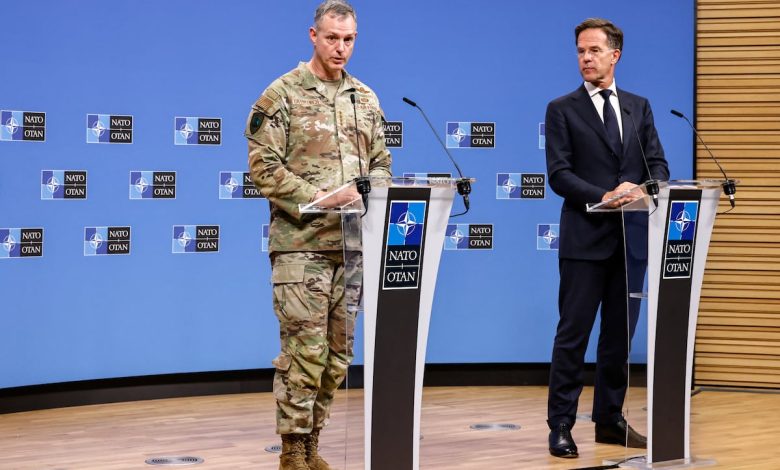
PARIS — Russia and China are increasingly working together in the Arctic region, and their presence there will be a growing threat to NATO allies, said Gen. Alexus Grynkewich, the Supreme Allied Commander Europe, speaking at a Swedish national security conference on Sunday.
As Arctic ice recedes and access to the region improves, Russia and China are cooperating with joint patrols not only on the north coast of Russia, but also north of Alaska and near Canada, Grynkewich said at this year’s National Conference organized by Sweden’s Folk och Förvars.
“It’s not for peaceful purposes,” Grynkewich said. “They’re not studying the seals and the polar bears. They’re out there doing bathymetric surveys and trying to figure out how they can counter NATO capabilities on and under the sea. So that’s something that could grow very quickly, and we need to be mindful of it and ready for it.”
U.S. President Donald Trump has cited the presence of Russia and China around Greenland to justify a claim to the Arctic island, an autonomous territory of Denmark where the U.S. has a military base.
The U.K. has reportedly been in talks with NATO allies about how to beef up security in the Arctic to counter threats from Russia and China.
RELATED
Grynkewich said Russia, China, Iran, North Korea and others increasingly cooperate in opposition to Western countries. The NATO commander said that includes Ukraine, where China continues to fund the Russian war effort, Iran supplies technology and weapons, while North Korean combat troops remain in Russia on the border with Ukraine.
“In the Arctic and the high north, we see a similar trend,” Grynkewich said. “Russian and Chinese vessels are conducting more and more joint patrols. Chinese icebreakers and research vessels are in Arctic waters, and their research is not for peaceful purposes. It’s to gain a military advantage.”
Russia meanwhile continues to test advanced capabilities in the Barents Sea, he said, without providing details.
As new shipping routes emerge and new resources are discovered, the Arctic will only become more strategically important, according to the American general. This comes as NATO faces an increasing hybrid threat, with airspace violations, navigation satellite interference, and the shadow fleet in the Baltic Sea threatening underwater infrastructure, according to Grynkewich.
“In short, the Arctic and Northern Europe, by extension, has become a front line for strategic competition,” the commander said.
Grynkewich said he doesn’t seen an immediate threat to NATO territory right now, one reason being that Russia’s forces are tied up in Ukraine, and its war economy dedicated to that effort.
NATO Allied Command Operations has strengthened its deterrent posture, including with the Baltic Sentry operation to defend underwater infrastructure in the Baltic Sea, according to Grynkewich. He said Joint Force Command Norfolk last month brought all NATO activities in the Arctic under one command, “allowing us to better defend all allies in Europe, in the Arctic and the strategic approaches to North America.”
NATO plans to expand its Arctic intelligence, surveillance and reconnaissance capabilities, improve infrastructure and logistics for military mobility and to strengthen its presence with Arctic capable forces, including those in Sweden, according to the commander.
“With seven of eight Arctic nations inside the alliance, the other one being Russia, we will and we can get this right,” Grynkewich said.
Rudy Ruitenberg is a Europe correspondent for Defense News. He started his career at Bloomberg News and has experience reporting on technology, commodity markets and politics.