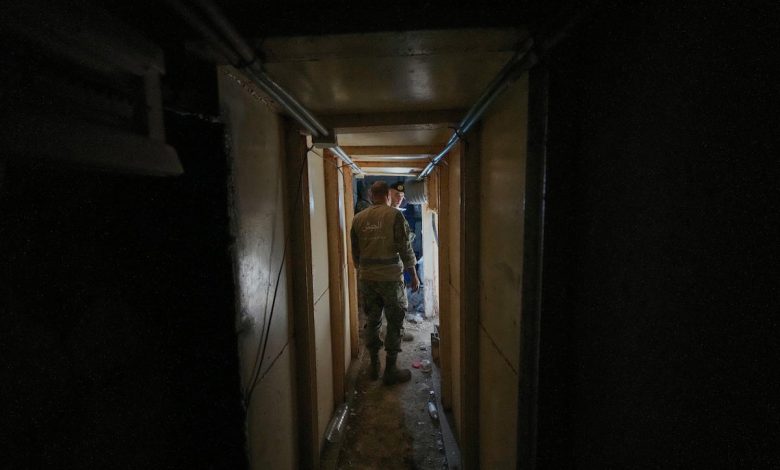
BEIRUT — One year after Lebanon and Israel signed a ceasefire agreement to end hostilities that had spilled over from Gaza, the Lebanese government is walking a tightrope between disarming Hezbollah and containing local resentment over continued Israeli strikes aimed at increasing pressure on the group, according to officials and analysts.
“The agreement is vague and open to interpretation,” said Ali Rikz, Beirut-based security and political analyst, referring to the Nov. 27, 2024, ceasefire deal. “Each side is reading it in its own favor.”
According to the pact, Lebanese state authorities would be the only actors authorized to carry weapons, requiring the disarmament of non-state factions in line with UN Security Council Resolution 1701, starting from south of the Litani River, with government security forces deploying to positions across the area.
In return, Israel agreed to halt any offensive military operations against Lebanese targets, including civilian, military or other state targets, by land, air or sea. The deal also called for a phased withdrawal of Israeli forces, within two months, behind the so-called Blue Line, vacating areas currently occupied inside Lebanese territory.
At the same time, under President Joseph Aoun, the new Lebanese government of Prime Minister Nawaf Salam publicly committed for the first time to bringing the monopoly of arms under state control.
Progress has been slow, as the process of disarming the Iran-backed group and political party Hezbollah presents a complex challenge, according to Dina Arakji, UAE-based analyst at Control Risks and non-resident fellow at Middle East Institute.
“In the south of the Litani, Hezbollah has been fully cooperative,” said Mounir Shehade, a retired brigadier general of the Lebanese Armed Forces (LAF) and the government’s designated coordinator for the United Nations interim force for south Lebanon, UNIFIL, established in 1978.
“The Lebanese Army has destroyed the arsenal and weapons including Katyusha rockets, Kornet missiles, drones, artillery, Burkan rockets and individual weapons,” he added.
All told, the disarmament south of the river, in UNIFIL’s operation area, is considered completed, sources told Defense News.
“We helped the LAF to redeploy to nearly 130 permanent positions and discovered more than 360 illegal weapons caches and other infrastructure,” said UNIFIL spokesperson Kandice Ardiel.
Over the past year, Israel has continued its attacks on Lebanon, conducting near-daily strikes in areas both south and north of the Litani River, including the southern suburbs of Beirut. Israel says that it is adhering to the ceasefire terms and targeting Hezbollah infrastructure and fighters to prevent the group from rebuilding or rearming.
That assessment appears to be at odds what UN troops are seeing, as least as it pertains to the south.
“We have not observed any new illegal infrastructure or rebuilding of capabilities within our area of operations in south Lebanon,” Ardiel said
South of Litani River, UNIFIL peacekeepers operate under challenging conditions. “The presence of Israeli soldiers in Lebanese territory prevents our full freedom of movement, and the full re-deployment of the Lebanese army,”, Ardiel said.
On the first anniversary of the cease-fire agreement, UNIFIL reported in a statement that more than 10,000 air and ground violations had occurred over the past twelve months. “We have also continued to monitor and report impartially on what is happening in the south, despite challenges,” Ardiel noted.
However, the disarmament of south Lebanon has had no bearing on full disarmament of the group.
“Hezbollah still retains weapons, including drones and missiles, in the north of the Litani, the Beqaa Valley and in other regions,” said retired Lebanese Maj. Gen. Hicham Jaber.
Rikz argued that, in Hezbollah’s view, weapons north of Litani River are not part of the ceasefire agreement, making the disarmament process there a matter of Lebanon’s internal politicking.
Moreover, other factors add to the complexity of the issue, including the Iran-Hezbollah special relationship and the broad support from the long-marginalized Shia community to the group.
According to a source within Hezbollah, any discussion on the future of the group’s weapons remains contingent on Israel’s full withdrawal from Lebanese territory, an end of the purported ceasefire violations, and guarantees on national security.
“Any future transition must take place within a framework that strengthens the state’s role, rather than leaving it exposed to threats,” the source said, speaking on condition of anonymity due to the affiliation with the group.
In essence, according to Arakji, the situation amounts to a catch-22 that could escalate at any time: Israel interprets the agreement as allowing it to conduct strikes against Hezbollah-linked sites and other militant infrastructure deemed a threat while demanding Hezbollah’s complete disarmament. At the same time, the ongoing Israeli military actions in Lebanon are used by Hezbollah to justify the goal of retaining weapons, while the LAF lacks capacities and remains heavily reliant on foreign security assistance, particularly from the United States.
“In this situation, the Lebanese state emerges as the weaker actor,” noted Rikz.
Some analysts here hope that the U.S. government can help mediate.
“The only available solution is for the U.S. to pressure Israel to withdraw from occupied territories and stop its escalation. If Lebanon remains unable to resolve the issue of the resistance weapons, there is a real possibility that the war could return,” former LAF general Shehade said.
Agnese Stracquadanio is a Middle East correspondent for Defense News. She has a background in writing and photojournalism, holds a master’s degree in international relations, and previously worked for Reuters.